
VISUAL ARCHIVE / IMAGE STORY
Inside an Exoplanet We Cannot See
A water-rich interior is one model for LHS 1140 b, not an image of its actual layers.
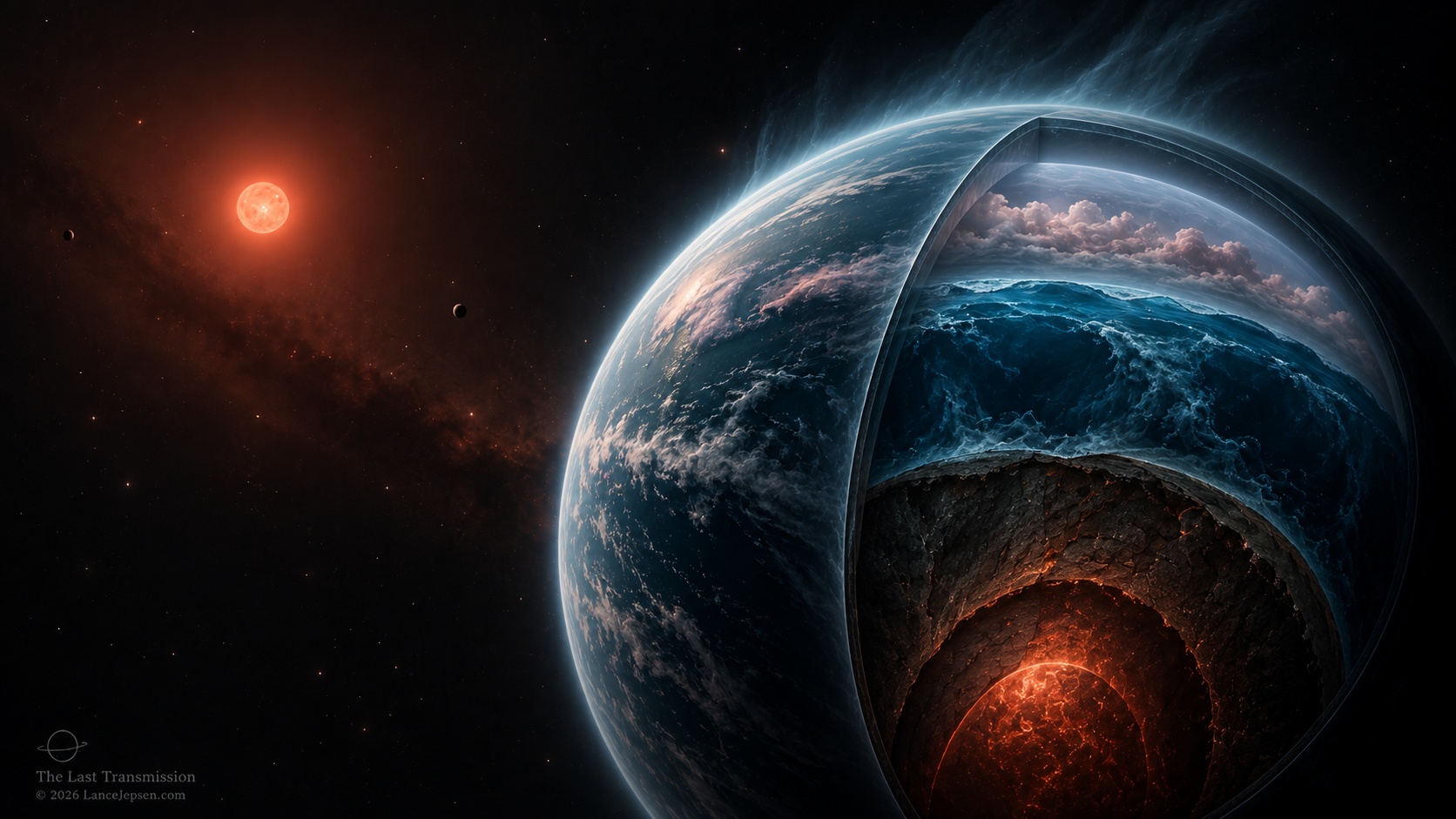
One possible interpretation of LHS 1140 b: a volatile-rich super-Earth with a substantial atmosphere, deep water-rich layers and a rocky interior. The actual internal structure and atmospheric composition remain uncertain. AI illustration by The Last Transmission. © 2026 DarkScienceDocs.com
THE OBSERVATION
What we can actually see.
Mass and radius measurements constrain LHS 1140 b’s bulk properties, and models explore possible rock, volatile, and gas distributions. The disputed helium measurements address the upper atmosphere, not a direct view of internal water layers. Several compositions can fit limited observations.
THE ILLUSTRATION
What the artwork imagines.
The clean shells of atmosphere, water, and rock supply a possible arrangement for the eye. Their thicknesses and colors are unmeasured, and the picture should not be read as proof of oceans or habitability.
FROM THE ILLUSTRATED ARTICLE
The story that inspired it.
The article asks how much of a distant world can be known from its shadow and spectrum when competing interior and atmosphere models remain viable.
Read A Planet 48 Light-Years Away May Have an Atmosphere. Then JWST Made It Stranger.CHECK THE RECORD
The image interprets the research below. Follow the original work for the measurements and limits behind the scene.
JWST helium nondetection and interior contextOTHER IMAGE STORIES
 A Planet’s Atmosphere in Starlight
 Two Worlds Around a Red Dwarf
 The Mark Shared by Titan and Pluto