
VISUAL ARCHIVE / IMAGE STORY
Ice Layers as a Climate Memory
Radar and imaging reveal layered ice; this cutaway imagines the story behind the strata.
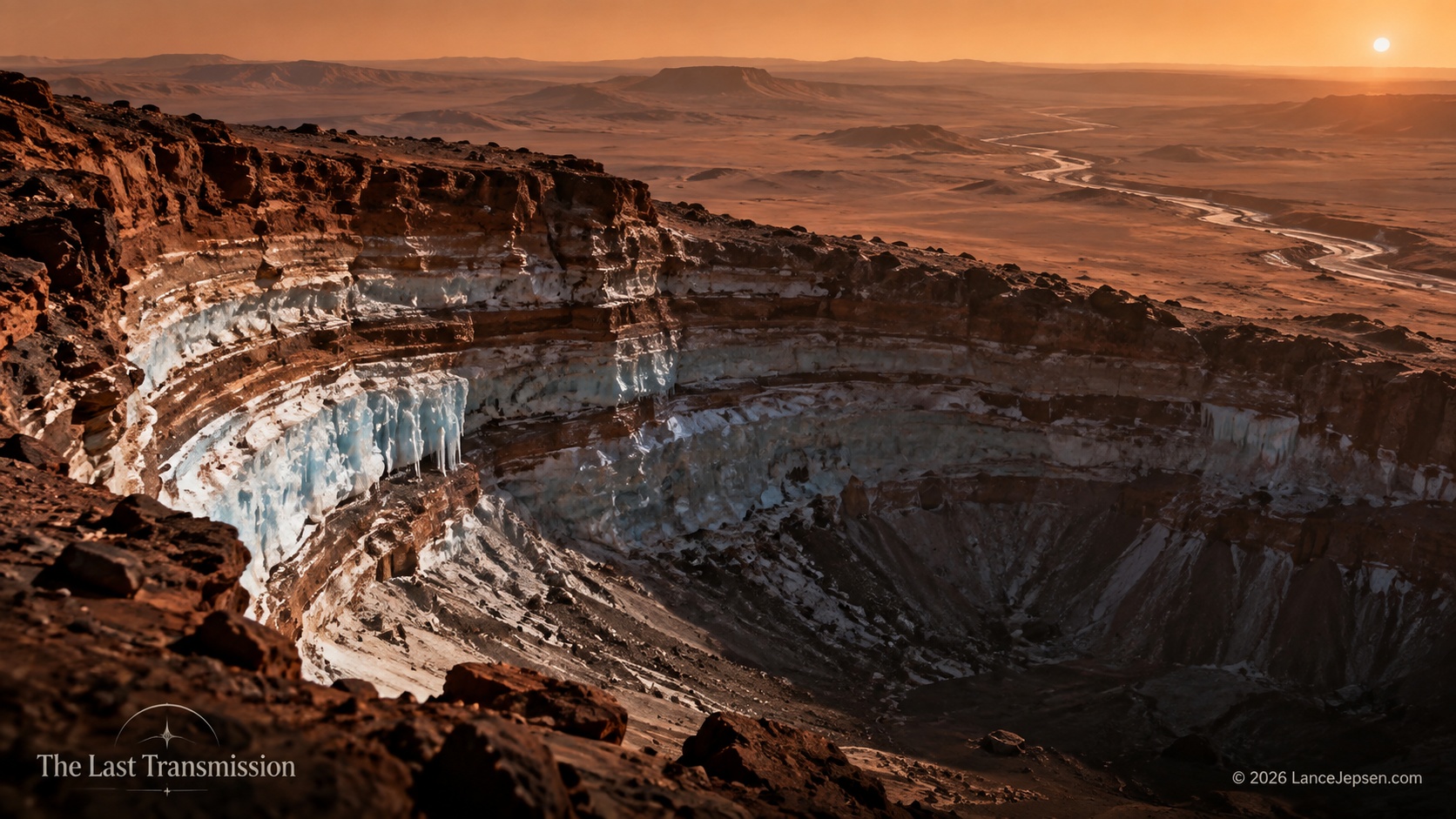
Layers of buried Martian ice may preserve a record of ancient climate cycles driven partly by changes in the planet’s axial tilt. Mars did not simply lose its water overnight; its transformation appears to have unfolded over immense stretches of time. AI-generated visualization by The Last Transmission.
THE OBSERVATION
What we can actually see.
Orbital radar has revealed layers of ice, dust, and sand in Martian polar deposits. Some layers record climate cycles influenced by changes in Mars’s tilt and orbit. The thickness and composition of any one buried layer require data from that site, not a generic picture of an ice-rich planet.
THE ILLUSTRATION
What the artwork imagines.
Colored bands and a clean underground view turn a difficult radar interpretation into a readable cross-section. Their proportions and exact ages are not taken from one measured core or directly exposed cliff face.
FROM THE ILLUSTRATED ARTICLE
The story that inspired it.
The article considers how Mars’s shifting climate both stores a history in ice and changes what evidence survives at the surface.
Read Mars Is Erasing Its Own Past While We WatchCHECK THE RECORD
The image interprets the research below. Follow the original work for the measurements and limits behind the scene.
NASA: Radar reveals layers below a Martian ice capOTHER IMAGE STORIES
 The Dark That Spread Across Utopia Planitia
 A Planet That Refuses to Stay Still
 The Mark Shared by Titan and Pluto