
VISUAL ARCHIVE / IMAGE STORY
Chemistry That Survived in Martian Rock
Rovers detected organic chemistry, but the image cannot show a living source or a single proven origin.
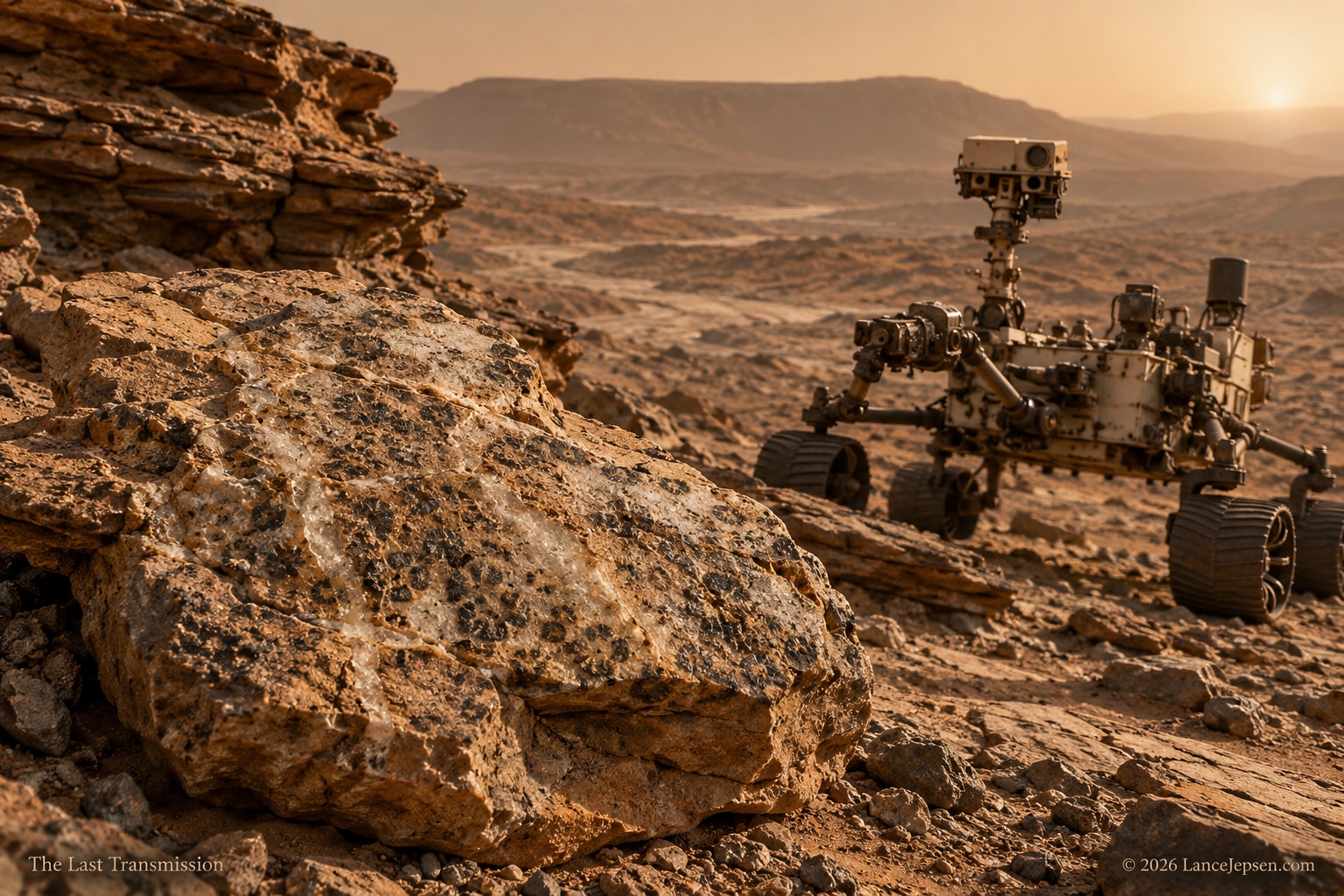
Ancient Martian rocks have preserved organic chemistry for billions of years. Curiosity has identified the most diverse collection of organic molecules yet detected on Mars, while Perseverance has encountered an even more provocative geological puzzle in Jezero Crater. AI-generated visualization by The Last Transmission.
THE OBSERVATION
What we can actually see.
Curiosity’s instruments have identified a diverse set of organic molecules in ancient Martian rock. Organic molecules can form through several nonliving processes and may also be altered over immense time. Perseverance’s Jezero observations pose separate geological questions; neither rover has established Martian life.
THE ILLUSTRATION
What the artwork imagines.
The close visual link between a rock layer and glowing chemistry helps viewers follow the clue. Molecules have no such visible color at rover scale, and the artwork does not reproduce a specific instrument readout or locate a biological fossil.
FROM THE ILLUSTRATED ARTICLE
The story that inspired it.
The article follows Mars as both a keeper and an eraser of traces, including chemistry that can outlast the conditions under which it formed.
Read Mars Is Erasing Its Own Past While We WatchCHECK THE RECORD
The image interprets the research below. Follow the original work for the measurements and limits behind the scene.
NASA: Curiosity finds organic molecules on MarsOTHER IMAGE STORIES
 The Dark That Spread Across Utopia Planitia
 A Planet That Refuses to Stay Still
 The Mark Shared by Titan and Pluto