
VISUAL ARCHIVE / IMAGE STORY
The Wind That Rewrites Mars
Martian winds move real dunes and dust; the depicted storm is an editorial scene.
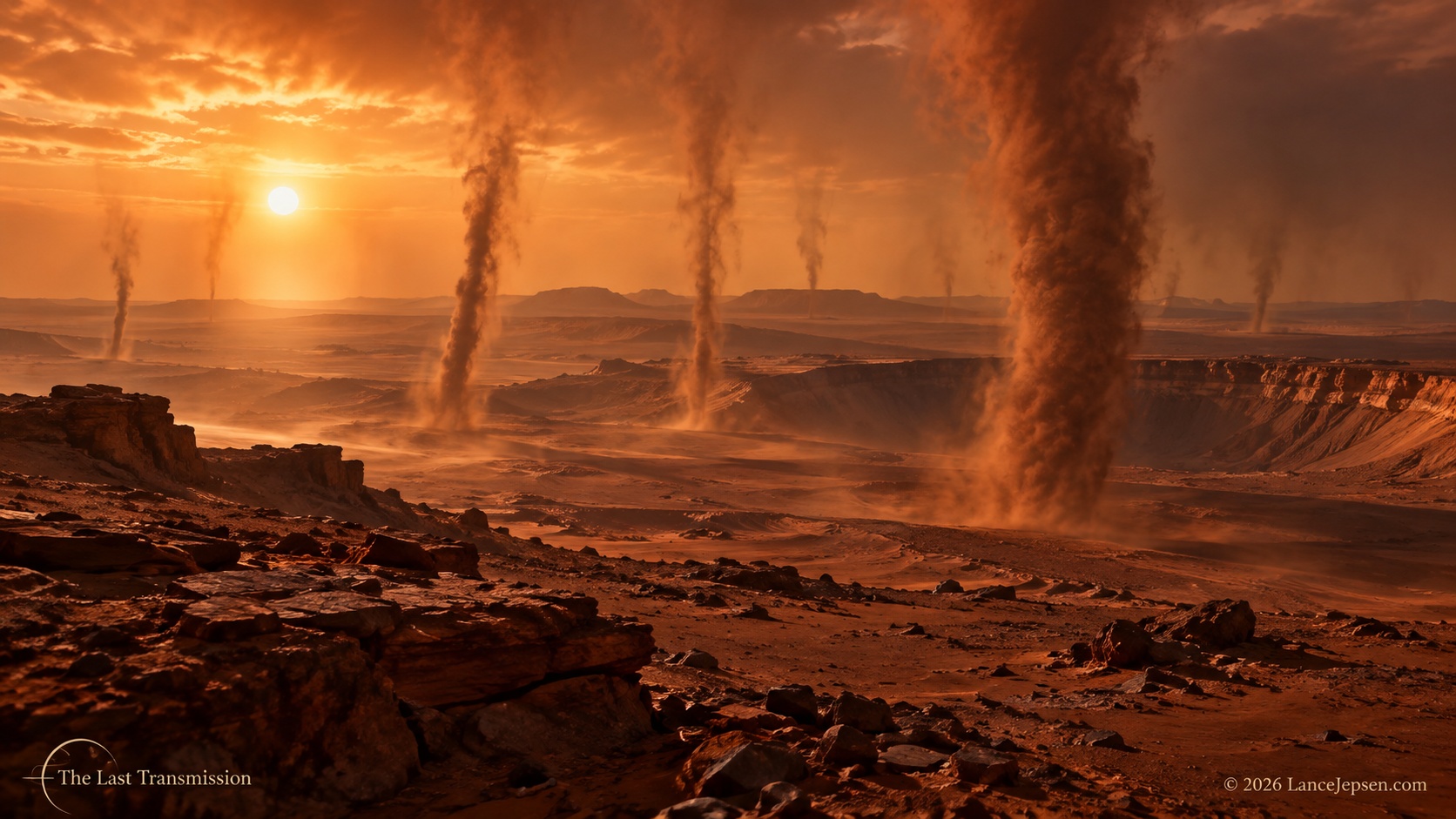
Mars has an atmosphere only a fraction as dense as Earth’s, yet its winds can still rearrange the landscape, loft dust and drive enormous dust devils across the surface. The planet is quieter than Earth, but it is not still. AI-generated visualization by The Last Transmission.
THE OBSERVATION
What we can actually see.
Even with a thin atmosphere, Mars has winds capable of transporting fine material and reshaping dunes. Orbiters can compare images of the same terrain to detect motion across time. That measurable change does not mean any particular dune or dust devil in this image was caught in the act.
THE ILLUSTRATION
What the artwork imagines.
The scene condenses many small movements into a visible sweeping force. Dust density, shadows, and the apparent rate of change are compositional choices rather than a time-lapse made from one observation sequence.
FROM THE ILLUSTRATED ARTICLE
The story that inspired it.
The article uses the moving surface to challenge the idea that Mars preserves every ancient clue untouched. The moving dunes show why even a thin atmosphere can alter what an orbiter sees next.
Read Mars Is Erasing Its Own Past While We WatchCHECK THE RECORD
The image interprets the research below. Follow the original work for the measurements and limits behind the scene.
NASA Mars Reconnaissance Orbiter: moving dunesOTHER IMAGE STORIES
 The Dark That Spread Across Utopia Planitia
 A Planet That Refuses to Stay Still
 The Mark Shared by Titan and Pluto