
VISUAL ARCHIVE / IMAGE STORY
The Oldest Amber Is Tiny
The Devonian fragments are millimeter-scale fossils; their dramatic glow is a visualization of analysis.
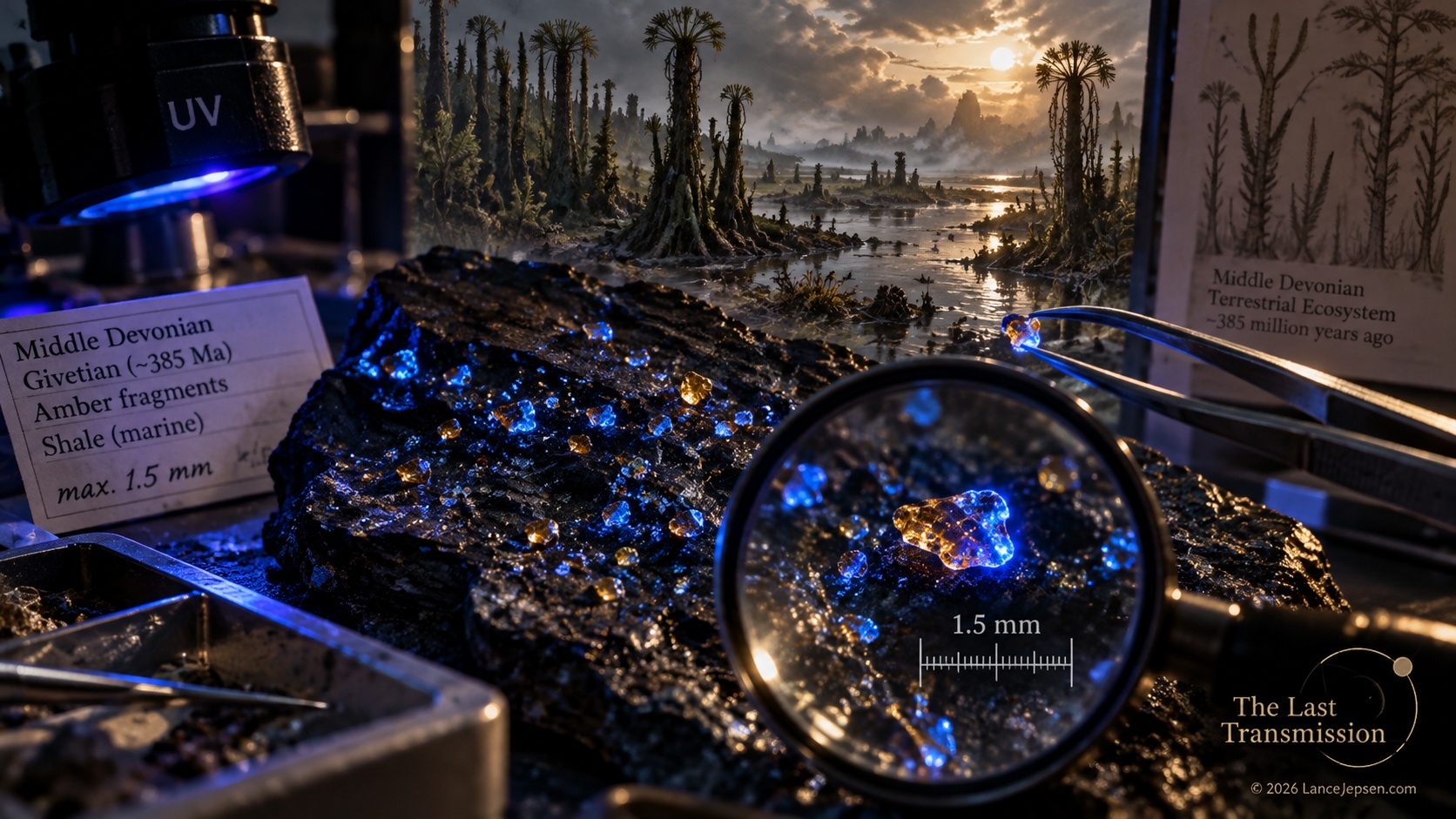
The oldest known amber is microscopic. Researchers recovered tiny Middle Devonian fragments from the Hujiersite Formation, with the largest specimens reaching only about 1.5 millimeters and fluorescing strongly under ultraviolet light. AI-generated editorial visualization based on the published discovery.
THE OBSERVATION
What we can actually see.
The reported Hujiersite fragments are tiny, with the largest about 1.5 millimeters, and the researchers used physical and chemical evidence to identify amber. Ultraviolet fluorescence is a useful analytical clue, but the material’s age and origin also depend on its geological setting and composition.
THE ILLUSTRATION
What the artwork imagines.
The enlarged chips and theatrical glow make an almost invisible find readable on screen. Their scale, arrangement, and lighting are not a literal photograph of the recovered specimens or the researchers’ equipment.
FROM THE ILLUSTRATED ARTICLE
The story that inspired it.
The article centers on a startling scale contrast: a minuscule fossil can push a major part of plant history far back in time.
Read The Trees Were Bleeding 385 Million Years AgoCHECK THE RECORD
The image interprets the research below. Follow the original work for the measurements and limits behind the scene.
Middle Devonian amber discovery, Science AdvancesOTHER IMAGE STORIES
 Amber Before the Jewel
 A Wound Sealed With Resin
 The Mark Shared by Titan and Pluto