
VISUAL ARCHIVE / IMAGE STORY
DNA Beyond Its Old Address
Mitochondrial DNA fragments can leave traces in nuclear chromosomes.
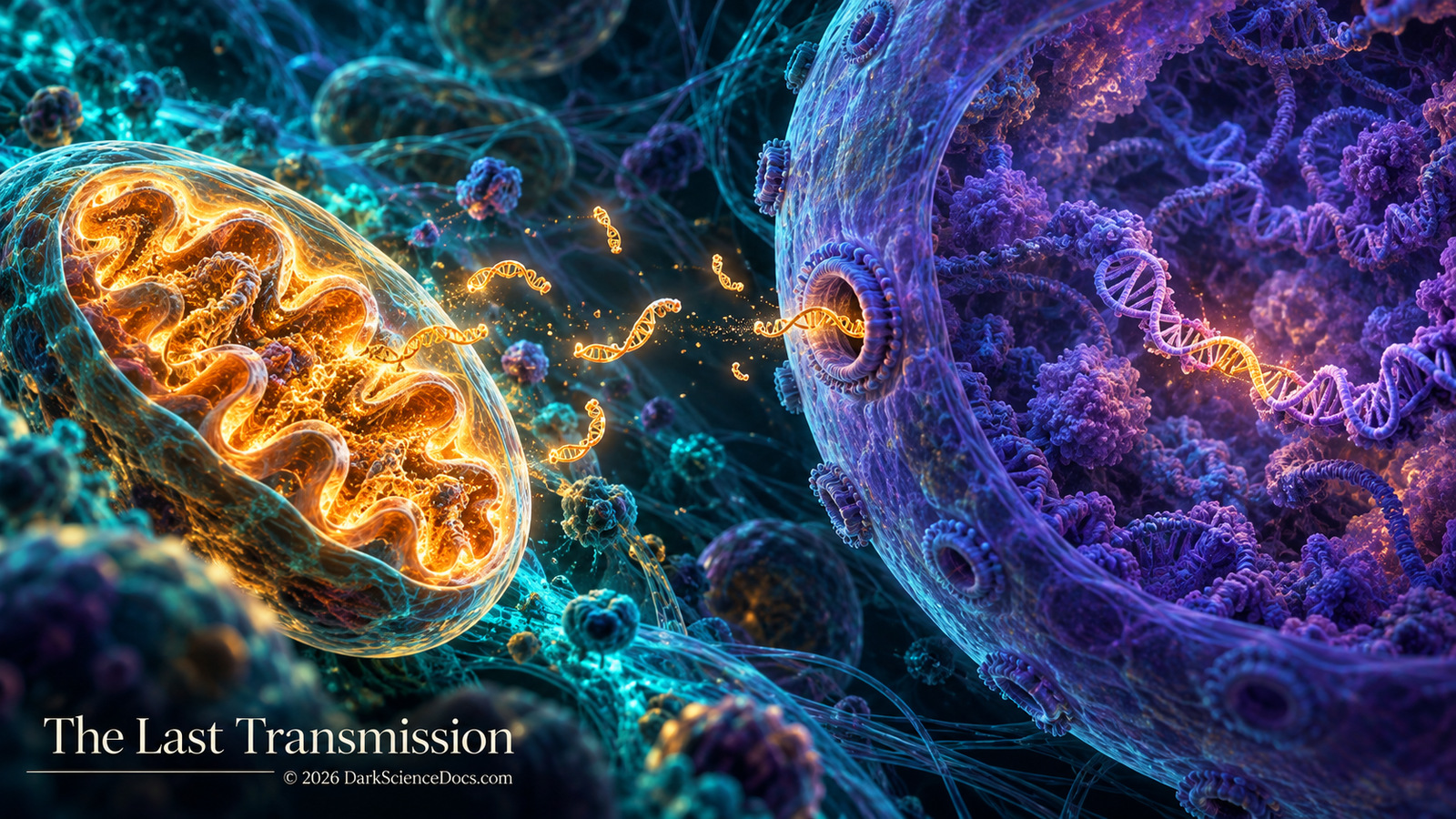
Mitochondrial DNA fragments can become embedded in nuclear chromosomes. Their significance depends on context, and many are benign. AI-generated conceptual illustration. The Last Transmission | © 2026 DarkScienceDocs.com
THE OBSERVATION
What we can actually see.
Sequencing can identify nuclear insertions of mitochondrial DNA, often called NUMTs. Their presence alone does not establish disease or a harmful effect; location, timing, and biological context determine what an individual insertion might mean.
THE ILLUSTRATION
What the artwork imagines.
The composition visualizes this idea: Mitochondrial DNA fragments can leave traces in nuclear chromosomes. Mitochondrial DNA fragments can become embedded in nuclear chromosomes. Their significance depends on context, and many are benign. AI-generated conceptual illustration.
FROM THE ILLUSTRATED ARTICLE
The story that inspired it.
The illustrated article begins with mitochondrial bacterial ancestry, then follows membrane energy production, separate magnetic-field and infrared studies, and DNA crossing into the nucleus. It keeps established biology distinct from proposed mechanisms. This frame focuses on mitochondrial DNA fragments can leave traces in nuclear chromosomes.
Read The Ancient Passengers Inside You May Be Listening to EarthCHECK THE RECORD
The image interprets the research below. Follow the original work for the measurements and limits behind the scene.
National Human Genome Research Institute: Mitochondria National Human Genome Research Institute: When cellular power plants go bad OpenStax Biology 2e: Oxidative Phosphorylation Iwata and colleagues: Mitochondria metabolism sets the species-specific tempo of neuronal development Reed and colleagues: Hypomagnetic fields modulate lifespan, physical ability and mitochondrial metabolism in a Pink1 model of neurodegeneration Yang, Gu, and Song: A quantum state of mitochondria in the living cell, bioRxiv, 2026 Shen and colleagues: The germline coordinates mitokine signaling Zhou and colleagues: Somatic nuclear mitochondrial DNA insertions are prevalent in the human brain and accumulate over time in fibroblastsOTHER IMAGE STORIES
Keep looking.
 The Passengers Inside the Cell
 When Two Histories Became One
 The Mark Shared by Titan and Pluto
EXPLORE IN 3D / ATLAS I-03
Enter the ancient partnership
Explore folded mitochondrial membranes and the energy system inside a cell. The model illustrates established structure and energy production; it does not simulate the magnetic-field or infrared hypotheses.
Explore Mitochondrion in 3D