
VISUAL ARCHIVE / IMAGE STORY
Competing Origins of the Martian Moons
Phobos may have formed from material associated with a massive Martian impact, captured asteroidal material, or a more complex process involving disrupted debris. Its composition could help scientists distinguish these possibilities. Conceptual illustration.
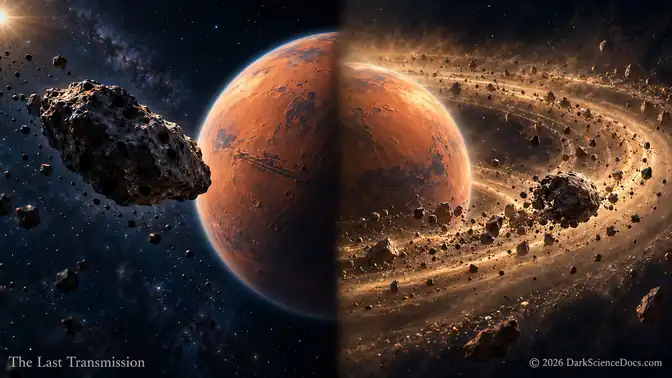
Phobos may have formed from material associated with a massive Martian impact, captured asteroidal material, or a more complex process involving disrupted debris. Its composition could help scientists distinguish these possibilities. Conceptual illustration.
THE OBSERVATION
What we can actually see.
The origin of Phobos remains unresolved. Models predict that its regolith may contain Martian impact ejecta, but a prediction is not a recovered grain. The abundance, condition, ages and provenance of any Martian material must be established from measurements. The image itself is not observational evidence.
THE ILLUSTRATION
What the artwork imagines.
Phobos may have formed from material associated with a massive Martian impact, captured asteroidal material, or a more complex process involving disrupted debris. Its composition could help scientists distinguish these possibilities. Conceptual illustration. This conceptual artwork invents viewpoint, lighting, scale relationships and spacecraft details. It is not a mission photograph, a measured trajectory, or confirmation that the depicted future operation has occurred.
FROM THE ILLUSTRATED ARTICLE
The story that inspired it.
A few grains from Phobos could test how the moon formed and whether impacts delivered fragments of Mars to its surface. MMX must first turn that possibility into a carefully documented sample. The companion investigation separates the mission plan, modeled possibilities and measurements still to come.
Read Phobos: The Moon That May Preserve Mars’s PastCHECK THE RECORD
The image interprets the research below. Follow the original work for the measurements and limits behind the scene.
JAXA: MMX mission profile and sample-return objectives ESA: August Mars arrival and September 2027 Phobos operations JAXA: scientific objectives and competing moon-origin models Hyodo et al. (2019): modeled transfer of Martian impact ejectaOTHER IMAGE STORIES
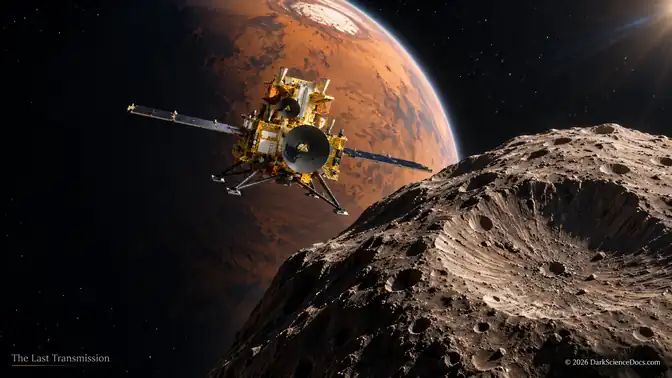 MMX Approaches Phobos
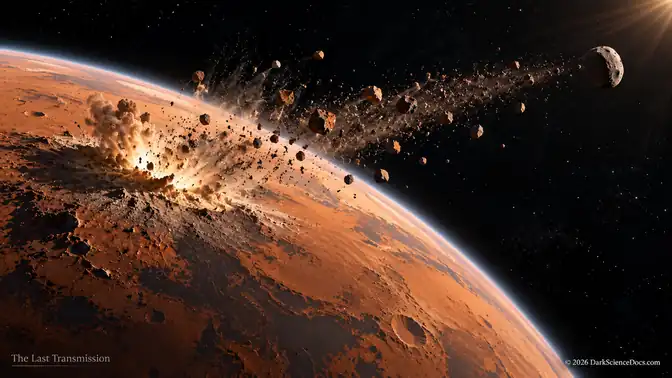 Mars Sends Fragments Into Space
 The Mark Shared by Titan and Pluto