
01 / Mars / Phobos / sample-return science
Phobos: Mars’s History in Another World’s Dust
A few grains from Phobos could test how the moon formed and whether impacts delivered fragments of Mars to its surface. MMX must first turn that possibility into a carefully documented sample.
The landscape of Phobos may hold two overlapping histories: the formation of a small moon and the material that reached it later. Japan’s MMX mission will investigate both. A returned grain could preserve information about its parent rock, but connecting that grain to Mars requires evidence rather than resemblance. The investigation follows that chain from orbital observations through surface sampling to the laboratory, keeping the possible discoveries separate from the work still required to establish them.
A moon can collect another world’s debris
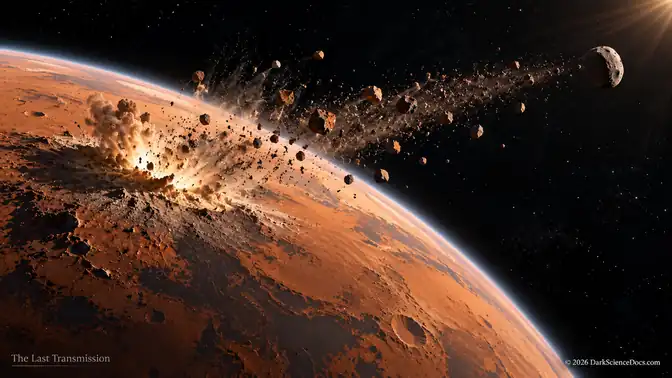
An impact does more than excavate a crater. It launches material along many trajectories, and some fragments can escape the planet or cross the paths of its moons. Numerical work asks how much Martian material might reach Phobos and what survives the trip. That makes a testable prediction for a returned sample, rather than a claim that scientists have already identified those grains. The source location of any fragment would still need its own evidence.
The moon’s origin and a grain’s origin are different questions
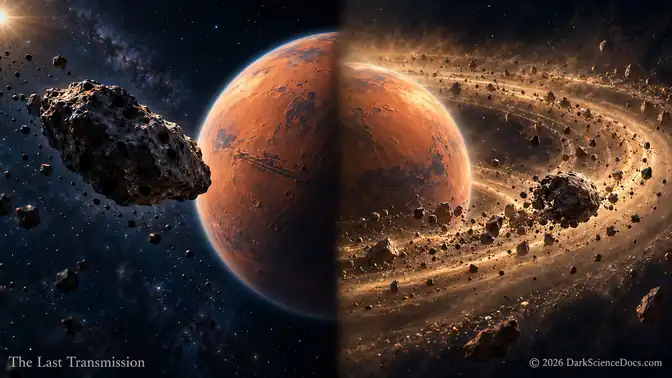
A Martian grain would not, on its own, establish that the whole moon formed from Mars. Material delivered by later impacts could be mixed into a body that began elsewhere. Conversely, a moon assembled after a giant impact could contain material from more than one parent body. Researchers will need composition, mineral textures, ages and orbital context to compare formation histories. A dramatic illustration cannot select the correct model.
Arrival begins the survey
The published sequence separates entry into the Martian system from sustained operations near Phobos. ESA lists Mars orbit in August 2027 and Phobos operations from September 2027. The spacecraft will survey candidate sites before surface work. The countdown therefore marks the beginning of the published September window, not an exact rendezvous instant and not a landing. The schedule may change as navigation and mission operations progress.
A rover explores contact with unfamiliar ground
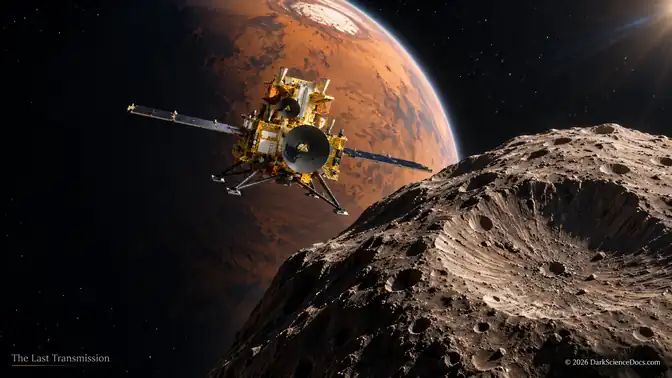
Idefix is intended to examine surface properties before the main spacecraft samples them. Exceptionally weak gravity makes ordinary assumptions about traction, bouncing and stable contact unreliable. The rover’s observations can inform decisions about the terrain, while the orbital instruments provide a wider view. ESA places deployment in early 2029; that is a separate milestone from arrival. The rover and lander in these images are artistic interpretations, not precise engineering drawings.
Ten grams are a goal, not a result
The mission aims to bring at least ten grams of Phobos material to Earth. Success requires surveying, selecting sites, making stable surface contact, collecting material, preserving it and completing the return. Until that chain succeeds, the target mass remains a mission objective. Samples would then be catalogued and studied with methods that can examine individual grains. Their value comes from information and provenance, rather than the apparent size of the container.
The strongest story is the one the grains can support
Mineral chemistry and structure could reveal how material formed and changed. Evidence consistent with water-related processes would concern geological conditions; it would not automatically identify living organisms. Contamination and nonbiological explanations must be considered before stronger claims. The planned return in 2031 opens a phase of laboratory investigation rather than guaranteeing one final answer. Future results will have to distinguish what was measured from the history inferred from it.
The full investigation continues with the evidence, illustrations, and sources at The Last Transmission on Substack.
Continue reading on SubstackTHE EVIDENCE / THE OPEN QUESTION
What we know.
Phobos is an irregular, cratered moon close to Mars. MMX is designed to map its surface, study its composition, and return at least ten grams of material. The material has not yet been collected or analyzed in Earth laboratories.
What remains open.
The origin of Phobos remains unresolved. Models predict that its regolith may contain Martian impact ejecta, but a prediction is not a recovered grain. The abundance, condition, ages and provenance of any Martian material must be established from measurements.
Why it matters.
A sample can connect remote observations to laboratory measurements of individual minerals. The challenge is to separate the moon’s original material from later additions, and to distinguish a history of habitable environments from evidence that life actually existed.
GO DEEPER / EVIDENCE FILE
Can Phobos Preserve Pieces of Mars?
Impact models predict Martian fragments in Phobos dust. Provenance, sampling context and laboratory controls are needed to turn that possibility into evidence.
COMPARE THE QUESTIONS
Follow the Martian system.
Explore the moon’s setting and the evidence needed to interpret a returned sample.
FOLLOW THE EVIDENCE
Research behind the field note.
COMING MILESTONE / SCIENCE COUNTDOWN
MMX approaches Phobos
The next threshold is sustained exploration near Mars’s larger moon, before the rover deployment and sample collection. September 2027, planned Phobos arrival window.
VISUAL EVIDENCE
Inside the investigation.
FOLLOW THE THREAD
Related signals.

The People Who Cared for Laika Knew She Would Never Come Home
Before her one-way flight, a doctor brought her home to play with his children. That small kindness leaves us with a harder question about what it means to care.
The Moon Has No Owner. Its Most Valuable Ground Is Already Being Contested.
Two space powers are racing toward a crater where the Sun has barely touched the ground for billions of years. What lies in the darkness could determine humanity's future on the Moon.
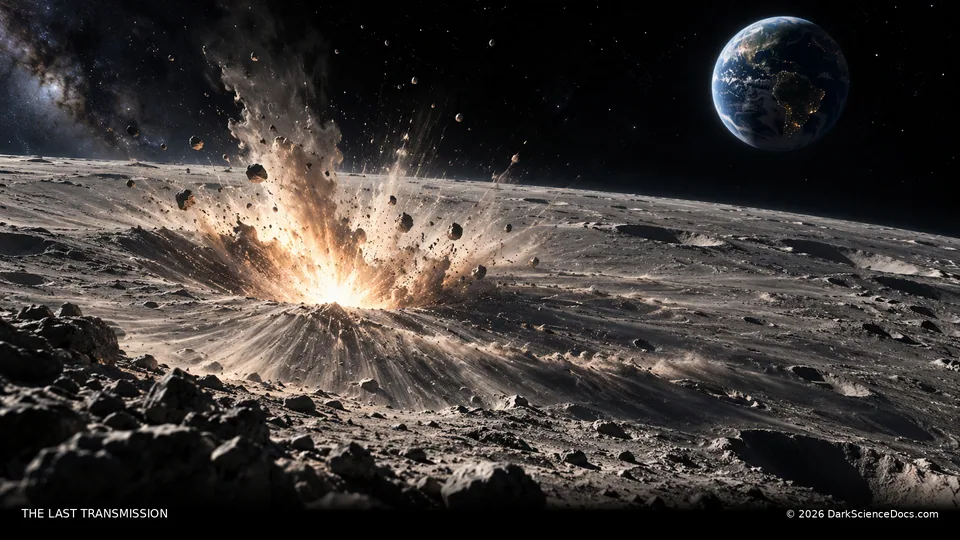
The Moon Was Hit. The Damage Reached 140 Kilometers.
In the spring of 2024, something struck the Moon hard enough to leave an impact crater. When scientists finally discovered the impact, they found that its effects reached astonishing distances.