
EVIDENCE FILE 29 / PHOBOS
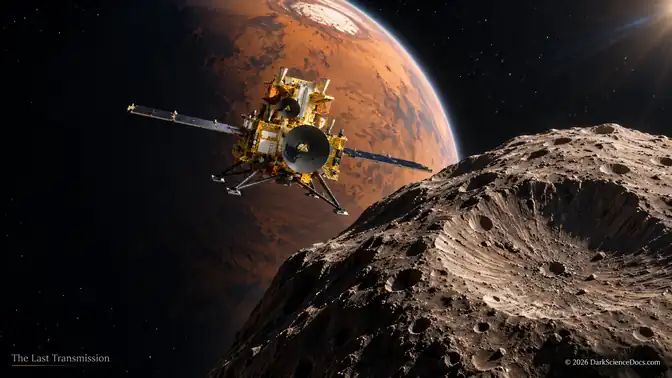
Can Phobos Preserve Pieces of Mars?
How could scientists establish that a grain returned from Phobos came from Mars?
All Evidence FilesTHE SHORT ANSWER
It is plausible, but unconfirmed in a returned sample. Multiple measurements must establish a grain’s provenance.
THE EVIDENCE MAP / PHOBOS
Can Phobos Preserve Pieces of Mars?
Impact models predict Martian fragments in Phobos dust. Provenance, sampling context and laboratory controls are needed to turn that possibility into evidence.
- 01Measurement
Record a grain’s properties
A grain’s color or resemblance to a Martian rock is not enough to identify its origin. Researchers would compare several properties, such as mineral composition, chemical relationships, isotopic measurements and the grain’s physical history. Each technique has a different sensitivity and potential ambiguity. Agreement among independent lines of evidence can strengthen an attribution, while disagreement may expose a mixed history or an incorrect assumption. The important result is the documented relationship between the measurement and the proposed parent material.
- 02Interpretation
Compare possible parent materials
Numerical models can test whether impact ejecta from Mars reaches Phobos under particular assumptions about impacts, trajectories and particle survival. Their output describes a possible delivery process, not a count of Martian grains in a recovered container. The prediction becomes useful when it states what a sample might contain and what measurements could challenge that expectation. A sample with little recognizable Martian material could constrain the model, although collection location, grain size and detection sensitivity would also matter.
- 03Competing explanation
Later delivery changes the mixture
A captured body can acquire ejecta after arriving near Mars. A moon assembled from impact debris can also accumulate unrelated particles later. Finding some Martian material would therefore answer a narrower question than identifying the origin of Phobos as a whole. To discriminate between formation models, investigators must examine how common different materials are, how their ages and textures relate, and how the sample represents the observed surface. One especially interesting grain cannot automatically stand for an entire moon.
- 04Open test
Analyze a controlled returned sample
The scientific meaning of a grain depends on knowing how it was collected, stored, transported and handled. Terrestrial contamination or material from the spacecraft can complicate interpretation, particularly for carbon-bearing compounds. Sample records and analytical controls help distinguish a celestial signal from an introduced one. Remote observations provide a further context for where the sample came from. These requirements make sample return more than a successful flight: it must also preserve information about the material’s history after collection.
OBSERVATION / INFERENCE / LIMIT
Read the signal.
At least 10 grams
Target sample mass, not material already returned.
Martian ejecta in regolith
Delivery and survival depend on assumptions that samples can test.
Converging provenance
Composition, textures and isotope evidence must agree with the proposed history.
INSIDE THE EVIDENCE
The chain of reasoning.
Each step has a different level of certainty. Follow the measured result into the explanation, then see where the trail ends.
Predicting delivery is different from collecting a sample
Numerical models can test whether impact ejecta from Mars reaches Phobos under particular assumptions about impacts, trajectories and particle survival. Their output describes a possible delivery process, not a count of Martian grains in a recovered container. The prediction becomes useful when it states what a sample might contain and what measurements could challenge that expectation. A sample with little recognizable Martian material could constrain the model, although collection location, grain size and detection sensitivity would also matter.
Determine provenance through converging measurements
A grain’s color or resemblance to a Martian rock is not enough to identify its origin. Researchers would compare several properties, such as mineral composition, chemical relationships, isotopic measurements and the grain’s physical history. Each technique has a different sensitivity and potential ambiguity. Agreement among independent lines of evidence can strengthen an attribution, while disagreement may expose a mixed history or an incorrect assumption. The important result is the documented relationship between the measurement and the proposed parent material.
Keep the bulk moon separate from later additions
A captured body can acquire ejecta after arriving near Mars. A moon assembled from impact debris can also accumulate unrelated particles later. Finding some Martian material would therefore answer a narrower question than identifying the origin of Phobos as a whole. To discriminate between formation models, investigators must examine how common different materials are, how their ages and textures relate, and how the sample represents the observed surface. One especially interesting grain cannot automatically stand for an entire moon.
A returned sample needs a documented chain of custody
The scientific meaning of a grain depends on knowing how it was collected, stored, transported and handled. Terrestrial contamination or material from the spacecraft can complicate interpretation, particularly for carbon-bearing compounds. Sample records and analytical controls help distinguish a celestial signal from an introduced one. Remote observations provide a further context for where the sample came from. These requirements make sample return more than a successful flight: it must also preserve information about the material’s history after collection.
Geological clues do not establish life
A mineral associated with water can support an interpretation of its formation environment without demonstrating that organisms lived there. Carbon-bearing compounds can arise through nonbiological processes, and an unusual structure needs comparison with alternative explanations. Stronger biological claims require more specific evidence, contamination controls and reproducible analysis. MMX can be scientifically valuable by clarifying the origin of Phobos or the history of Martian material even if its samples supply no evidence of life. Habitability and habitation remain different questions.
THE EASY MISREADING
A modeled grain count is not a recovered sample. A Martian grain would not by itself settle the moon’s origin or demonstrate Martian life.
PRIMARY RESEARCH & MISSION RECORDS
Check the source.
These are the studies and mission records behind this explainer. The illustrated article and related research pages continue the investigation.
FOLLOW THE THREAD
Stay with the question.
A few grains from Phobos could test how the moon formed and whether impacts delivered fragments of Mars to its surface. MMX must first turn that possibility into a carefully documented sample.
MORE EVIDENCE FILES
Keep looking.

EVIDENCE FILE 01 / EUROPA
How Do We Know Europa Has an Ocean?
Galileo's magnetic measurements point to a conducting layer beneath Europa's ice. A salty ocean is the leading explanation. Its chemistry and seafloor activity remain open questions.
Read the evidence
EVIDENCE FILE 02 / TITAN & PLUTO
What Is the 5.11-Micrometer Mark on Titan and Pluto?
The 5.11-micrometer absorption is measured on both worlds, but the Pluto feature is broader. A shared wavelength is a clue to investigate, not a chemical identification.
Read the evidence