VISUAL ARCHIVE / IMAGE STORY
A Chemical Link Between Two Worlds
Escaping material offers a possible explanation for Charon’s reddish polar region.
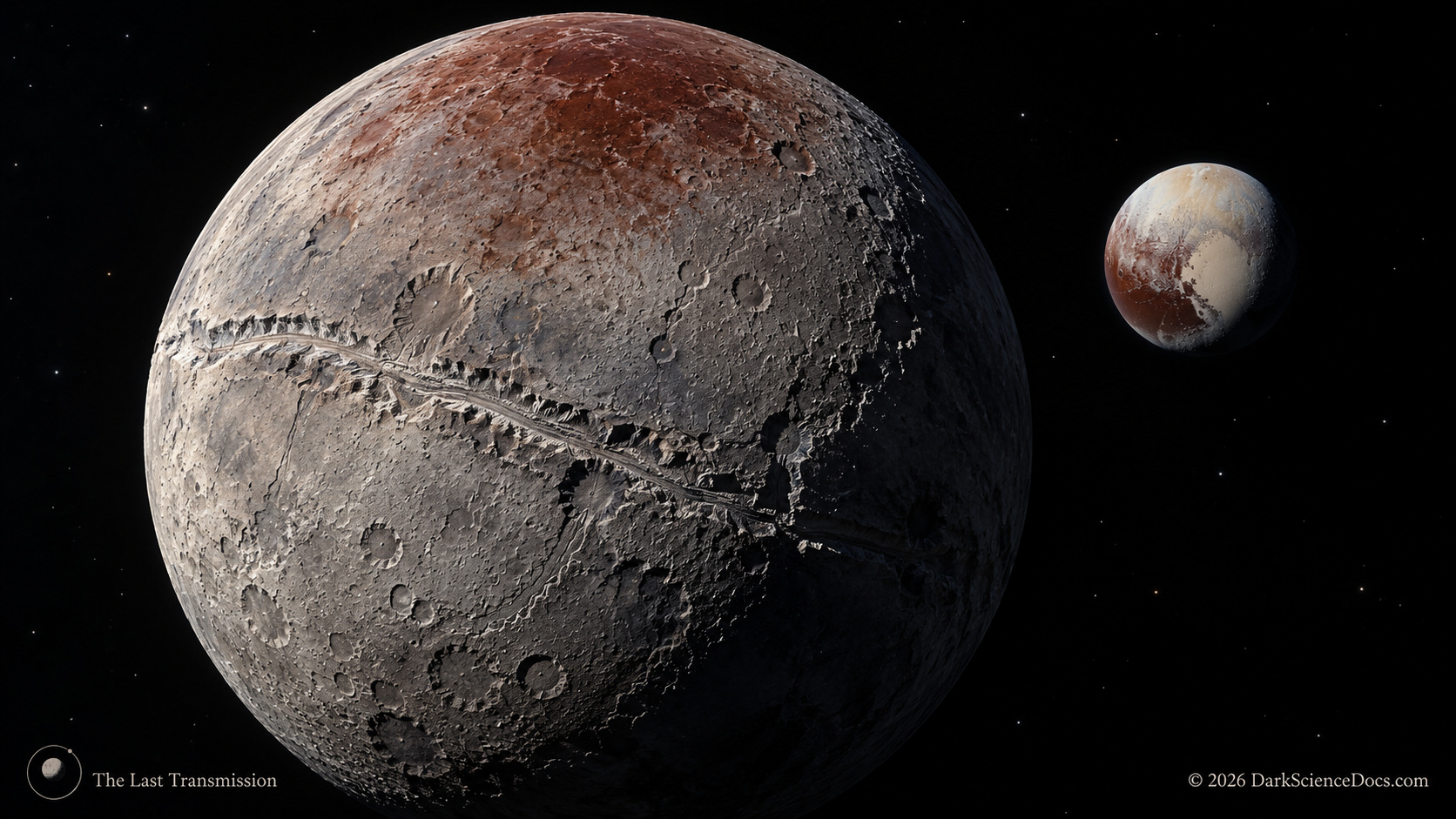
Charon’s reddish polar region may owe part of its color to methane escaping from Pluto and undergoing chemical processing on the moon. AI-generated illustration; the arrangement of the two worlds is composed for storytelling.
THE OBSERVATION
What we can actually see.
Observations show Charon’s reddish north-polar terrain. A proposed mechanism involves methane escaping Pluto, collecting in cold regions, and being chemically processed; the arrangement and glowing material between the two worlds here are composed for illustration.
THE ILLUSTRATION
What the artwork imagines.
The composition visualizes this idea: Escaping material offers a possible explanation for Charon’s reddish polar region. Charon’s reddish polar region may owe part of its color to methane escaping from Pluto and undergoing chemical processing on the moon. AI-generated illustration; the arrangement of the two worlds is composed for storytelling.
FROM THE ILLUSTRATED ARTICLE
The story that inspired it.
The article starts at Sputnik Planitia’s renewing nitrogen ice and follows New Horizons clues into Pluto’s unresolved interior. It compares ocean interpretations with alternatives, then turns to possible cryovolcanism and the chemical link with Charon. This frame focuses on escaping material offers a possible explanation for Charon’s reddish polar region.
Read Pluto May Be Hiding an Ocean Beneath Its HeartCHECK THE RECORD
The image interprets the research below. Follow the original work for the measurements and limits behind the scene.
NASA: New Horizons mission history and discoveries NASA: Pluto facts International Astronomical Union: The 2006 planet definition NASA: Convection and surface renewal in Pluto’s heart McKinnon and colleagues: Convection in a volatile nitrogen-ice-rich layer drives Pluto’s geological vigour NASA: Modeling glacial flow on Pluto NASA: Pluto’s mysterious floating hills NASA: Basin reorientation and the ocean hypothesis Bierson, Nimmo and Stern: Evidence for a hot start and early ocean formation on Pluto Ballantyne and colleagues: Sputnik Planitia as an impactor remnant indicative of an ancient rocky mascon in an oceanless Pluto Singer and colleagues: Large-scale cryovolcanic resurfacing on Pluto NASA: Pluto paints its largest moon redOTHER IMAGE STORIES
Keep looking.
 The Heart That Keeps Changing
 One Flyby, a Changed World
 The Mark Shared by Titan and Pluto
EXPLORE IN 3D / MAP 07
Explore Pluto and its companion
Move around Pluto and Charon, then compare the illustrated worlds with New Horizons evidence. The viewer shows surface context without confirming or exposing a liquid ocean beneath Pluto’s ice.
Open Pluto & Charon map