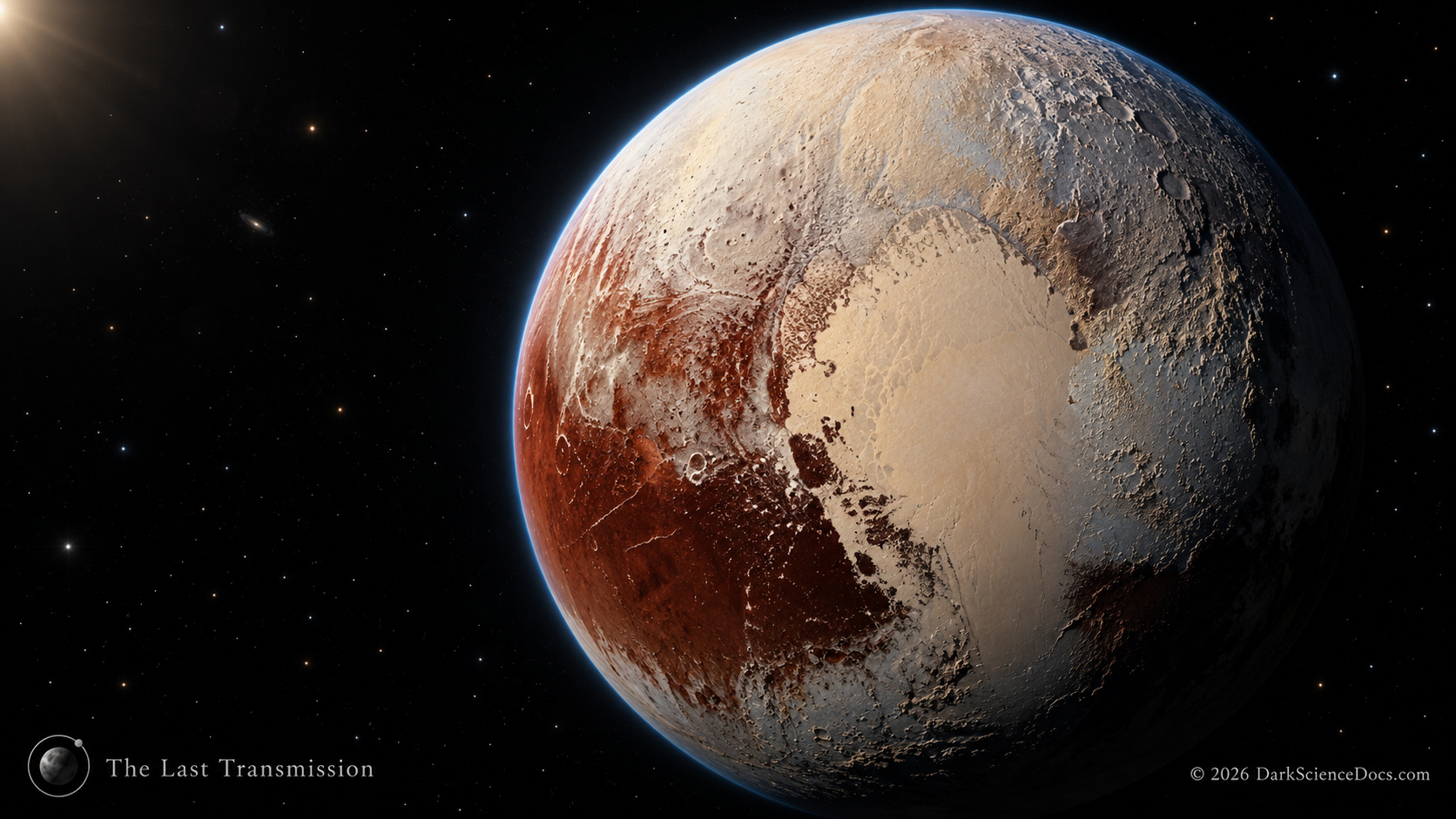
Pluto and Charon, brought into focus by one fleeting encounter. Explore full artistic globes, then follow the observations that inspired them.
AI-generated artist reconstructions: NASA’s New Horizons imagery does not cover every region or show all terrain at equal resolution. Both Pluto and Charon use AI-generated surface images with an artist’s perspective based on the imagery we have. Missing and blurred regions are completed with imagined detail, so the globes can be explored without black coverage gaps. They are artistic interpretations rather than complete spacecraft photographs.
PLUTO–CHARON / 07 AI ARTIST TEXTURES · NEW HORIZONS REFERENCES
Select a destination. Drag to look around; pinch or use the zoom buttons.
DESTINATION 01 / PLUTO–CHARON SYSTEM
Pluto
The distant world in focus
What changed when a point of light became a place?
New Horizons passed Pluto in July 2015 and returned surface images, color measurements, and a view through its thin atmosphere. Its encounter turned the dwarf planet into a world of contrasting ices and dark terrain. This globe uses an AI-generated artist reconstruction based on NASA/JHUAPL/SwRI imagery. It keeps familiar terrain recognizable and invents detail where the spacecraft record is missing or low in resolution.
Why does Pluto have such a bright, restless plain?
The western lobe of Pluto’s famous heart is Sputnik Planitia, a vast nitrogen-ice glacier. Its bright surface and patterns gave New Horizons an immediate geological question. The artist texture keeps the feature recognizable on the globe. Its fine detail is illustrative and cannot establish measured relief, ongoing flow, or the location of another instrument’s spectral absorber.
A departure view revealed layers of haze above Pluto. NASA’s color processing shows a blue-scattering atmospheric veil; a likely pathway begins when sunlight drives reactions involving methane and nitrogen. The faint halo around this globe is a visual cue, not a reconstruction of measured layers or a view from the surface.
Webb measured an absorption near 5.11 micrometers on Titan and a broader feature near that wavelength on Pluto. The absorber is unidentified. The measurement does not pin it to Sputnik Planitia or to any feature visible on this globe, and the different band widths resist a simple claim that the two worlds contain identical material.
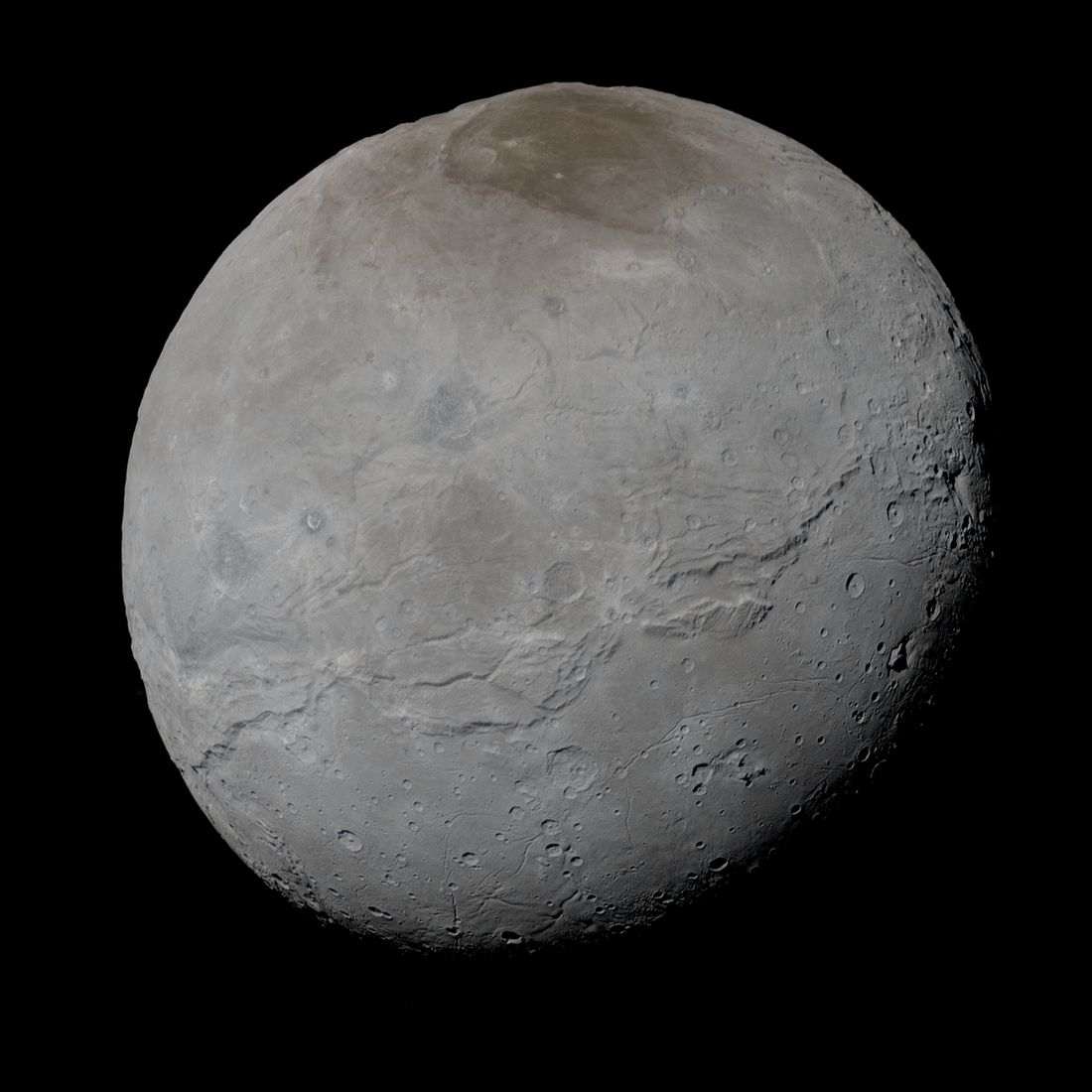
Charon is much smaller than Pluto yet large enough to anchor its own geological story. New Horizons mapped fractures, varied terrain, and a darker northern polar region. The rotating sphere now uses an AI-generated artist reconstruction guided by the global mosaic and natural-color view. It completes missing coverage with imagined gray ice terrain and a restrained polar tint. The separate image below remains an actual New Horizons view for comparison.
What are we seeing where the spacecraft could not see?
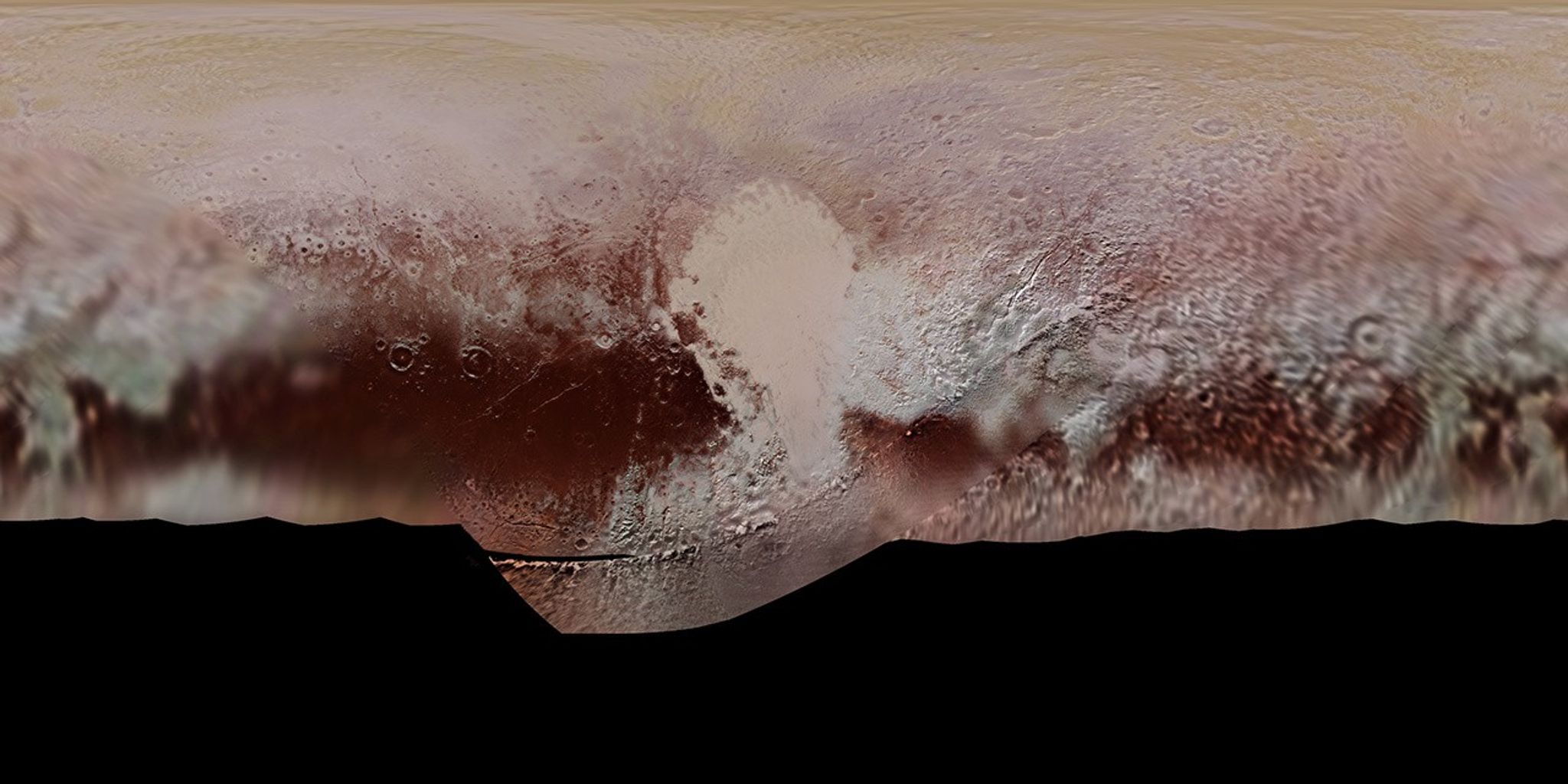
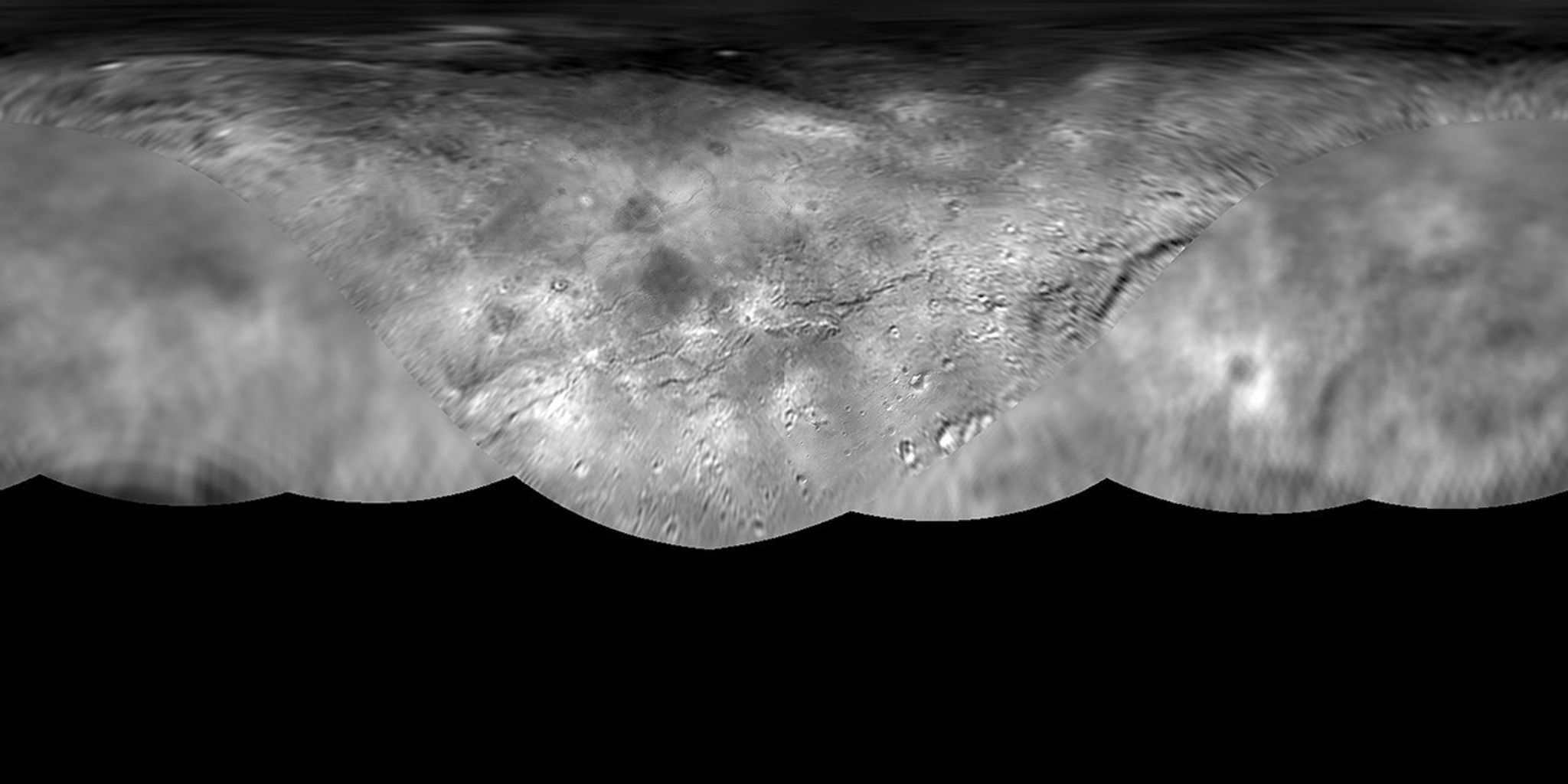
New Horizons made one fast passage. The clearest images concentrate on the encounter-facing hemispheres; some southern terrain was in darkness, and other regions were seen at much lower resolution. The black areas in the original mosaics are missing data, not a literal black landscape. We now fill the globe with AI-generated artistic terrain based on the available imagery. The completed southern surface is an artist’s perspective, not an observation of that hidden terrain.
The active Pluto and Charon globe textures are AI-generated images created from NASA/JHUAPL/SwRI New Horizons references, with an artist’s perspective used to complete missing satellite imagery and interpret blurred regions. The completed textures are artwork across the whole surface, not recovered observations of the unphotographed terrain. The Charon dossier retains a separate actual natural-color image. The faint illustrated atmospheric halo does not represent measured haze height or density.
Compare the original NASA maps and their missing coverage
Original Pluto mosaic, NASA/JHUAPL/SwRI. Black areas mark missing imagery. Check the source ↗Original Charon mosaic, NASA/JHUAPL/SwRI. The active artistic globe also uses the natural-color reference. Check the source ↗
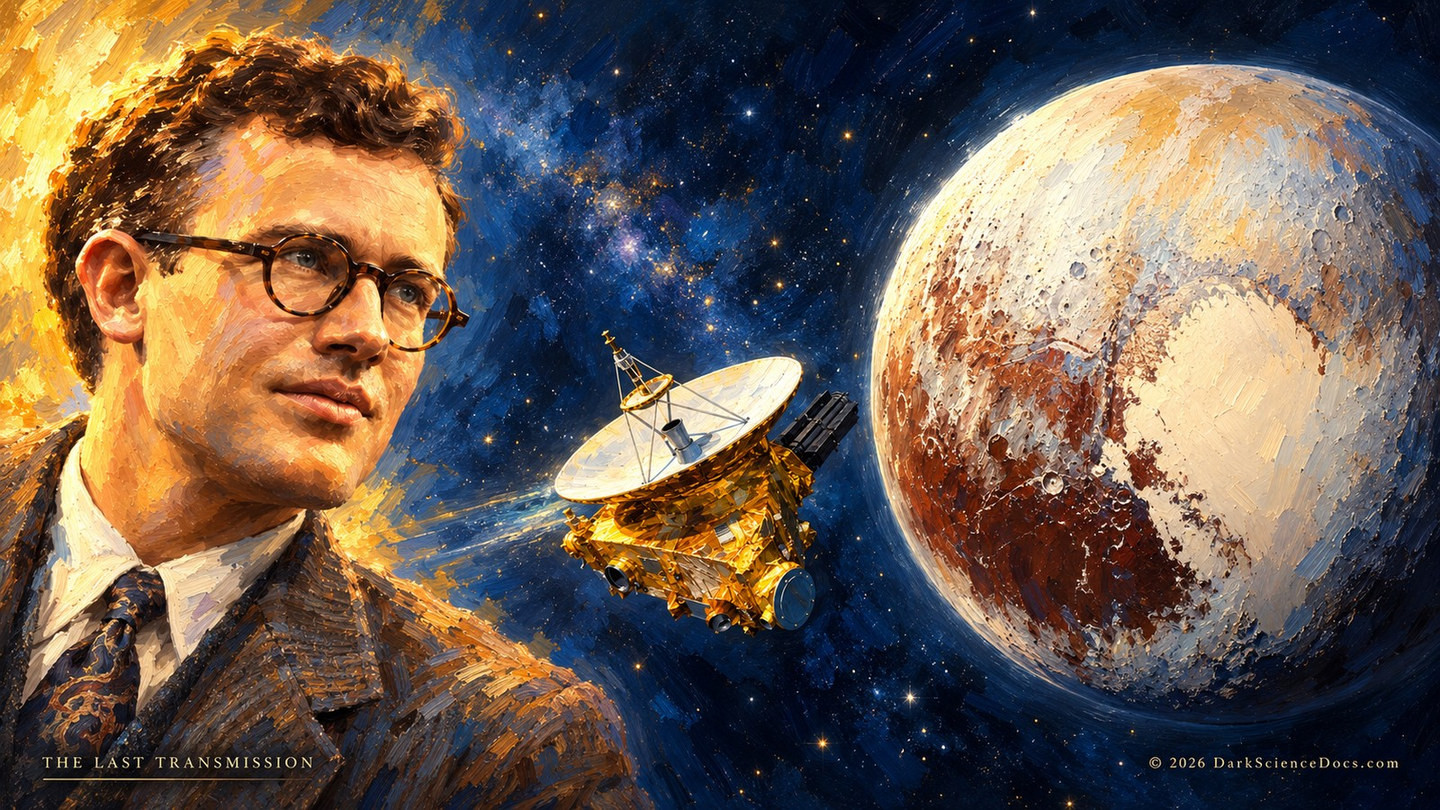
A discovery became a destination. Follow Clyde Tombaugh, the memorial carried aboard New Horizons, and the people who revealed a world he never saw up close.
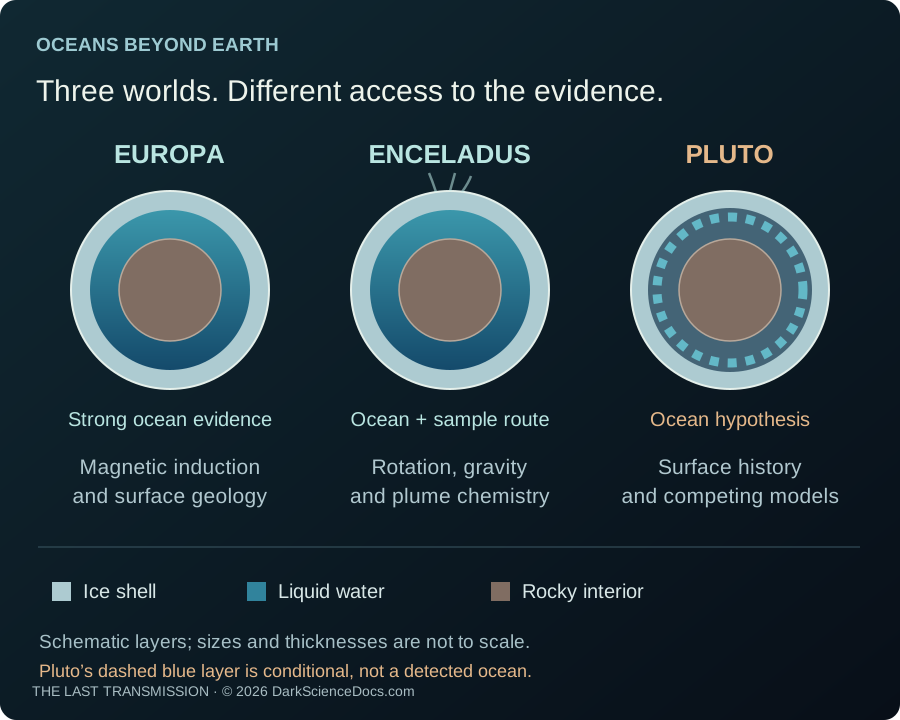
Compare Europa’s magnetic response, Enceladus’s sampled spray, and Pluto’s competing interior models. Follow the measurements into the hidden-ocean question, the search for habitable conditions, and the Atlas.
Compare black-hole horizons, calculate a signal’s travel time, and zoom from a cell toward an atom. Every tool shows its working and the assumptions behind its answer.
TAKE THE QUESTION OFFSCREEN / PRINTABLE ACTIVITIES
Investigate an Alien Ocean
A printable ocean-world investigation comparing Europa, Enceladus, and Pluto. Trace observations into inferences, evaluate limits, and propose a useful next measurement.
New Horizons provided detailed views of some regions and much less information about others. Keep those gaps in mind when rotating the worlds. An inferred hidden ocean belongs to an argument from geology and models, not to the surface texture itself.
Ask yourself How large are the uncertainties, and which claim would go beyond the data?
THE SIGNAL CONTINUES
Some discoveries stay with you.
Get the illustrated investigations delivered to your inbox. Then follow the questions that refuse to leave.