
VISUAL ARCHIVE / IMAGE STORY
Robotic Exploration of Polar Terrain
American and Chinese robotic missions are converging on the lunar south polar region, seeking scientific measurements and operational experience that could shape future settlements.
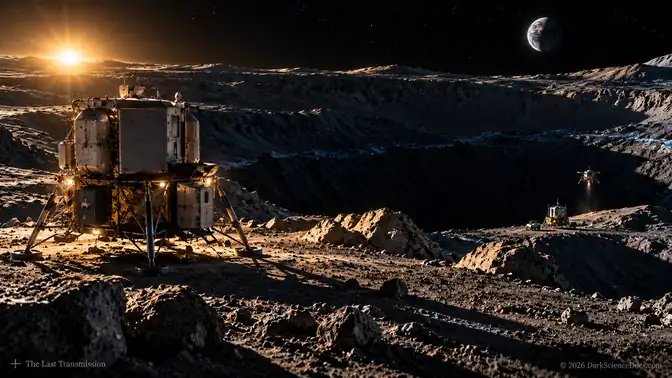
American and Chinese robotic missions are converging on the lunar south polar region, seeking scientific measurements and operational experience that could shape future settlements. Conceptual illustration of planned exploration systems. AI-generated conceptual illustration; not a direct astronomical observation or mission photograph.
THE OBSERVATION
What we can actually see.
Lunar observations support the presence of water ice in cold polar environments. Orbital maps and images reveal temperature and terrain, while neutron measurements provide indirect evidence related to hydrogen. A detailed local resource estimate requires measurements at the scale and depth relevant to surface operations.
THE ILLUSTRATION
What the artwork imagines.
American and Chinese robotic missions are converging on the lunar south polar region, seeking scientific measurements and operational experience that could shape future settlements. Conceptual illustration of planned exploration systems. AI-generated conceptual illustration; not a direct astronomical observation or mission photograph. Colors, lighting, viewpoint and simultaneous arrangement are artistic choices. The frame supplies no instrument measurement, site survey or confirmation of a proposed mechanism.
FROM THE ILLUSTRATED ARTICLE
The story that inspired it.
Sunlit ridges and deeply shadowed crater floors make the lunar south pole scientifically valuable and operationally difficult. Evidence for ice is a starting point, rather than a proven inventory of usable fuel. This artwork provides visual context for the illustrated article while its scientific claims remain tied to the linked research and mission records.
Read The Moon Has No Owner. Its Most Valuable Ground Is Already Being Contested.CHECK THE RECORD
The image interprets the research below. Follow the original work for the measurements and limits behind the scene.
NASA: LRO evidence for lunar polar ice NASA: Shackleton crater and lunar south-pole imaging Zuber et al.: constraints on volatile distribution in Shackleton craterOTHER IMAGE STORIES
 Light Above Shackleton’s Shadow
 An Imagined Apollo-Era Lunar Surface
 The Mark Shared by Titan and Pluto