
VISUAL ARCHIVE / IMAGE STORY
Sensors Beneath Antarctic Ice
The IceCube Neutrino Observatory uses 86 vertical strings carrying 5,160 optical sensors distributed through approximately one cubic kilometer of Antarctic ice, roughly 1.45 to 2.45 kilometers beneath the surface. This cutaway is an artistic representation of the instrument’s scale and arrangement rather than a precise engineering diagram. AI-generated illustration.
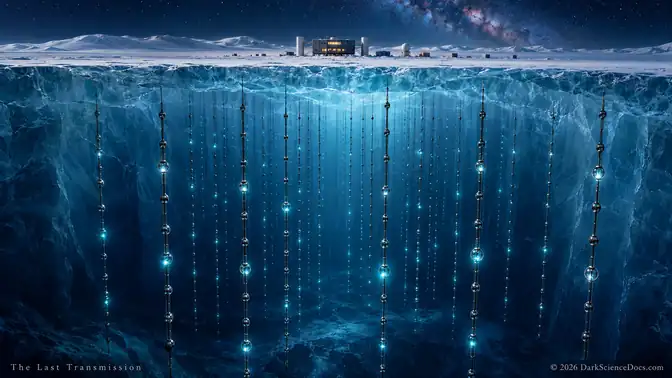
The IceCube Neutrino Observatory uses 86 vertical strings carrying 5,160 optical sensors distributed through approximately one cubic kilometer of Antarctic ice, roughly 1.45 to 2.45 kilometers beneath the surface. This cutaway is an artistic representation of the instrument’s scale and arrangement rather than a precise engineering diagram. AI-generated illustration.
THE OBSERVATION
What we can actually see.
IceCube detects light from charged particles produced in neutrino interactions, then reconstructs event directions and energies. Its NGC 1068 analysis reports statistical evidence for a source against a background, rather than a photograph of the central black hole.
THE ILLUSTRATION
What the artwork imagines.
The IceCube Neutrino Observatory uses 86 vertical strings carrying 5,160 optical sensors distributed through approximately one cubic kilometer of Antarctic ice, roughly 1.45 to 2.45 kilometers beneath the surface. This cutaway is an artistic representation of the instrument’s scale and arrangement rather than a precise engineering diagram. AI-generated illustration. The selected artwork is a conceptual reconstruction. Viewpoint, lighting and apparent detail are illustrative, not additional measurements or a confirmed photograph of the depicted event.
FROM THE ILLUSTRATED ARTICLE
The story that inspired it.
IceCube connects a directional excess of high-energy neutrinos with an obscured active galaxy. The signal opens a view of particle acceleration while leaving its exact location and mechanism unsettled.
Read The Black Hole Hid Its Light. The Neutrinos Escaped.CHECK THE RECORD
The image interprets the research below. Follow the original work for the measurements and limits behind the scene.
https://icecube.wisc.edu/data-releases/2022/11/evidence-for-neutrino-emission-from-the-nearby-active-galaxy-ngc-1068/ https://icecube.wisc.edu/news/press-releases/2022/11/icecube-neutrinos-give-us-first-glimpse-into-the-inner-depths-of-an-active-galaxy/ https://icecube.wisc.edu/news/press-releases/2018/07/icecube-neutrinos-point-to-long-sought-cosmic-ray-accelerator/ https://icecube.wisc.edu/news/research/2025/10/evidence-for-neutrino-emission-from-x-ray-emitting-galaxies/ https://icecube.wisc.edu/news/research/2026/03/new-evidence-from-the-southern-hemisphere-links-neutrinos-to-x-ray-bright-active-galaxies/OTHER IMAGE STORIES
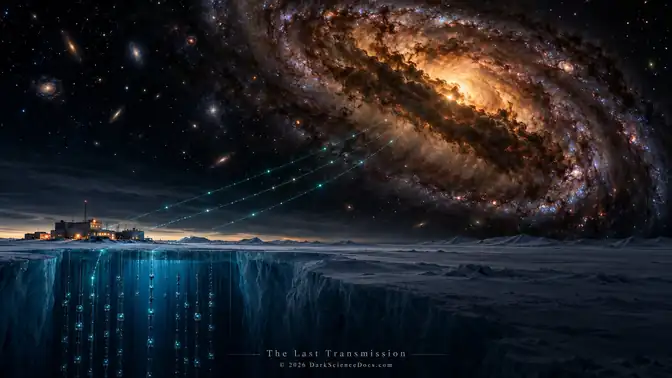 Neutrinos from an Obscured Galaxy
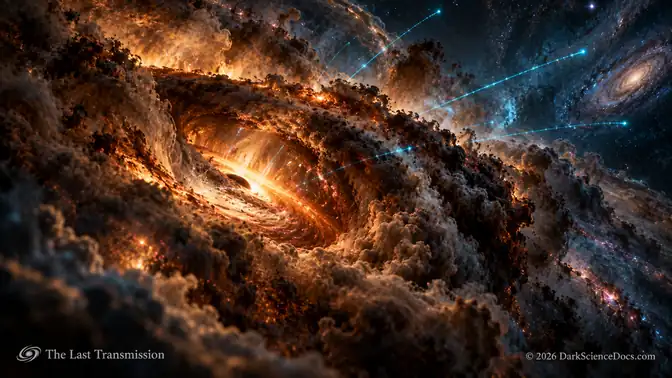 Inside the Hidden Nucleus of NGC 1068
 The Mark Shared by Titan and Pluto