
EVIDENCE FILE 30 / RESEARCH
What Does NGC 1068’s Neutrino Signal Establish?
What Does NGC 1068’s Neutrino Signal Establish?
All Evidence FilesTHE SHORT ANSWER
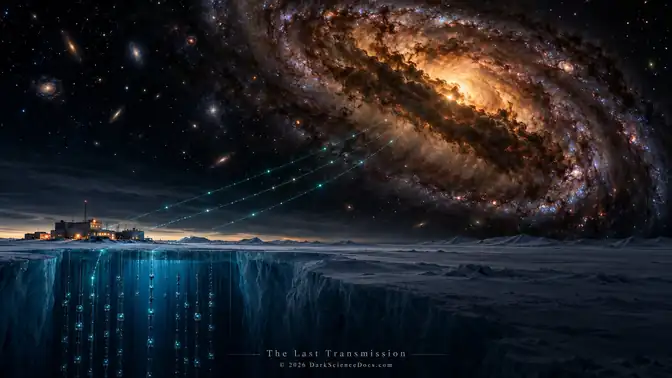
IceCube detects light from charged particles produced in neutrino interactions, then reconstructs event directions and energies. Its NGC 1068 analysis reports statistical evidence for a source against a background, rather than a photograph of the central black hole.
THE EVIDENCE MAP / RESEARCH
What Does NGC 1068’s Neutrino Signal Establish?
IceCube connects a directional excess of high-energy neutrinos with an obscured active galaxy. The signal opens a view of particle acceleration while leaving its exact location and mechanism unsettled.
- 01Measurement
What the instrument records
IceCube records the timing and intensity of light at sensors in Antarctic ice. That light is produced by charged particles associated with interactions, rather than a visible image of an arriving neutrino. Reconstruction estimates an event’s direction and energy with uncertainty. The source claim therefore comes from the distribution of reconstructed events and its comparison with expected backgrounds. A single attractive track display is not sufficient to identify an active galaxy.
- 02Interpretation
What makes a source association
A search tests whether events near a proposed direction exceed the expectation from background under a specified analysis. Angular uncertainty, energy information and the treatment of the search affect the inference. Statistical evidence for NGC 1068 means that the source interpretation is supported by that comparison; it does not mean every event in the region came from the galaxy. A reconstructed excess is a population result with an uncertainty budget.
- 03Competing explanation
The source is larger than a point in an illustration
The nucleus contains accreting matter, radiation, magnetic fields and surrounding gas. Different interaction regions can produce high-energy particles, and electromagnetic radiation may be absorbed before escaping. A neutrino association does not resolve those regions separately. Comparing the neutrino spectrum with X-ray and gamma-ray constraints can test proposed production sites, but the colored layers in a cutaway do not provide the spatial resolution that the detector lacks.
- 04Open test
What would improve the explanation
A stronger physical account would connect the source direction, energy distribution and electromagnetic constraints using one consistent model. Additional neutrino data can refine a signal; observations at other wavelengths can constrain the environment that produced it. A model that matches one part of the record while violating another needs revision. The appropriate conclusion is an evidence-supported source association with open production physics, rather than a complete view of the black hole’s surroundings.
OBSERVATION / INFERENCE / LIMIT
Read the signal.
Reconstructed event sample
IceCube detects light from charged particles produced in neutrino interactions, then reconstructs event directions and energies. Its NGC 1068 analysis reports statistical evidence for a source against a background, rather than a photograph of the central black hole.
A model-dependent explanation
IceCube connects a directional excess of high-energy neutrinos with an obscured active galaxy. The signal opens a view of particle acceleration while leaving its exact location and mechanism unsettled.
A stronger claim needs another test
The observations do not locate every interaction inside the nucleus or establish one unique acceleration process. Gas, magnetic fields and radiation all enter the interpretation, and gamma-ray absorption complicates comparison with electromagnetic observations.
INSIDE THE EVIDENCE
The chain of reasoning.
Each step has a different level of certainty. Follow the measured result into the explanation, then see where the trail ends.
What the instrument records
IceCube records the timing and intensity of light at sensors in Antarctic ice. That light is produced by charged particles associated with interactions, rather than a visible image of an arriving neutrino. Reconstruction estimates an event’s direction and energy with uncertainty. The source claim therefore comes from the distribution of reconstructed events and its comparison with expected backgrounds. A single attractive track display is not sufficient to identify an active galaxy.
What makes a source association
A search tests whether events near a proposed direction exceed the expectation from background under a specified analysis. Angular uncertainty, energy information and the treatment of the search affect the inference. Statistical evidence for NGC 1068 means that the source interpretation is supported by that comparison; it does not mean every event in the region came from the galaxy. A reconstructed excess is a population result with an uncertainty budget.
The source is larger than a point in an illustration
The nucleus contains accreting matter, radiation, magnetic fields and surrounding gas. Different interaction regions can produce high-energy particles, and electromagnetic radiation may be absorbed before escaping. A neutrino association does not resolve those regions separately. Comparing the neutrino spectrum with X-ray and gamma-ray constraints can test proposed production sites, but the colored layers in a cutaway do not provide the spatial resolution that the detector lacks.
How another team can examine the claim
IceCube’s public release supplies analysis inputs and scripts associated with the NGC 1068 result. Reproducing a published calculation checks that the route from those inputs to the reported result is accessible. It is different from gathering an independent detector dataset. Both are valuable: reanalysis can expose sensitivity to choices, while additional observations can test whether the inferred emission remains consistent as the event sample grows and instrumental conditions change.
What would improve the explanation
A stronger physical account would connect the source direction, energy distribution and electromagnetic constraints using one consistent model. Additional neutrino data can refine a signal; observations at other wavelengths can constrain the environment that produced it. A model that matches one part of the record while violating another needs revision. The appropriate conclusion is an evidence-supported source association with open production physics, rather than a complete view of the black hole’s surroundings.
THE EASY MISREADING
The observations do not locate every interaction inside the nucleus or establish one unique acceleration process. Gas, magnetic fields and radiation all enter the interpretation, and gamma-ray absorption complicates comparison with electromagnetic observations.
PRIMARY RESEARCH & MISSION RECORDS
Check the source.
These are the studies and mission records behind this explainer. The illustrated article and related research pages continue the investigation.
- https://icecube.wisc.edu/data-releases/2022/11/evidence-for-neutrino-emission-from-the-nearby-active-galaxy-ngc-1068/
- https://icecube.wisc.edu/news/press-releases/2022/11/icecube-neutrinos-give-us-first-glimpse-into-the-inner-depths-of-an-active-galaxy/
- https://icecube.wisc.edu/news/press-releases/2018/07/icecube-neutrinos-point-to-long-sought-cosmic-ray-accelerator/
- https://icecube.wisc.edu/news/research/2025/10/evidence-for-neutrino-emission-from-x-ray-emitting-galaxies/
- https://icecube.wisc.edu/news/research/2026/03/new-evidence-from-the-southern-hemisphere-links-neutrinos-to-x-ray-bright-active-galaxies/
- https://icecube.wisc.edu/news/press-releases/2023/06/our-galaxy-seen-through-a-new-lens-neutrinos-detected-by-icecube/
- https://www.nature.com/articles/s41586-021-03256-1
FOLLOW THE THREAD
Stay with the question.
IceCube connects a directional excess of high-energy neutrinos with an obscured active galaxy. The signal opens a view of particle acceleration while leaving its exact location and mechanism unsettled.
Explore the related science modelMORE EVIDENCE FILES
Keep looking.
EVIDENCE FILE 01 / EUROPA
How Do We Know Europa Has an Ocean?
Galileo's magnetic measurements point to a conducting layer beneath Europa's ice. A salty ocean is the leading explanation. Its chemistry and seafloor activity remain open questions.
Read the evidence
EVIDENCE FILE 02 / TITAN & PLUTO
What Is the 5.11-Micrometer Mark on Titan and Pluto?
The 5.11-micrometer absorption is measured on both worlds, but the Pluto feature is broader. A shared wavelength is a clue to investigate, not a chemical identification.
Read the evidence