
12 / RESEARCH / OBSERVATION & INTERPRETATION
NGC 1068: Reading a Hidden Nucleus with Neutrinos
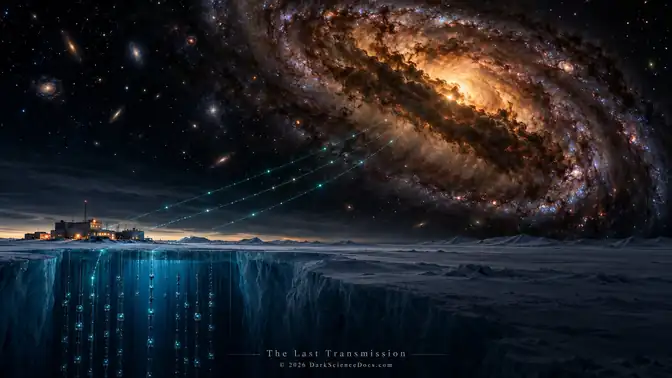
IceCube connects a directional excess of high-energy neutrinos with an obscured active galaxy. The signal opens a view of particle acceleration while leaving its exact location and mechanism unsettled.
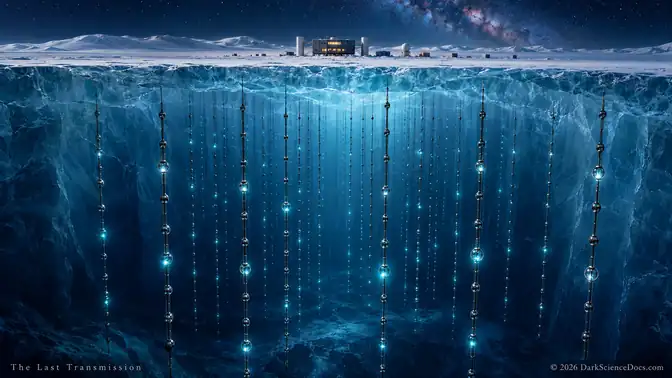
IceCube detects light from charged particles produced in neutrino interactions, then reconstructs event directions and energies. Its NGC 1068 analysis reports statistical evidence for a source against a background, rather than a photograph of the central black hole. The observations do not locate every interaction inside the nucleus or establish one unique acceleration process. Gas, magnetic fields and radiation all enter the interpretation, and gamma-ray absorption complicates comparison with electromagnetic observations.
A telescope built into the ice
Ordinary telescopes depend on light interacting with a detector. Mirrors collect photons, antennas respond to radio waves, and electronic sensors convert incoming radiation into measurable signals. They interact primarily through the weak nuclear force, and most pass through ordinary matter without leaving any detectable evidence of their presence. Even the planet beneath our feet is largely transparent to lower-energy neutrinos. A successful neutrino telescope therefore needs something that conventional observatories do not: an enormous volume of material in which the occasional particle interaction might occur. Scientists had already demonstrated that large volumes of water could serve this purpose. Neutrino experiments in Japan and Canada helped establish neutrino astronomy and transformed our understanding of particle physics.
From a flash to an inferred direction
When a neutrino passes through Antarctic ice, it usually leaves no detectable trace. Very occasionally, however, it interacts with a particle in the surrounding material. One possible outcome is the production of a muon, a heavier relative of the electron. If the newly created muon has enough energy, it can travel through the ice at a speed greater than light travels through that material. This does not violate Einstein’s speed limit. Nothing is outrunning light in a vacuum. Light moves more slowly through ice than through empty space, and the muon can exceed that reduced local speed. Much as an aircraft traveling faster than the speed of sound produces a sonic boom, a charged particle traveling faster than light propagates through the surrounding medium can generate a characteristic cone of radiation.
An obscured galaxy becomes a test
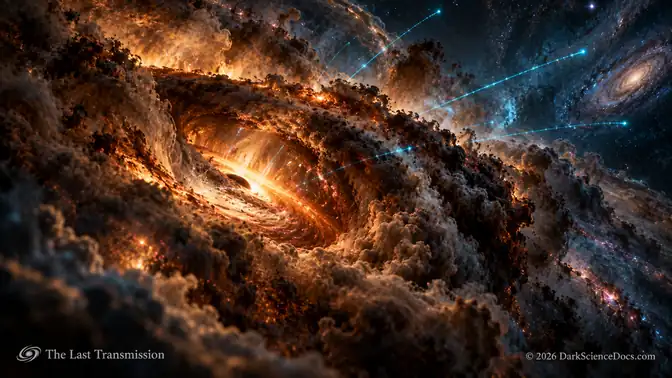
It is a beautiful spiral galaxy that has been studied for generations. Its central supermassive black hole powers an active galactic nucleus, but our view of its inner regions is partially obstructed by thick material surrounding the central engine. Unlike the blazar associated with the 2017 IceCube alert, NGC 1068 is not viewed along a dominant relativistic jet pointing directly at Earth. Its central environment includes dense gas, dust, and powerful radiation fields that complicate efforts to observe its innermost activity. High-energy gamma rays may be absorbed through interactions with radiation and matter before they can escape the vicinity of the black hole.
Read the illustrated companion article for the full narrative and its source trail. The selected passages above follow that article’s investigation.
Continue reading on SubstackTHE EVIDENCE / THE OPEN QUESTION
What we know.
IceCube detects light from charged particles produced in neutrino interactions, then reconstructs event directions and energies. Its NGC 1068 analysis reports statistical evidence for a source against a background, rather than a photograph of the central black hole.
What remains open.
The observations do not locate every interaction inside the nucleus or establish one unique acceleration process. Gas, magnetic fields and radiation all enter the interpretation, and gamma-ray absorption complicates comparison with electromagnetic observations.
Why it matters.
Combining neutrinos with electromagnetic measurements can test how active galaxies accelerate particles. A source association becomes more useful when its uncertainties and possible production sites remain visible alongside the striking artistic reconstruction.
GO DEEPER / EVIDENCE FILE
What Does NGC 1068’s Neutrino Signal Establish?
IceCube connects a directional excess of high-energy neutrinos with an obscured active galaxy. The signal opens a view of particle acceleration while leaving its exact location and mechanism unsettled.
COMPARE THE QUESTIONS
Follow what the light reveals.
Follow the relevant evidence and teaching models. Each model explains a mechanism and retains its own stated assumptions and limits.
FOLLOW THE EVIDENCE
Research behind the field note.
EXPLORE IN 3D / MAP G-01
Explore the related science model
Combining neutrinos with electromagnetic measurements can test how active galaxies accelerate particles. A source association becomes more useful when its uncertainties and possible production sites remain visible alongside the striking artistic reconstruction.
Open Sagittarius A* mapVISUAL EVIDENCE
Inside the investigation.
FOLLOW THE THREAD
Related signals.
The Black Hole Hid Its Light. The Neutrinos Escaped.
Scientists buried a telescope beneath Antarctica to catch particles from the universe’s most violent places. What they discovered is shocking.
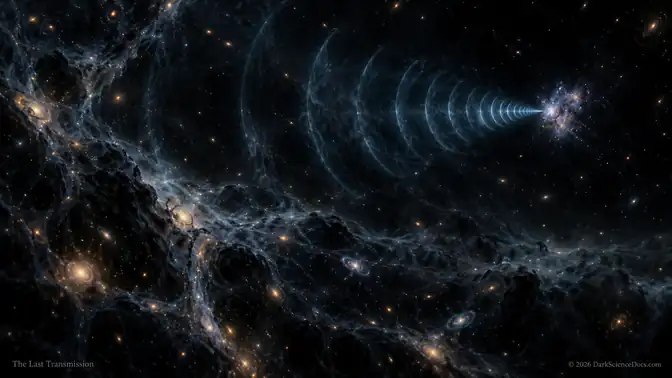
A Signal Crossed 10 Billion Years of Darkness. We Still Don't Know What Sent It.
The James Webb Space Telescope has traced an extraordinarily powerful radio flash to a galaxy so small that Earth's largest telescopes couldn't see it.
What If Dark Energy Comes From the Edge of the Universe?
At 14, Liam Desre won an international science prize for exploring a remarkable possibility: perhaps the force accelerating the cosmos is connected to the information we can never see.