
VISUAL ARCHIVE / IMAGE STORY
A Neighbor While Humans Watched
A reconstruction places an old stellar encounter beside the much shorter human story.
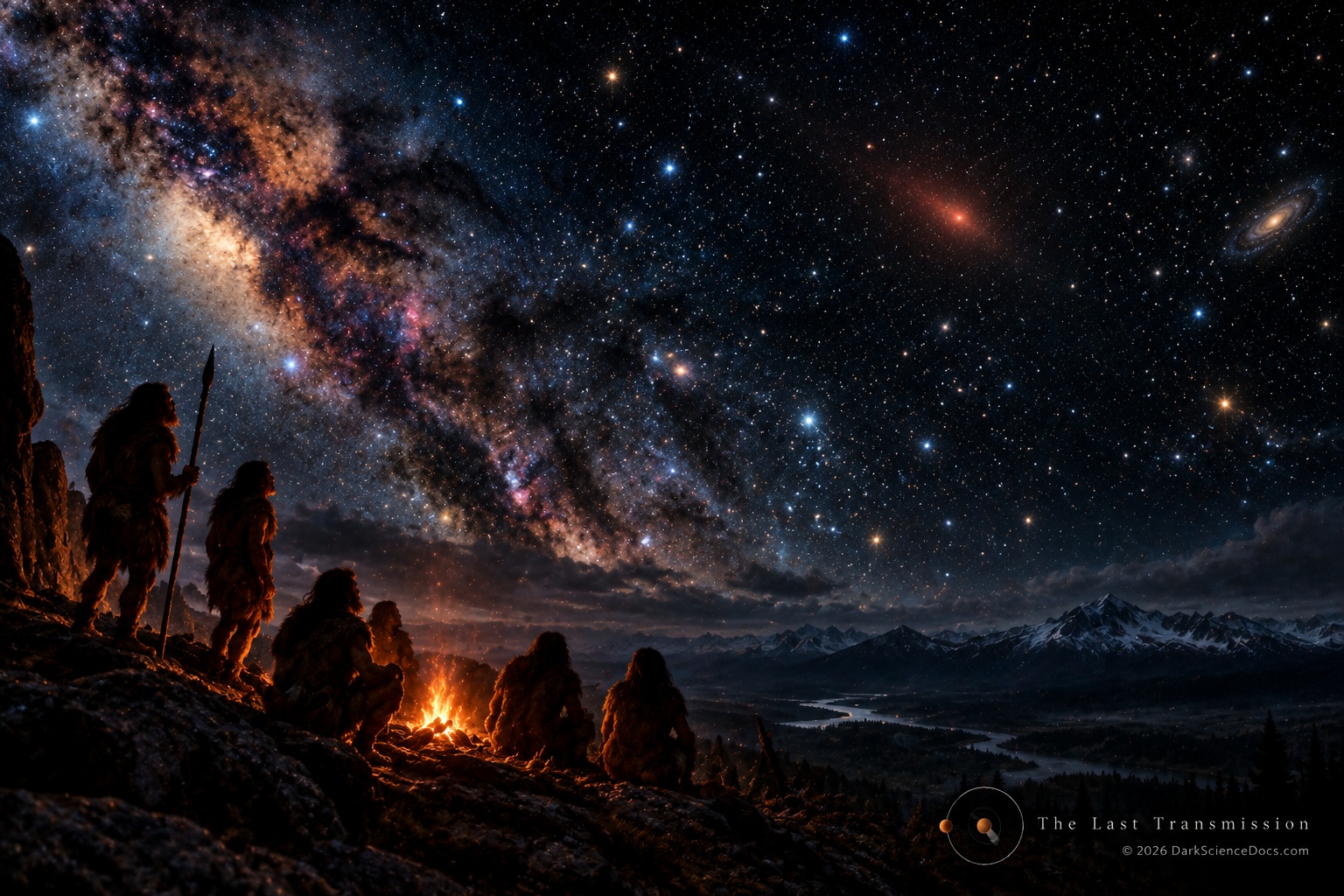
Scholz’s star, a faint red-dwarf system accompanied by a brown dwarf, passed about 0.8 light-years from the Sun roughly 70,000 years ago. Early Homo sapiens and Neanderthals were already alive on Earth while the binary system crossed the outer reaches of the Solar System. Conceptual illustration. The Last Transmission © 2026 DarkScienceDocs.com.
THE OBSERVATION
What we can actually see.
Measurements of Scholz’s star system support a past passage near the Solar System’s outer reaches. The prehistoric observers and visual sky are imagined; the existence of people then does not establish that they saw or recorded the faint system.
THE ILLUSTRATION
What the artwork imagines.
The composition visualizes this idea: A reconstruction places an old stellar encounter beside the much shorter human story. Scholz’s star, a faint red-dwarf system accompanied by a brown dwarf, passed about 0.8 light-years from the Sun roughly 70,000 years ago. Early Homo sapiens and Neanderthals were already alive on Earth while the binary system crossed the outer reaches of the Solar System. Conceptual illustration.
FROM THE ILLUSTRATED ARTICLE
The story that inspired it.
The article places the predicted Gliese 710 passage alongside proposed past stellar encounters and the distant Oort Cloud. Its story concerns changes over astronomical timescales, with encounter uncertainties and comet consequences kept separate. This frame focuses on a reconstruction places an old stellar encounter beside the much shorter human story.
Read A Star Is Coming for the Solar System. It Could Wake the Oort Cloud.CHECK THE RECORD
The image interprets the research below. Follow the original work for the measurements and limits behind the scene.
Research record: www.mdpi.com/2218-1997/12/9/258 Research record: doi.org/10.3847/PSJ/ae7a65 Research record: www.nature.com/articles/s41550-024-02349-x Research record: www.nature.com/articles/s41598-025-29033-y University of Rochester overview Research record: science.nasa.gov/solar-system/oort-cloud/facts/ Research record: www.esa.int/Science_Exploration/Space_Science/Gaia/Guide_to_our_galaxyOTHER IMAGE STORIES
Keep looking.
 A Visitor to the Distant Reservoir
 Beyond the Planetary Plane
 The Mark Shared by Titan and Pluto
EXPLORE IN 3D / MAP 12
Locate our neighborhood in the Milky Way
Find the Solar System’s neighborhood in an illustrated Milky Way. This provides Galactic context for stellar encounters without calculating Gliese 710’s future trajectory or an individual comet’s path.
Open Milky Way map