Look down on a galaxy we can only reconstruct from inside. Cross the spiral. Find one small star. Follow its worlds, or turn toward the mysteries beyond.
MILKY WAY / 12 GAIA-INFORMED RECONSTRUCTION · NOT A PHOTOGRAPH
Choose a region. Drag to tilt the galaxy; pinch or use the zoom buttons.
FILE 01 / MILKY WAY
The Milky Way
Our galaxy from an impossible vantage
How do we map a place we cannot leave?
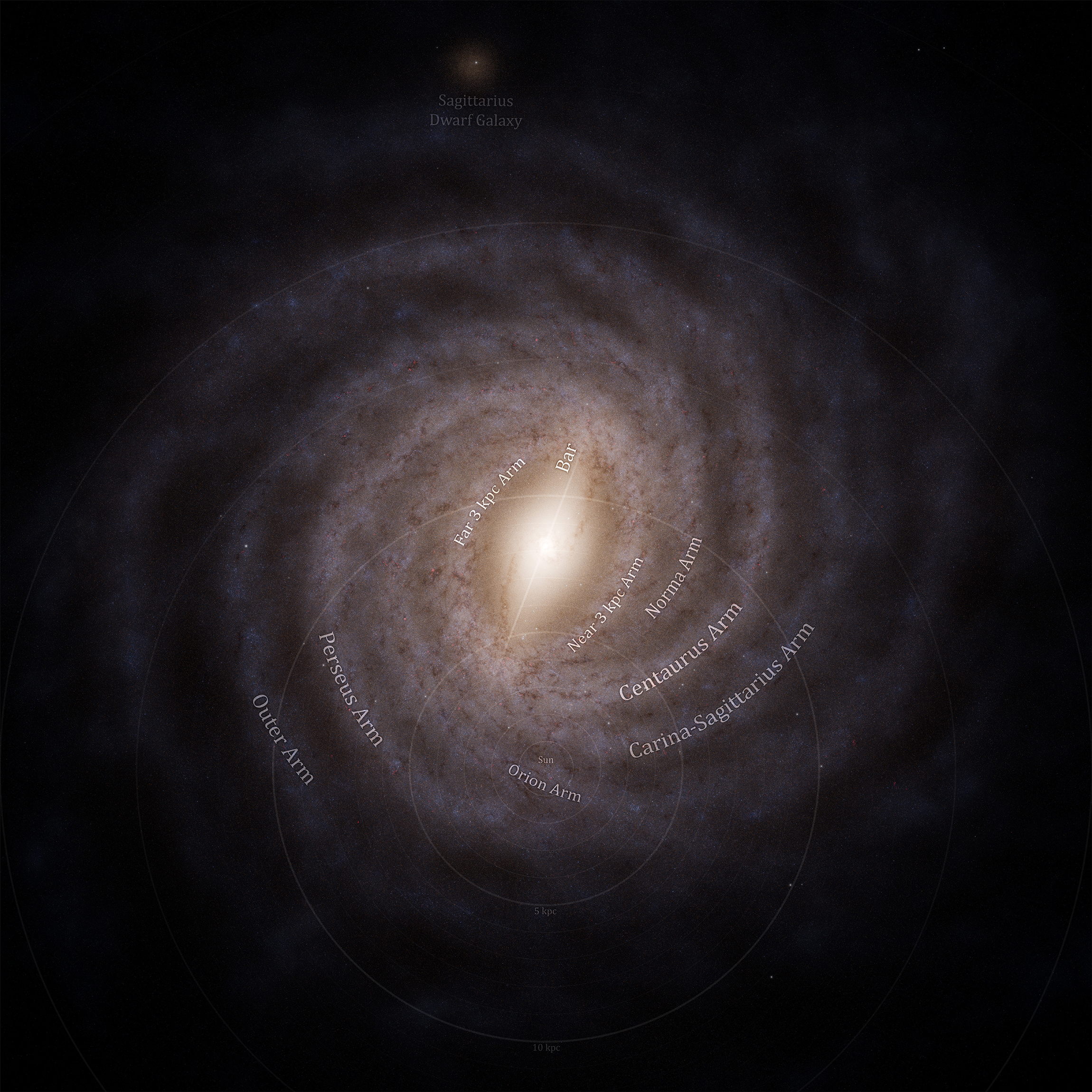
We see the Milky Way from inside its disk, where dust hides much of the view. Surveys measure stellar positions and motions, gas, and infrared light to build a picture of its barred center and spiral structure. ESA’s Gaia-based image below is an artist’s impression informed by those measurements. This interactive star field is another illustration of the broad structure, not a catalog of individually plotted Gaia stars. Even the positions of some outer arms have been revised by additional measurements.
Gaia-informed artist’s impression · ESA/Gaia/DPAC, Stefan Payne-Wardenaar · Original ↗ · CC BY-SA 3.0 IGO ↗. Image reproduced unaltered.
Where does the solar system sit in this immense disk?
The Sun is roughly 26,000 light-years from the Galactic Center in the local Orion Spur. The glowing marker shows that approximate galactic neighborhood, not the radius of our planetary system. Select it to change from the galaxy overview to an illustrative local-star scene, then enter any of the solar system maps below. That transition changes scale by thousands of times; the nearby stars in this scene are decorative, not mapped neighbors.
CHANGE SCALE / ENTER THE SOLAR SYSTEM
One star. An entire solar system to explore.
Choose an existing 3D map. The galaxy scene stays behind as your point of departure.
Sagittarius A* is a black hole of about four million solar masses at the Galactic Center. Astronomers measure stars moving around it; the S301 Evidence File follows one proposed route to testing the black hole’s spin with future orbital measurements. The luminous central bar in this scene represents stars, not visible light emitted by the black hole, and this overview does not show the scale of S301’s orbit. Enter the separate Sagittarius A* explorer below to change scale and investigate the black-hole exterior, light paths, a teaching orbit inspired by S2, and a probe-release experiment.
Researchers mapped a long chain of nearby star-forming clouds called the Radcliffe Wave. Motions of young stars indicate the structure oscillates through the galactic plane. That is a local, three-dimensional measurement, not a visible ripple wrapping every spiral arm. The galaxy view marks the broader disk only; it does not trace the wave’s precise shape or motion.
Did the solar system pass through a different neighborhood?
Stars orbit the Galaxy while interstellar clouds and nearby stellar groups change around them. Your position in the Milky Way today cannot by itself reveal the path the Sun took in the distant past. The two illustrated articles below follow proposed reconstructions and their possible effects on the heliosphere and Earth. No glowing route is drawn across this map because a single exact historical track has not been established here.
An extended stellar halo contains old stars and globular clusters, and faint satellite systems can be difficult to recognize against the foreground. A sparse concentration of stars may reveal an object long before it resembles a bright galaxy in an image. The atmospheric outer points in this viewer stand for a region, not observed positions of individual halo objects or a measured boundary.
Stellar motions imply more gravitating matter than the stars and gas we can see. Dark matter does not form a glowing shell around the picture; the faint boundary here merely invites you to ask about the missing mass. A proposed 43 GeV gamma-ray feature in three galaxy clusters is a separate, tentative particle clue, with the lack of a clear matching line in the inner Milky Way an important test. No bright ring or particle signal is drawn onto this galaxy.
This scene is an original, procedural artist’s reconstruction informed by ESA’s Gaia-based illustration, shown separately in the first research file. Stars, dust-like points, lighting, marker sizes, and the central glow are illustrative. They are not individual Gaia coordinates, observed colors, or a photo taken outside the Milky Way. Only the Sun’s approximate distance from the Galactic Center and its general Orion Spur neighborhood are asserted; none of the markers are precision coordinates. The dark matter halo is not drawn as if it emits light.
The Sun-neighborhood view is a deliberate change of scale, not a continuous spatially accurate flight from the 100,000-light-year disk into planetary orbits. Its surrounding stars are decorative.
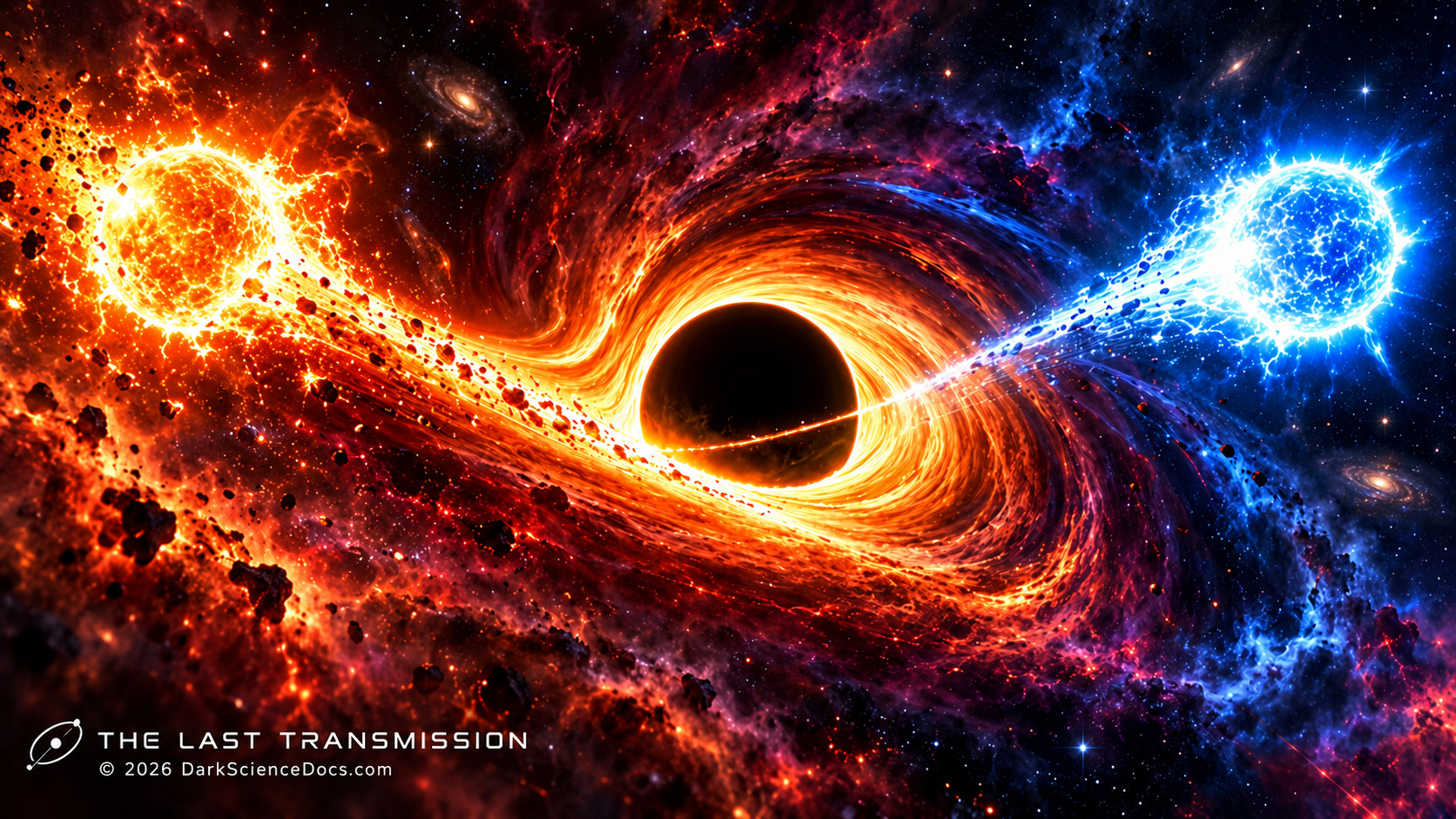
A runaway star’s motion points back to the Galactic Center, where a black hole may have broken a binary apart and sent its members toward very different futures.
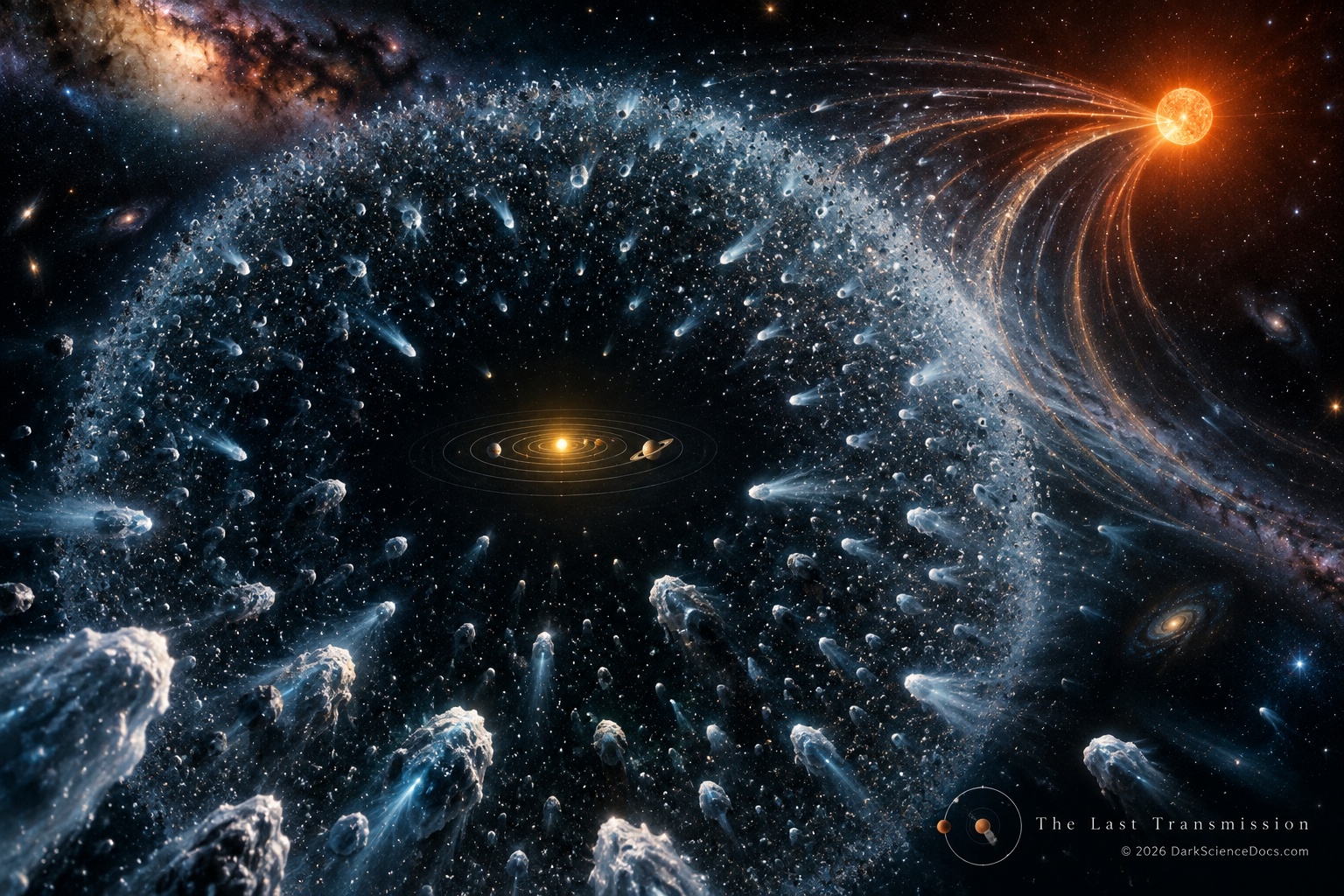
Gliese 710 will pass through our distant comet reservoir in roughly 1.3 million years. Earlier stellar visitors suggest the Solar System has never been as isolated as it feels.
We observe the Milky Way from within it, through obscuring material and incomplete distance records. The illustration organizes inferred structure and linked questions. Its smooth spiral form should not be mistaken for a photograph taken outside the galaxy.
Ask yourself Which assumptions drive this result, and where would the model stop being useful?
THE SIGNAL CONTINUES
Some discoveries stay with you.
Get the illustrated investigations delivered to your inbox. Then follow the questions that refuse to leave.