
VISUAL ARCHIVE / IMAGE STORY
Watching Between the Exposures
A cinematic observatory scene evokes the patient search for rapid changes in incoming starlight.
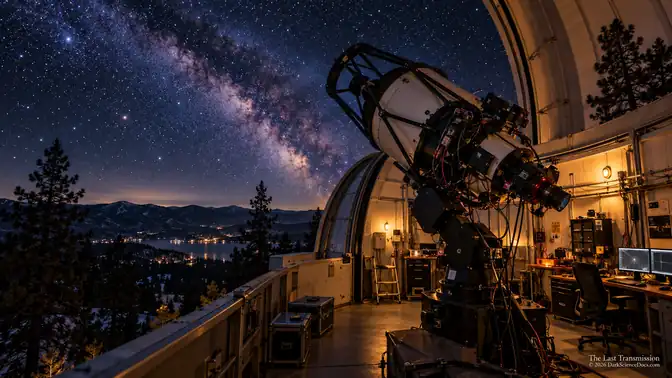
From a privately operated observatory near Big Bear, California, Richard Stanton searched the light of more than 1,300 Sun-like stars for rapid optical anomalies. His high-speed measurements revealed a pattern that conventional long-exposure astronomical images might miss.
THE OBSERVATION
What we can actually see.
The 2025 journal paper reports the HD 89389 pair and a comparison with an earlier record. A subsequent conference paper discusses three paired events in different stars and proposes synchronized telescopes. The 4.4-second separation belongs to the two observed disturbances in HD 89389’s light; it is not a measured gravitational-lensing delay.
THE ILLUSTRATION
What the artwork imagines.
The observatory, equipment and sky are AI-generated scenery, not a documentary photograph of Stanton’s instrument or site. The artwork is not a direct astronomical observation.
FROM THE ILLUSTRATED ARTICLE
The story that inspired it.
The article follows an unusual optical record into competing explanations and a possible timing experiment. From a privately operated observatory near Big Bear, California, Richard Stanton searched the light of more than 1,300 Sun-like stars for rapid optical anomalies. His high-speed measurements revealed a pattern that conventional long-exposure astronomical images might miss.
Read A Star Blinked Twice. Whatever Caused It May Be Much Closer to Earth.CHECK THE RECORD
The image interprets the research below. Follow the original work for the measurements and limits behind the scene.
Stanton (2025): Unexplained starlight pulses found in optical SETI searches — Acta Astronautica Stanton (2025): Telescope Arrays to Solve a Double Optical Pulse Mystery — SAS proceedings, pp. 79–84OTHER IMAGE STORIES
 A Star’s Light, an Unseen Cause
 A Pair of Disturbances, Imagined
 The Mark Shared by Titan and Pluto