
VISUAL ARCHIVE / IMAGE STORY
The Cluster Behind a Cosmic Question Mark
The galaxy cluster MACS J0417.5-1154 bends and magnifies light from more distant galaxies, producing distorted arcs and multiple images of the same background objects.
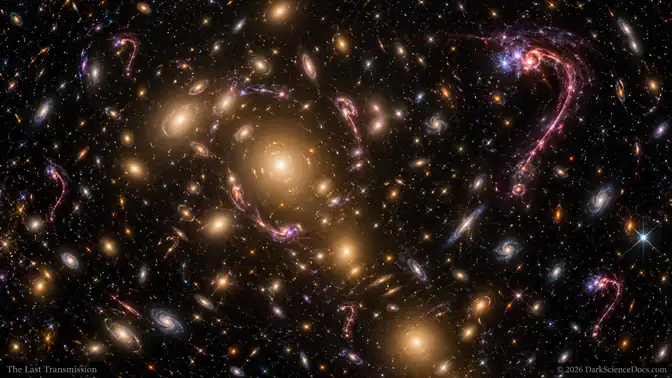
The galaxy cluster MACS J0417.5-1154 bends and magnifies light from more distant galaxies, producing distorted arcs and multiple images of the same background objects. The remarkable question-mark configuration contains the galaxy system in which Supernova Athena was discovered. Conceptual visualization inspired by Webb’s observations. AI-generated conceptual illustration; not a direct astronomical observation or mission photograph.
THE OBSERVATION
What we can actually see.
Strong gravitational lensing can produce multiple images with different arrival times. NASA’s September 2026 report describes Athena monitoring and a predicted return window extending to early March 2027. That published forecast is a model prediction, not a confirmed arrival date or a reported second detection.
THE ILLUSTRATION
What the artwork imagines.
The galaxy cluster MACS J0417.5-1154 bends and magnifies light from more distant galaxies, producing distorted arcs and multiple images of the same background objects. The remarkable question-mark configuration contains the galaxy system in which Supernova Athena was discovered. Conceptual visualization inspired by Webb’s observations. AI-generated conceptual illustration; not a direct astronomical observation or mission photograph. Colors, lighting, viewpoint and simultaneous arrangement are artistic choices. The frame supplies no instrument measurement, site survey or confirmation of a proposed mechanism.
FROM THE ILLUSTRATED ARTICLE
The story that inspired it.
A foreground cluster can send the light of one supernova toward Earth along several routes. Comparing their arrival times turns a repeated appearance into a test of the lens and cosmic distances. This artwork provides visual context for the illustrated article while its scientific claims remain tied to the linked research and mission records.
Read A Star Died 6.5 Billion Years Ago. Its Explosion Is About to Arrive Again.CHECK THE RECORD
The image interprets the research below. Follow the original work for the measurements and limits behind the scene.
NASA: Hubble monitoring of supernova Athena (September 2026) VENUS collaboration: strongly lensed supernova research NASA: the predicted reappearance of supernova RefsdalOTHER IMAGE STORIES
 A Supernova Seen Along Different Paths
 Searching for a Point of Light
 The Mark Shared by Titan and Pluto