
VISUAL ARCHIVE / IMAGE STORY
The Shorter-Lived Clock
Plutonium-244 has a half-life of approximately 81 million years, while curium-247 decays much faster, with a half-life of about 15.6 million years.

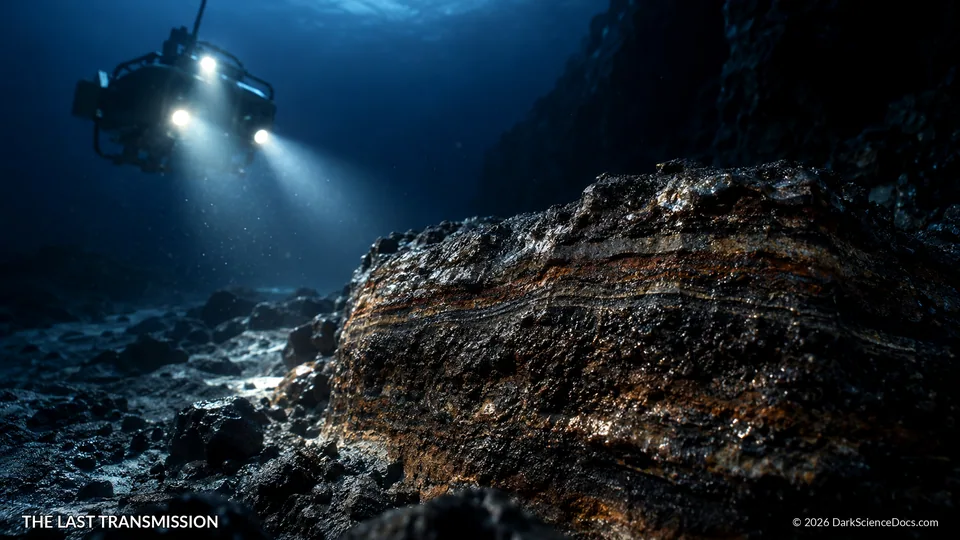
Plutonium-244 has a half-life of approximately 81 million years, while curium-247 decays much faster, with a half-life of about 15.6 million years. The absence of a significant interstellar curium signal constrains the age of the ancient event responsible for the plutonium. AI-generated conceptual illustration.
THE OBSERVATION
What we can actually see.
The reported plutonium influx is not significantly correlated with the better-defined iron-60 deposition peaks associated with nearby supernova-related material. Under a conserved curium-to-plutonium ratio, the curium limit yields an age bound above roughly 70 million years. Applying the authors’ estimated relative chemical enrichment in the crust moves the bound above about 95 million years. These are production-age constraints, not the age of the sampled crust layer.
THE ILLUSTRATION
What the artwork imagines.
Plutonium-244 has a half-life of approximately 81 million years, while curium-247 decays much faster, with a half-life of about 15.6 million years. The absence of a significant interstellar curium signal constrains the age of the ancient event responsible for the plutonium. AI-generated conceptual illustration. The viewpoint, illumination, colors and simultaneous arrangement are artistic choices. This is a cinematic illustration, not a direct instrument image or a quantitative reconstruction of every feature.
FROM THE ILLUSTRATED ARTICLE
The story that inspired it.
Traces of plutonium-244 in Pacific crust carry a record of heavy-element production beyond Earth. Missing curium helps constrain when that production occurred, but the oldest headline estimate depends on how the crust incorporated the elements. This frame focuses on the shorter-lived clock, within the complete illustrated article and its source-linked research context.
Read They Found Plutonium at the Bottom of the Pacific. The Explosion That Made It May Be Over 95 Million Years Old.CHECK THE RECORD
The image interprets the research below. Follow the original work for the measurements and limits behind the scene.
The timing of the last r-process event near Earth from interstellar 60Fe, 244Pu and 247Cm deposition on Earth Wallner and colleagues: open Nature Astronomy articleOTHER IMAGE STORIES
Keep looking.
 A Galactic Archive on the Ocean Floor
 Layers of Ferromanganese Crust
 The Mark Shared by Titan and Pluto
EXPLORE IN 3D / ATLAS S-01
Compare stellar evolutionary pathways
Explore a teaching model of stellar stages and remnants. It is not a fitted simulation of this particular star or the unidentified isotope source.
Explore Stellar Fates in 3D