
11 / Interstellar material / the isotope archive
An Ocean Crust Holding an Older Galactic Clock
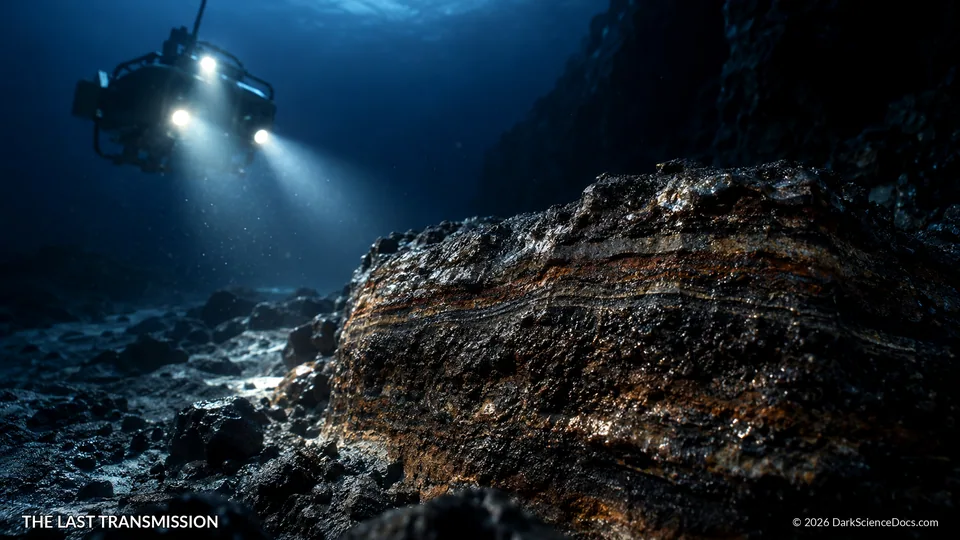
Traces of plutonium-244 in Pacific crust carry a record of heavy-element production beyond Earth. Missing curium helps constrain when that production occurred, but the oldest headline estimate depends on how the crust incorporated the elements.
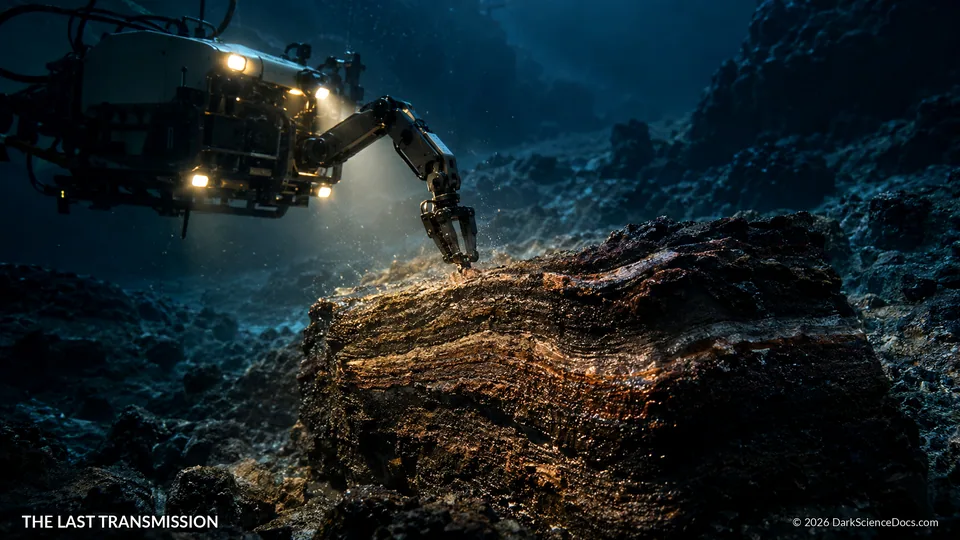
A slowly growing ferromanganese crust can collect material that reaches the ocean floor over millions of years. Isolating an interstellar isotope signal requires dating that archive, measuring extremely small abundances and separating extraterrestrial input from terrestrial contamination. Plutonium-244 survives long enough to preserve information about older rapid-neutron-capture production. Curium-247 fades more quickly, making its absence informative when compared with the plutonium. The analysis therefore combines a positive detection, a nondetection and assumptions about how material traveled and became part of the sample.
The full investigation continues with the evidence, illustrations, and sources at The Last Transmission on Substack.
Continue reading on SubstackTHE EVIDENCE / THE OPEN QUESTION
What we know.
The reported plutonium influx is not significantly correlated with the better-defined iron-60 deposition peaks associated with nearby supernova-related material. Under a conserved curium-to-plutonium ratio, the curium limit yields an age bound above roughly 70 million years. Applying the authors’ estimated relative chemical enrichment in the crust moves the bound above about 95 million years. These are production-age constraints, not the age of the sampled crust layer.
What remains open.
The source event has not been located or identified. A neutron-star merger is a leading setting for r-process production, but this sample does not prove that a particular merger made these atoms. Interstellar transport, redistribution by later events and unequal crust uptake all affect the inference. The model-dependent greater-than-95-million-year estimate should remain visibly tied to its chemical correction.
Why it matters.
The ocean floor can preserve a form of astronomical evidence that never arrived as a telescope image. Comparing isotopes with different half-lives helps separate production from recent delivery. Additional independent archives and better uptake constraints could sharpen the clock while keeping the source event an open question.
GO DEEPER / EVIDENCE FILE
How Can Plutonium and Missing Curium Date a Galactic Event?
Follow plutonium detection, a curium limit, unequal radioactive decay and crust uptake into a qualified age constraint for an unidentified r-process source.
FOLLOW THE EVIDENCE
Research behind the field note.
EXPLORE IN 3D / ATLAS S-01
Compare stellar evolutionary pathways
Explore a teaching model of stellar stages and remnants. It is not a fitted simulation of this particular star or the unidentified isotope source.
Explore Stellar Fates in 3DVISUAL EVIDENCE
Inside the investigation.
FOLLOW THE THREAD
Related signals.
A Star Blinked Twice. Whatever Caused It May Be Much Closer to Earth.
Two nearly identical optical disturbances, 4.4 seconds apart, appeared in HD 89389’s light. Follow the unexplained record, a foreground diffraction hypothesis, and the synchronized telescopes proposed to test it.
What If the Universe Is Accelerating Because Stars Die?
For nearly three decades, scientists have struggled to identify the mysterious force accelerating the expansion of the universe. Now a radical theory suggests the answer.
A Star Died 6.5 Billion Years Ago. Its Explosion Is About to Arrive Again.
NASA is watching for a supernova we have already seen. When that light finally reaches Earth, it could help answer one of the most troubling questions in modern cosmology.