
VISUAL ARCHIVE / IMAGE STORY
The Signal Recovered as Kepler-1649c
Kepler-1649c was recovered when researchers reconsidered a signal previously rejected by automated analysis.
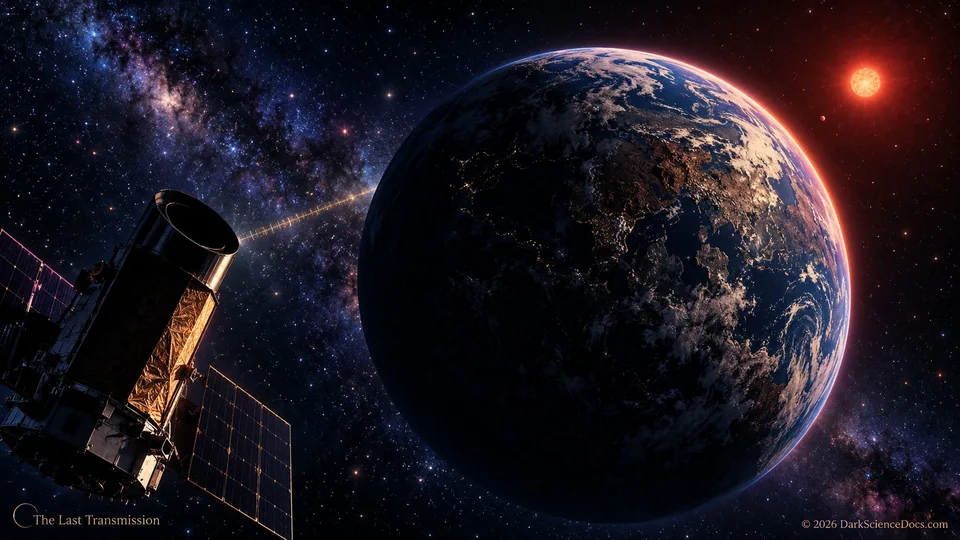
Kepler-1649c was recovered when researchers reconsidered a signal previously rejected by automated analysis. The planet’s size and stellar heating resemble Earth’s, but its atmosphere and surface remain unknown. Artist’s concept.
THE OBSERVATION
What we can actually see.
Superhabitability is a comparative framework, and published candidate lists include objects whose planetary status or environmental properties still need confirmation. The atmospheric dispute at LHS 1140 b makes the problem concrete. A ground-based helium claim and subsequent Webb nondetections concern escaping gas under particular observing conditions. Two Webb analyses use the same four transits, so they must not be counted as eight separate visits.
THE ILLUSTRATION
What the artwork imagines.
Kepler-1649c was recovered when researchers reconsidered a signal previously rejected by automated analysis. The planet’s size and stellar heating resemble Earth’s, but its atmosphere and surface remain unknown. Artist’s concept. The viewpoint, illumination, colors and simultaneous arrangement are artistic choices. This is a cinematic illustration, not a direct instrument image or a quantitative reconstruction of every feature.
FROM THE ILLUSTRATED ARTICLE
The story that inspired it.
A temperate orbit is a promising address, but a livable planet also needs a history that preserves the right surface conditions. The superhabitable-world idea turns that gap into a testable research question. This frame focuses on the signal recovered as kepler-1649c, within the complete illustrated article and its source-linked research context.
Read The Planets That Could Be Better Than Earth Have One Terrifying ProblemCHECK THE RECORD
The image interprets the research below. Follow the original work for the measurements and limits behind the scene.
In Search for a Planet Better than Earth: Top Contenders for a Superhabitable World KOI-5715.01 Helium escaping from the atmosphere of a nearby rocky exoplanet orbiting in a habitable zone No Helium Detected in LHS 1140 b from Four JWST NIRISS/SOSS Transits No Persistent Helium Absorption in LHS 1140 b: Four JWST/NIRISS SOSS Transits and Multi-epoch Stellar He I VariabilityOTHER IMAGE STORIES
Keep looking.
 An Unconfirmed Better Earth
 Two Climates Under One Sun
 The Mark Shared by Titan and Pluto
EXPLORE IN 3D / MAP 06
Explore Earth and the Moon
Compare the nearby Earth–Moon system in an interactive teaching model. The explorer does not reconstruct the impact event or an unmeasured exoplanet climate.
Open Earth & Moon map