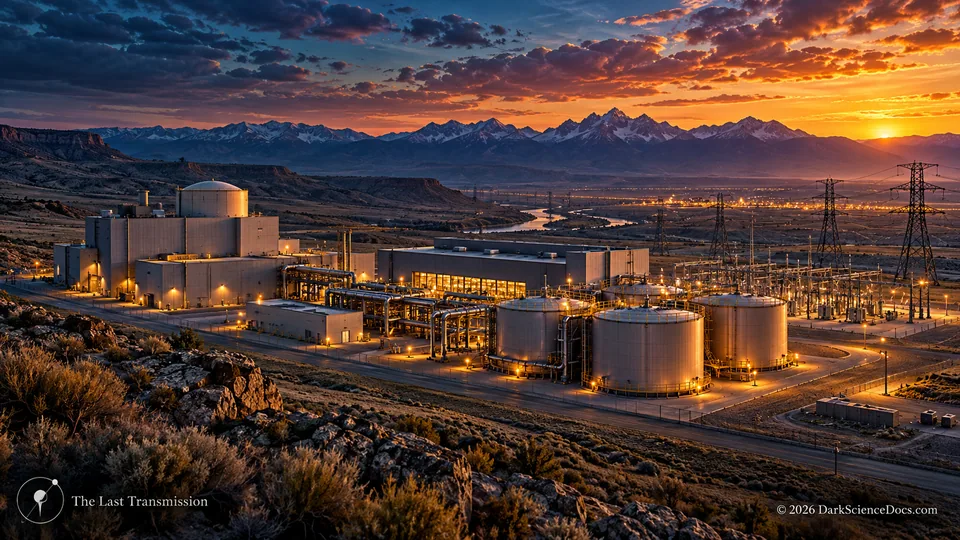
DOCUMENTARIES / THE LAST TRANSMISSION
What Happens If the Electricity Grid Collapses?
The grid coordinates generation, transmission, protection, and control. A long outage reaches far beyond a dark room.
On YouTube: The Complete Timeline of What Happens If The Grid Goes Down
If the player is unavailable, watch directly on YouTube ↗
THE QUESTION BEHIND THE FILM
Which systems fail after the lights go out?
ORIGINAL VIEWING GUIDE
Look closer.
Follow dependencies
Electricity serves water treatment, communications, fuel delivery, refrigeration, and medical care. A local interruption and a widespread, prolonged outage have very different effects.
Recovery is an engineering task
Grid operators isolate faults, balance supply and demand, and restore service in stages. The film’s darker scenario is useful when it makes these dependencies visible rather than treating every outage as permanent collapse.
A risk has several causes
Storms, equipment failures, and other disruptions do not share one probability or duration. Assess the scale and evidence for each scenario before treating a possible chain reaction as inevitable.
THE EVIDENCE TRAIL / RESEARCH COMPANION
What the record says.
A power outage exposes the links between electricity and other services. The severity depends on where power fails, for how long, and which backup and restoration systems work.
CHOOSE A CLUE / FOLLOW THE RECORD
These are research waypoints, not video timestamps. Explore them in any order, then return to the film.
Water depends on electrical systems
Observed or documented
Drinking-water and wastewater utilities use powered pumps, controls, and treatment processes. EPA publishes emergency checklists so operators can prepare for failures and restore safe service.
What it suggests
A prolonged outage can become a water problem even when a pipe has not broken. Backup supply, fuel, and access to repair crews influence the path of failure.
Where the claim stops
The timing differs by utility and storage capacity. A loss of power is not proof that every water system immediately becomes unsafe.
Restarting a grid needs a sequence
Observed or documented
FERC and NERC examine blackstart resources: generators and procedures that can begin restoring service when a wide area lacks external power.
What it suggests
Grid restoration is an engineered process of energizing equipment and matching load to available generation, not simply flipping a master switch.
Where the claim stops
A plan and available equipment do not guarantee instantaneous recovery. Damage, fuel, communications, and weather can complicate the sequence.
Dependencies can amplify a disruption
Observed or documented
Water treatment, communications, and fuel delivery may each need electricity, while electrical crews themselves need transport, coordination, and access to equipment.
What it suggests
A sufficiently broad, prolonged interruption can create cascading difficulties. Studying links between sectors identifies which facilities need protected supplies or realistic contingencies.
Where the claim stops
The effects are highly local and time-dependent. A small outage and a regional infrastructure disaster should not be assigned the same consequences.
Different hazards imply different recovery paths
Observed or documented
Grid operators monitor and isolate faults; regulators study restoration readiness. Severe weather, a damaged substation, and a system-wide imbalance call for different responses.
What it suggests
The most useful questions are what failed, which loads are critical, what can be islanded, and what resources can start without a functioning grid.
Where the claim stops
A documentary scenario illustrates dependencies, but it cannot predict the exact sequence of failures in every city without local engineering data.
Which critical service in your community has the shortest backup-power window, and does the restoration plan account for its dependencies?
FOLLOW THE EVIDENCE
Keep the question open.
Watch the documentary, check the research, and continue into the illustrated archive.
MORE DOCUMENTARIES
 Everything You Need to Know About the 1977 Wow Signal
 The Dark Forest Theory: The Terrifying Answer to the Fermi Paradox
 The Complete Guide to Spacetime Shortcuts: The Krasnikov Tube vs Alcubierre Drive