DOCUMENTARIES / THE LAST TRANSMISSION
Everything You Need to Know About the 1977 Wow Signal
One narrowband radio event in 1977 became a lasting symbol of the search for extraterrestrial intelligence. It has never been confirmed as an alien transmission.
If the player is unavailable, watch directly on YouTube ↗
THE QUESTION BEHIND THE FILM
How much can we learn from a signal that was detected only once?
ORIGINAL VIEWING GUIDE
Look closer.
The famous printout
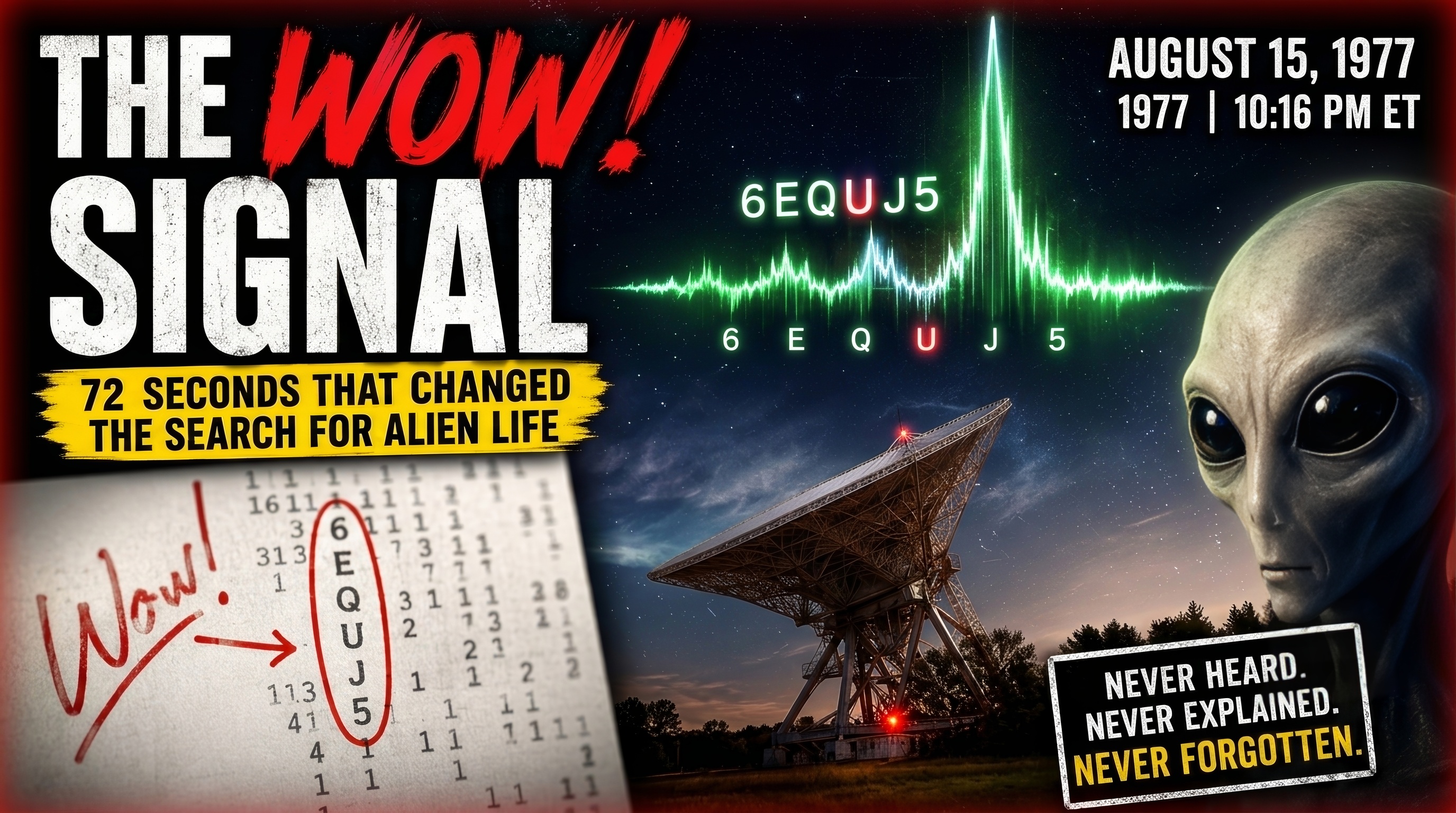
Ohio State’s Big Ear radio telescope recorded a strong, narrowband signal in August 1977. Jerry Ehman circled the sequence on the printout and wrote the word that gave it a name.
Follow-up is the hard part
A candidate signal becomes a discovery when it can be independently checked and natural or human sources can be ruled out. The Wow signal has not been redetected despite later searches.
Keep the mystery precise
The event is intriguing because of its strength and narrow bandwidth. Its single appearance leaves the origin unresolved, so any confident account of a sender goes beyond the evidence.
THE EVIDENCE TRAIL / RESEARCH COMPANION
What the record says.
One printout from an Ohio radio telescope became one of SETI’s most memorable observations. Its strength and narrow frequency made it interesting; its failure to recur makes its origin difficult to establish.
CHOOSE A CLUE / FOLLOW THE RECORD
These are research waypoints, not video timestamps. Explore them in any order, then return to the film.
Big Ear recorded an unusual event
Observed or documented
Ohio State’s Big Ear telescope registered a strong narrowband signal on August 15, 1977. Jerry Ehman later circled the “6EQUJ5” sequence on the computer printout and wrote “Wow!”
What it suggests
The sequence encoded relative signal strength in successive time intervals; it was not an alien sentence. Its shape drew attention because it resembled a source passing through the telescope’s beam.
Where the claim stops
The printout documents a candidate radio event. It does not identify the transmitter, its distance, or even whether its source was astronomical.
The observing window shaped the record
Observed or documented
Big Ear’s scanning arrangement and Earth’s rotation limited the time a source would remain in its receiving beam. The event occupied the available observation window of roughly 72 seconds.
What it suggests
That duration is a property of the telescope’s encounter with a possible source, not evidence that a transmitter switched on for exactly 72 seconds.
Where the claim stops
The instrument’s beam and receiver channels also leave uncertainty about the precise sky location. A single passage cannot provide a full light curve.
Narrowband makes the signal worth testing
Observed or documented
The recorded power was concentrated in a narrow frequency band near the hydrogen line. Radio SETI values narrowband candidates because many natural astrophysical sources emit over broader ranges.
What it suggests
A narrow spectrum makes an artificial transmitter worth considering, alongside terrestrial interference and natural or instrumental possibilities.
Where the claim stops
Interesting spectral shape is not proof of engineering. Identifying a source requires independent confirmation and exclusion of nearby human-made signals.
Follow-up did not recover it
Observed or documented
The Ohio State observatory and later searches looked for a repeat from the relevant direction but did not establish a recurring source matching the original event.
What it suggests
A second independent detection with stable localization would have changed the evidentiary picture dramatically; the missing repeat leaves several explanations viable.
Where the claim stops
“Unexplained” is an honest description of the record. It does not mean the origin must be alien or that an exact natural cause has been proven.
What observation could turn a memorable single radio event into a reproducible source with a defensible location and origin?
FOLLOW THE EVIDENCE
Keep the question open.
Watch the documentary, check the research, and continue into the illustrated archive.
MORE DOCUMENTARIES
 The Dark Forest Theory: The Terrifying Answer to the Fermi Paradox
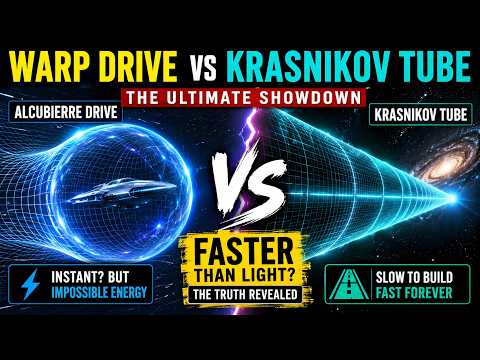 The Complete Guide to Spacetime Shortcuts: The Krasnikov Tube vs Alcubierre Drive
 Solar Storms vs. the Power Grid