
SCIENCE COUNTDOWNS / SKYWATCHING / NOVEMBER SUPERMOON
November 2026 Supermoon Countdown
The Moon’s familiar face, a different distance
A nearby full Moon opens a chance to separate a real change in apparent size from the powerful illusion at the horizon.
Upcoming sky event; visibility depends on your location, weather and horizon.
Until the published full-Moon instant; local moonrise occurs at a different time
Remind me to check the outcome
Choose your calendar
Check for results and the latest update on at 9:00 a.m. in your calendar’s time zone, two days after the listed event day.
This is one reminder with a link to this event file. Review the time and notification before saving. Updates may take longer; the reminder does not mean an outcome has been confirmed.
Saved reminders won’t change if the event is rescheduled. Remove the old reminder and add a new one from this page. Add it once; alerts depend on your calendar and device settings.
Need another way?
Download the calendar file (.ics) and open it in your calendar. For Outlook on the web, choose Add calendar → Upload from file. For Google Calendar on a computer, choose Settings → Import & export → Import.
Check that the reminder date above is still in the future before adding it.
This reminder date has passed. Read the latest status in the event file.
No email signup. We don’t receive your calendar details.
WHERE THE SCIENCE STANDS
A changing distance, a subtle difference.
NASA lists November 24, 2026, at 14:54 UTC as an upcoming full supermoon. The term describes a full Moon near the closer part of its elliptical orbit. The published full-Moon instant is worldwide, but the time the Moon rises above your own horizon is local.
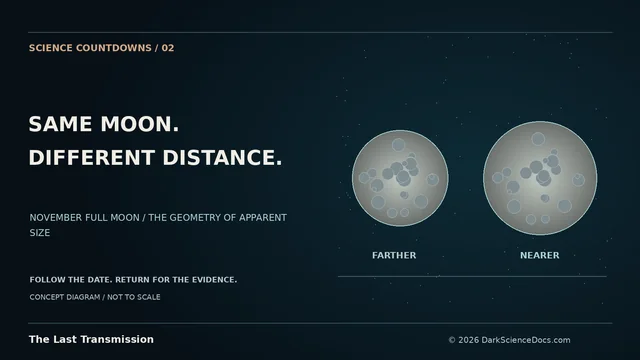
A closer Moon has a larger angular diameter than a more distant one. That difference is much less dramatic than many telephoto composites suggest. Its striking appearance near buildings or trees can also involve the Moon illusion, which is different from a physical change in distance.
If conditions permit, compare photographs taken with the same camera settings and focal length across different full Moons. Keep the original files and note the time and location. This page will remain a place to compare the geometry, observations and explanations after the date passes.
WHY THE SCIENCE MATTERS
Questions worth returning for.
Can you measure the difference?
Keep focal length, image scale and processing consistent. Measure the lunar disk in pixels before interpreting a comparison. A photograph cropped more tightly can make an ordinary full Moon look larger without recording a larger angular size.
Why does moonrise look enormous?
The horizon view can change our perception. Compare a photograph with a direct measurement of the disk rather than assuming that the impression of size is a measurement. Nearby landscape features can make the scene especially persuasive.
When should you look?
Check local moonrise and weather. The full-Moon instant may occur while the Moon is below your horizon or during daylight. The evenings around the listed date can still offer useful views; a countdown cannot predict clear skies.
CONTINUE THE INVESTIGATION
Follow the thread.
Explore the science before the milestone, then return to compare what the evidence establishes.
DATE & SCIENCE SOURCES
NASA’s supermoon calendar lists November 24, 2026, at 14:54 UTC. The clock counts to that full-Moon instant, not to local moonrise or the exact moment of perigee. “Supermoon” is a descriptive term; it does not guarantee an unusually dramatic naked-eye appearance.
Source and schedule review: . Published precision retained where no firmer target is verified. Check the primary source for later changes; a clock reaching zero does not confirm an outcome.