
SCIENCE COUNTDOWNS / NASA / NOAA / LIBERA ON JPSS-4
Libera Earth Energy Mission Launch Countdown
Taking Earth’s energy account into orbit
A new instrument will continue the record of energy leaving Earth, helping researchers test why the planet gains or loses heat.
Planned launch month; no firm launch day used for this clock.
Until the planned September launch window begins; an exact launch date is not published here
Calendar reminder available once a firm event day is listed. This clock marks a planned month, not an exact event date.
WHERE THE SCIENCE STANDS
Following the energy that leaves Earth.
NASA lists September 2027 for Libera’s launch aboard JPSS-4, the next Joint Polar Satellite System spacecraft. The instrument is designed to continue the long record of Earth’s outgoing radiation measured by CERES instruments. NOAA identifies the spacecraft’s future on-orbit name as NOAA-22.
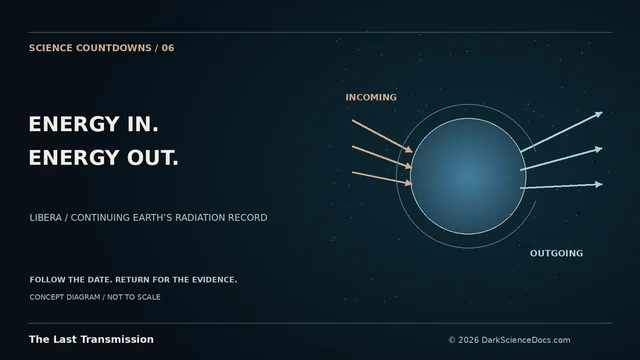
Earth absorbs energy from sunlight and sends energy back to space. Measuring outgoing radiation helps researchers examine the balance between those flows. A sustained imbalance can change the energy stored in the climate system; a long, consistent record helps separate a trend from shorter variations.
Launch is the beginning of an observing mission, not the date of a new climate conclusion. Instrument checkout, calibration, comparison with earlier records and documented data releases all matter. Return for the launch status first, then follow the evidence as the measurement record develops.
WHY THE SCIENCE MATTERS
Questions worth returning for.
Why preserve a long record?
A trend can be confused with a change in instrument response if one sensor replaces another without careful comparison. Look for calibration documentation and continuity checks, not just a headline about a new satellite.
What does an energy imbalance mean?
Compare incoming and outgoing energy over a suitable area and time period. A local warm afternoon is not a measurement of the global radiation budget. Distinguish the quantity being measured from the experiences used to illustrate it.
What follows a successful launch?
Spacecraft deployment, instrument checkout and validated data access are different milestones. A useful follow-up explains which stage has been confirmed and what can actually be measured with the released products.
CONTINUE THE INVESTIGATION
Follow the thread.
Explore the science before the milestone, then return to compare what the evidence establishes.
DATE & SCIENCE SOURCES
NASA’s Libera mission page lists September 2027. This clock uses September 1 at 00:00 UTC only as the beginning of that planned month, not as a launch appointment. NOAA describes the mission as flying on JPSS-4 in 2027. A calendar return reminder will be offered when a firm launch day is published.
Source and schedule review: . Published precision retained where no firmer target is verified. Check the primary source for later changes; a clock reaching zero does not confirm an outcome.