
SCIENCE COUNTDOWNS / NASA / VOYAGER 1
Voyager 1 One Light-Day Countdown
The reply that takes two days
Humanity’s most distant spacecraft approaches a point where even light needs a full day to cross the gap back to Earth.
Upcoming distance milestone; NASA prediction reviewed November 3, 2026.
Until NASA’s predicted one-light-day milestone from Earth
Remind me to check the outcome
Choose your calendar
Check for results and the latest update on at 9:00 a.m. in your calendar’s time zone, two days after the listed event day.
This is one reminder with a link to this event file. Review the time and notification before saving. Updates may take longer; the reminder does not mean an outcome has been confirmed.
Saved reminders won’t change if the event is rescheduled. Remove the old reminder and add a new one from this page. Add it once; alerts depend on your calendar and device settings.
Need another way?
Download the calendar file (.ics) and open it in your calendar. For Outlook on the web, choose Add calendar → Upload from file. For Google Calendar on a computer, choose Settings → Import & export → Import.
Check that the reminder date above is still in the future before adding it.
This reminder date has passed. Read the latest status in the event file.
No email signup. We don’t receive your calendar details.
WHERE THE SCIENCE STANDS
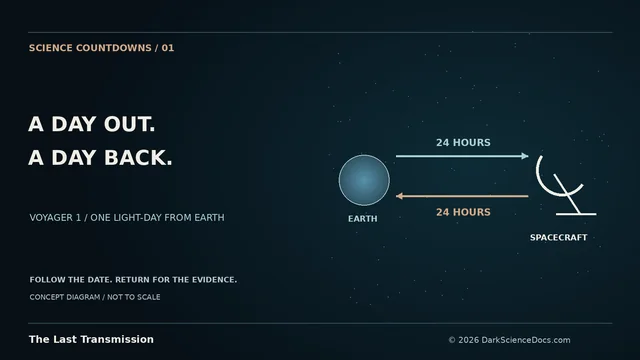
A day out. A day back.
NASA predicts that Voyager 1 will be one light-day from Earth on November 18, 2026, at 10:16:07 UTC. That is about 16.1 billion miles (25.9 billion kilometers). This target concerns distance from Earth, rather than the Sun; the distinction matters because Earth moves along its own orbit.
A one-way radio signal then takes 24 hours to cross that distance. A reply would require another day of travel, plus any time needed to process the command and arrange communications. The milestone does not create a new boundary in space or change the spacecraft’s surroundings.
Voyager is already exploring interstellar space. This next marker is an opportunity to understand how scientists operate a distant instrument with a very long conversation between question and answer. Return for the mission update and the measurements behind the predicted crossing.
WHY THE SCIENCE MATTERS
Questions worth returning for.
What does “one light-day” measure?
It describes distance using the travel time of light. Try the Scale Lab, then compare one-way light time with a complete command-and-reply exchange. A long communication delay does not mean the spacecraft’s clock has stopped or that its signal has slowed down.
Why specify “from Earth”?
A distance needs a reference point. Earth and the spacecraft both move, so Earth-distance and Sun-distance need not cross a chosen threshold together. Check which reference the mission tracker uses before comparing apparently different numbers.
What should we check afterward?
Look for a dated NASA mission update and the tracking record. Distinguish the predicted crossing from an announcement received on Earth. The radio travel time itself helps explain why spacecraft operations cannot be reported instantly.
CONTINUE THE INVESTIGATION
Follow the thread.
Explore the science before the milestone, then return to compare what the evidence establishes.
DATE & SCIENCE SOURCES
NASA publishes 5:16:07 a.m. EST on November 18, equivalent to 10:16:07 UTC. This clock uses that full predicted instant, not midnight. NASA’s November 17 public celebration is a separate activity. The distance milestone is not an encounter with a physical edge of the Solar System.
Source and schedule review: . Published precision retained where no firmer target is verified. Check the primary source for later changes; a clock reaching zero does not confirm an outcome.