FILE 01 / COSMIC ATLAS
The Local Group
Our neighborhood of galaxies
Where do we begin when there are too many galaxies to count?
Begin close to home. The Milky Way and Andromeda are the two dominant members of the Local Group; Triangulum is another large member, and the group contains dozens of smaller galaxies. The three bright forms in this scene are a curated doorway, not a complete membership map. Their projected positions and separations are arranged for navigation and are not measured coordinates.
FILE 02 / COSMIC ATLAS
You Are Here
The Milky Way, our galaxy
How do you find home inside a universe this large?
Our Sun is one star inside the Milky Way. This marker identifies its host galaxy, not the precise position of Earth or the Sun within the galactic disk. Enter the Milky Way map for the next change of scale: the Orion Spur, the Sun, and routes onward to the solar system.
FILE 03 / COSMIC ATLAS
Andromeda
M31 · about 2.5 million light-years away
What can our closest major galactic neighbor teach us?
Hubble can resolve individual stars in Andromeda, giving us a view of a spiral galaxy that we cannot get from outside our own. Light leaving Andromeda takes roughly 2.5 million years to reach us. A newer Hubble and Gaia analysis finds that the future Milky Way–Andromeda collision is uncertain; a long-term simulation is not a scheduled event. The relativity question in the linked article concerns how different observers define distant “now,” not a photograph of Andromeda’s present state.
FILE 04 / COSMIC ATLAS
Triangulum
M33 · another Local Group spiral
Does the neighborhood end with two galaxies?
Triangulum is another large spiral in the Local Group. It matters to the long-term gravitational story of Andromeda and the Milky Way, but this small scene does not resolve its stars or calculate future paths. Smaller group members are omitted from the illustration, not absent from the real neighborhood.
FILE 05 / COSMIC ATLAS
The Cosmic Web
Groups, filaments, and immense voids
What happens when we look beyond one group?
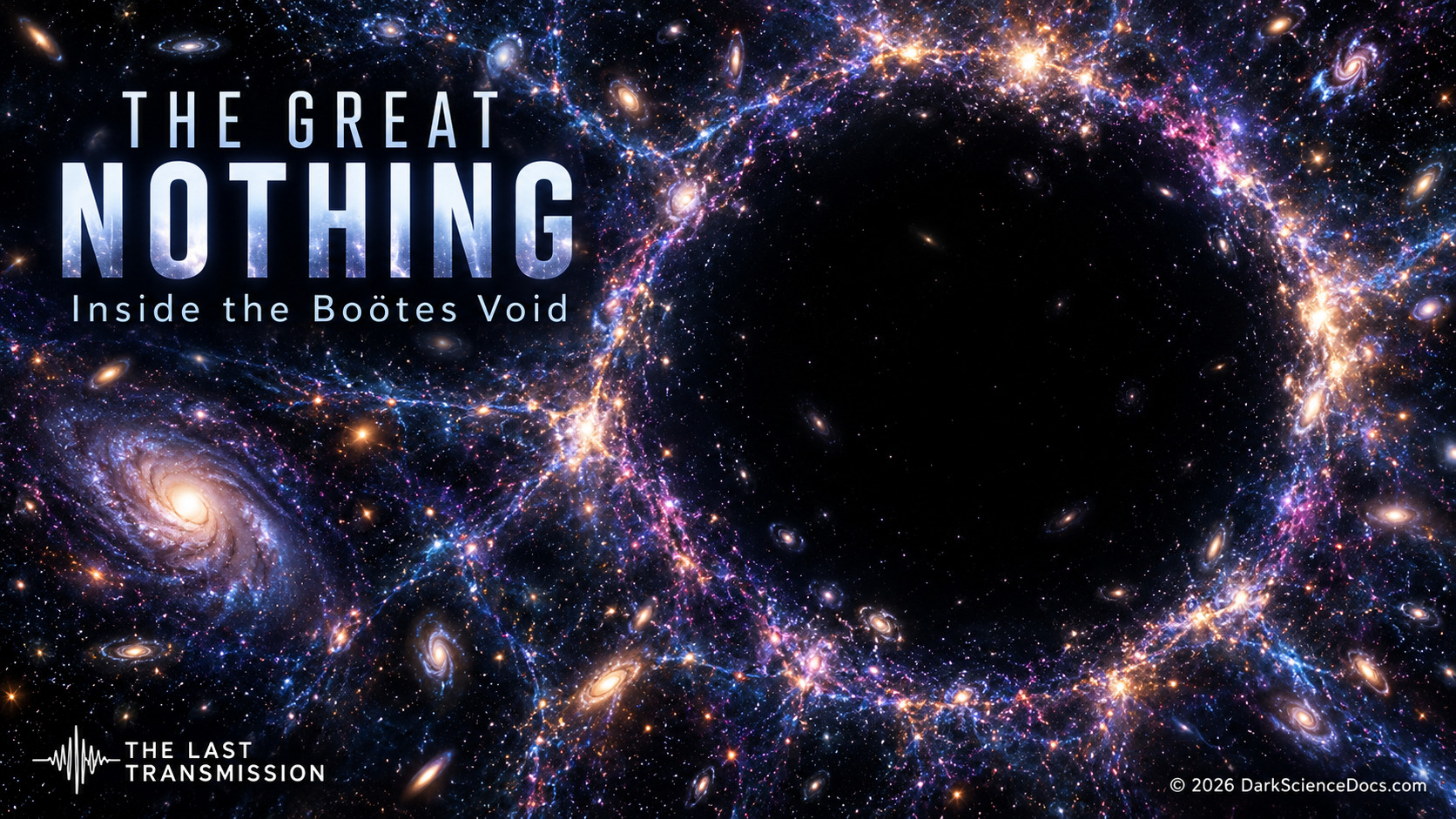
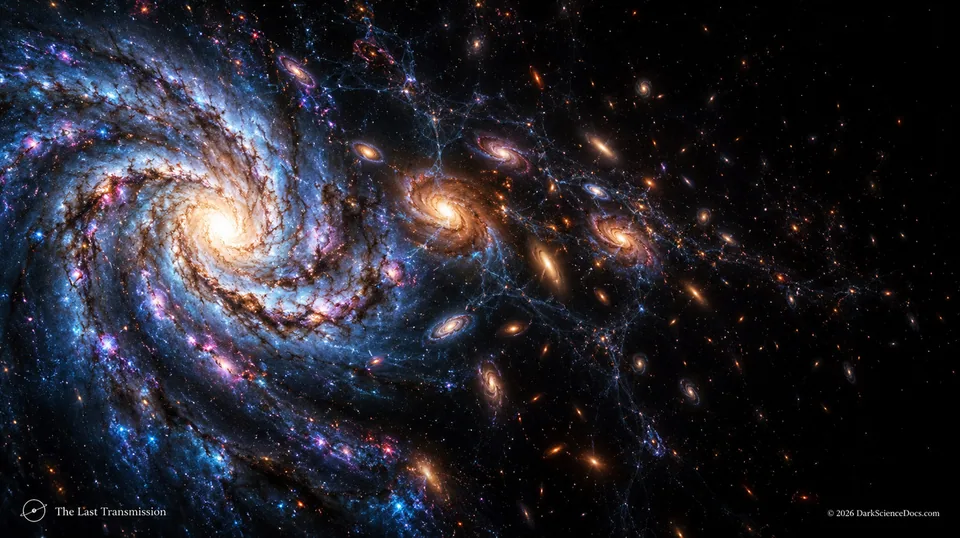
Galaxies gather in groups and clusters. Across still larger volumes, matter forms broad filaments and walls around comparatively sparse regions. The faint threads in this viewer symbolize that pattern; they are not measured locations of named galaxies, a flight route, or something our eyes could see glowing in empty space. We deliberately stop naming galaxies at this scale and follow questions instead.
FILE 06 / COSMIC ATLAS
The Distant Light
Looking back through cosmic time
Why does a distant galaxy tell us about an earlier universe?
Light takes time to travel. When we observe a very distant galaxy, we see light emitted long ago rather than a simultaneous map of the universe today. Early galaxies and the gas between them help test how the young universe became transparent to ultraviolet light. This file is a question about time and evidence; no single point in the scene stands for the edge of all space.