
EVIDENCE FILE 14 / BACTERIAL MEMORY
Can Bacteria Pass a Chemical Memory to Their Descendants?
If a cell has no brain, what would count as a memory, and how could another generation inherit its effect?
All Evidence FilesTHE SHORT ANSWER
In the reported experiments, E. coli’s swarming behavior tracked its cellular iron state, and an associated tendency persisted through several generations. Changing iron conditions altered the response. Here, memory means a retained state that influences later behavior; the measurements do not establish awareness or permanent genetic inheritance.
THE EVIDENCE MAP / BACTERIAL MEMORY
From a swarming delay to an inherited chemical state
The retained influence is measurable. Conscious recollection is not what the experiment tested.
- 01Measurement
Measure repeated behavior and descendant responses
Single-cell assays record swarming initiation alongside iron-associated state, then follow the persistence and loss of the effect through successive generations.
- 02Interpretation
A cellular state carries an influence of the past
The relationship between iron, prior conditions, and later behavior supports a chemically retained influence. Interventions make the mechanism more testable than a correlation alone.
- 03Competing explanation
Adaptation, selection, or continuing exposure
A different response can also reflect ordinary adaptation, a changed population, or an environment that never reset. Lineage and intervention tests help separate those possibilities.
- 04Open test
Match histories and perturb the stored state
Compare controlled cell histories and descendant responses after removing the original conditions. Test whether changing the proposed chemical state changes the later behavior as predicted.
OBSERVATION / INFERENCE / LIMIT
Read the signal.
More than 10,000 tests
Single-cell swarm assays let researchers compare initiation behavior across many cells rather than rely on a striking image of one swarm.
Cellular iron
Lower iron was associated with earlier and more efficient swarming under the tested conditions; interventions strengthened the causal investigation.
Fourth to seventh
The reported effect persisted to fourth-generation descendants and was naturally lost by the seventh; those are experimental observations, not a universal clock.
INSIDE THE EVIDENCE
The chain of reasoning.
Each step has a different level of certainty. Follow the measured result into the explanation, then see where the trail ends.
Define the memory before naming it
A useful experimental definition begins with a measurable response. If earlier conditions leave a state that changes what a cell does later, the system retains information about its history. Calling that a memory describes the relationship between past conditions and present behavior. It does not require a bacterium to picture the past, understand an experience, or possess an inner narrative. This definition makes the claim testable: change the history, measure the retained state, and compare the later response.
University of Texas: the laboratory meaning of bacterial memoryWatch the delay before the swarm begins
The study followed E. coli swarming, a form of collective movement across a surface. Cells with relevant prior history could initiate the behavior more efficiently when tested again. Researchers examined more than 10,000 single-cell swarm assays and related the differences to cellular iron. Measuring initiation matters because a final photograph cannot reveal why one population began earlier. The evidence rests on repeated behavior measurements and a chemical state, rather than an illustrated cell’s brightness or an appearance of coordinated intention.
Bhattacharyya et al. (2023): a heritable iron memory in E. coliUse an intervention to challenge the explanation
Iron is involved in ordinary cell physiology, so a correlation with movement could reflect several connected processes. The researchers also manipulated iron conditions and examined how the swarming tendency and its persistence changed. That intervention gives the explanation more traction than observing that two variables rise together. It still needs interpretation within the tested system: altering an essential cellular resource can affect multiple pathways. The result supports a role for iron-associated state while leaving detailed regulatory connections available for further investigation.
Bhattacharyya et al. (2023): a heritable iron memory in E. coliFollow descendants instead of assuming a permanent change
Cell division passes cellular material to daughter cells as well as copying DNA. The reported swarming tendency persisted through several descendant generations and then faded naturally in the tested lineage. A fading state is compatible with information carried through chemistry, rather than requiring a lasting change to a DNA sequence. That distinction also keeps the generation counts in proportion. Four and seven describe this experimental record; different environments or interventions can change how long a retained influence remains detectable.
UTHealth research record: study abstract and publication detailsAsk what a different explanation would predict
A rigorous memory test must consider ordinary adaptation, selection among cells, and continued exposure to the original conditions. An informative follow-up would match cell histories, track descendants, remove the initiating condition, and perturb the proposed stored state while measuring behavior again. These are ways to sharpen the causal question, not additional outcomes claimed for this study. The broader lesson is that a biological system can preserve an influence of the past without the experiment answering whether it has subjective experience.
THE EASY MISREADING
Chemical memory is an operational description of a retained influence on behavior. It is not evidence that bacteria consciously remember events, and it does not establish that every species inherits the same response or that the effect is permanent.
PRIMARY RESEARCH & MISSION RECORDS
Check the source.
These are the studies and mission records behind this explainer. The illustrated article and related research pages continue the investigation.
EXPLORE IN 3D / ATLAS I-04
Meet the cell behind the memory question
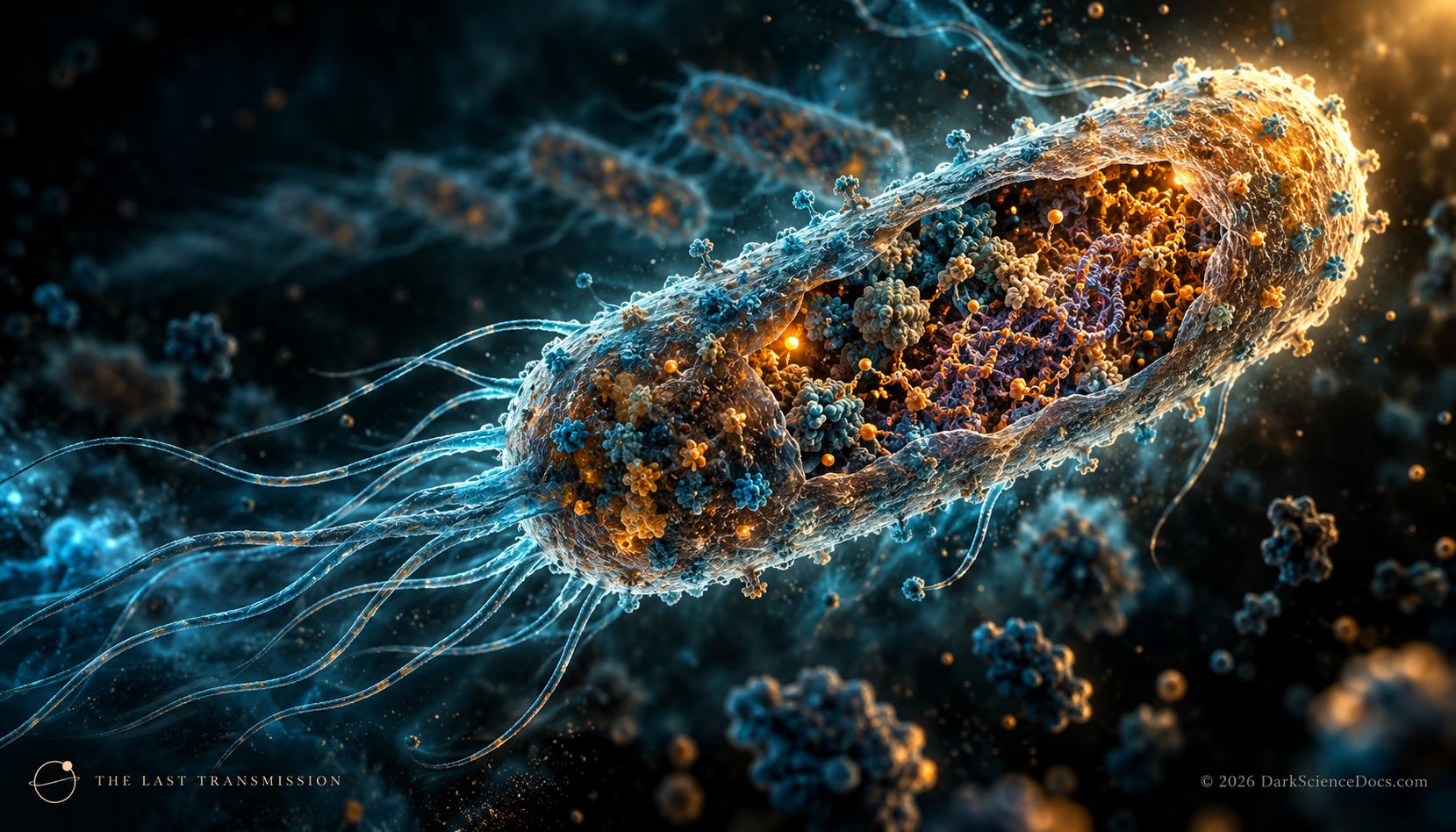
Inspect a representative bacterial membrane, nucleoid, and surrounding structures. The model gives the laboratory question a cellular setting; it does not simulate iron-memory chemistry or conscious experience.
Explore Prokaryotic cell in 3DFOLLOW THE THREAD
Stay with the question.
The illustrated article follows this idea into other single-cell experiments. Inspect a representative bacterial cell, then compare the separate origins documentary with the much later ability of cells to retain a chemical state.
MORE EVIDENCE FILES
Keep looking.

EVIDENCE FILE 10 / IMPACT LIFE
Did an Asteroid Crater Become a Habitat?
Hapcheon core samples reveal post-impact stromatolites and chemical signs consistent with hot-water circulation. They do not show that an impact created life.
Read the evidence
EVIDENCE FILE 13 / ENCELADUS OCEAN CHEMISTRY
What Do Enceladus’ Ice Grains Reveal About Its Ocean?
Follow fresh plume grains into Cassini’s mass spectra, laboratory comparisons, and the distinction between an organic inventory and evidence of life.
Read the evidence