
EVIDENCE FILE 33 / RESEARCH
How Can a White Dwarf Appear Green?
How Can a White Dwarf Appear Green?
All Evidence FilesTHE SHORT ANSWER
White-dwarf spectra reveal absorption shaped by temperature, atmospheric density and chemical composition. Researchers combine those spectra with models of human color response to predict how a resolved stellar disk would appear.
THE EVIDENCE MAP / RESEARCH
How Can a White Dwarf Appear Green?
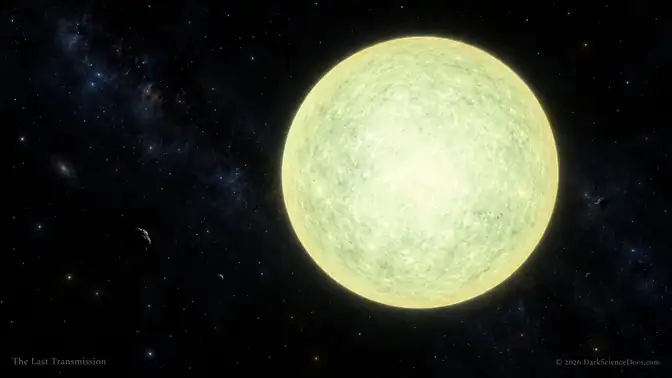
Dense stellar atmospheres can remove broad regions of a spectrum and alter perceived color. The green-white-dwarf result comes from spectra and color modeling, rather than a close-up photograph.
- 01Measurement
Begin with the spectrum, not the illustration
The relevant observation is the distribution of starlight across wavelength, interpreted together with atmospheric models. A rendered green disk is an explanatory output, rather than an independent measurement. To assess the color claim, readers need to know which spectral features were measured and how the modeled atmosphere changes the escaping light. A photograph of an artist’s reconstruction would not provide a second confirmation of the proposed appearance.
- 02Interpretation
Absorption changes a balance of wavelengths
A star emits light across a range of wavelengths. Its atmosphere can remove or redistribute enough of that light to change the balance that reaches an observer. In dense white-dwarf atmospheres, pressure-broadened absorption from elements such as sodium or calcium can produce unusual broad spectral shapes. The result need not resemble a simple temperature-based blackbody color, and a green appearance does not require emission concentrated in a single narrow green line.
- 03Competing explanation
Human color response is part of the calculation
A chromaticity prediction combines a spectrum with a representation of human visual response. It describes a viewing condition, such as being close enough to resolve the stellar disk, rather than how an unresolved faint star must look in an ordinary telescope. Display calibration and image rendering add further differences. The physical claim is that an atmospheric spectrum can support an unusual perceived color under specified conditions, not that every screen reproduces an exact visual experience.
- 04Open test
How to test the model more closely
A useful atmospheric model should reproduce the measured spectral features as well as the broader continuum. Better observations, alternative parameter choices and independent atmosphere calculations can reveal where the inferred temperature, composition or density is uncertain. Comparing unusual objects with ordinary white dwarfs also tests whether the explanation is specific enough. The spectroscopy teaching lab illustrates selective absorption, while the research calculation contains atmospheric details that the simplified lab deliberately leaves out.
OBSERVATION / INFERENCE / LIMIT
Read the signal.
Stellar absorption spectrum
White-dwarf spectra reveal absorption shaped by temperature, atmospheric density and chemical composition. Researchers combine those spectra with models of human color response to predict how a resolved stellar disk would appear.
A model-dependent explanation
Dense stellar atmospheres can remove broad regions of a spectrum and alter perceived color. The green-white-dwarf result comes from spectra and color modeling, rather than a close-up photograph.
A stronger claim needs another test
The inferred chartreuse color does not mean the star emits only green wavelengths. Atmospheric abundances and pressure-broadened absorption matter, and an illustrated disk cannot establish the precise color a person would perceive in a real viewing situation.
INSIDE THE EVIDENCE
The chain of reasoning.
Each step has a different level of certainty. Follow the measured result into the explanation, then see where the trail ends.
Begin with the spectrum, not the illustration
The relevant observation is the distribution of starlight across wavelength, interpreted together with atmospheric models. A rendered green disk is an explanatory output, rather than an independent measurement. To assess the color claim, readers need to know which spectral features were measured and how the modeled atmosphere changes the escaping light. A photograph of an artist’s reconstruction would not provide a second confirmation of the proposed appearance.
Absorption changes a balance of wavelengths
A star emits light across a range of wavelengths. Its atmosphere can remove or redistribute enough of that light to change the balance that reaches an observer. In dense white-dwarf atmospheres, pressure-broadened absorption from elements such as sodium or calcium can produce unusual broad spectral shapes. The result need not resemble a simple temperature-based blackbody color, and a green appearance does not require emission concentrated in a single narrow green line.
Human color response is part of the calculation
A chromaticity prediction combines a spectrum with a representation of human visual response. It describes a viewing condition, such as being close enough to resolve the stellar disk, rather than how an unresolved faint star must look in an ordinary telescope. Display calibration and image rendering add further differences. The physical claim is that an atmospheric spectrum can support an unusual perceived color under specified conditions, not that every screen reproduces an exact visual experience.
Atmospheric material has another history to explain
Spectral features can constrain which elements are present in a stellar atmosphere. Explaining why they are there is a further inference that depends on the star and the relevant transport processes. For polluted white dwarfs, material from former planetary systems is an important interpretation to test. The color alone cannot identify a particular destroyed planet, reconstruct its orbit or determine the complete history of the debris that supplied the atmosphere.
How to test the model more closely
A useful atmospheric model should reproduce the measured spectral features as well as the broader continuum. Better observations, alternative parameter choices and independent atmosphere calculations can reveal where the inferred temperature, composition or density is uncertain. Comparing unusual objects with ordinary white dwarfs also tests whether the explanation is specific enough. The spectroscopy teaching lab illustrates selective absorption, while the research calculation contains atmospheric details that the simplified lab deliberately leaves out.
THE EASY MISREADING
The inferred chartreuse color does not mean the star emits only green wavelengths. Atmospheric abundances and pressure-broadened absorption matter, and an illustrated disk cannot establish the precise color a person would perceive in a real viewing situation.
PRIMARY RESEARCH & MISSION RECORDS
Check the source.
These are the studies and mission records behind this explainer. The illustrated article and related research pages continue the investigation.
FOLLOW THE THREAD
Stay with the question.
Dense stellar atmospheres can remove broad regions of a spectrum and alter perceived color. The green-white-dwarf result comes from spectra and color modeling, rather than a close-up photograph.
MORE EVIDENCE FILES
Keep looking.

EVIDENCE FILE 01 / EUROPA
How Do We Know Europa Has an Ocean?
Galileo's magnetic measurements point to a conducting layer beneath Europa's ice. A salty ocean is the leading explanation. Its chemistry and seafloor activity remain open questions.
Read the evidence
EVIDENCE FILE 02 / TITAN & PLUTO
What Is the 5.11-Micrometer Mark on Titan and Pluto?
The 5.11-micrometer absorption is measured on both worlds, but the Pluto feature is broader. A shared wavelength is a clue to investigate, not a chemical identification.
Read the evidence