
17 / RESEARCH / OBSERVATION & INTERPRETATION
White Dwarf Colors: What a Green Appearance Would Mean
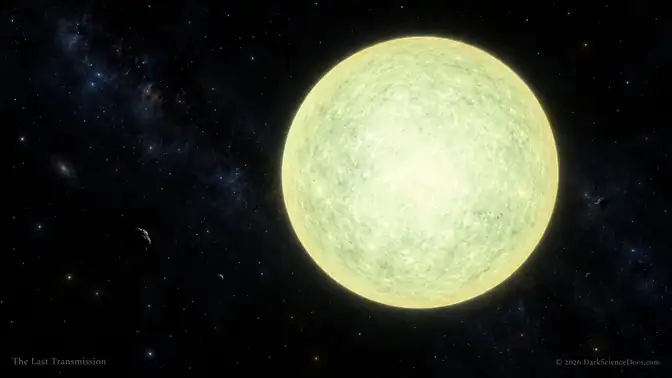
Dense stellar atmospheres can remove broad regions of a spectrum and alter perceived color. The green-white-dwarf result comes from spectra and color modeling, rather than a close-up photograph.
White-dwarf spectra reveal absorption shaped by temperature, atmospheric density and chemical composition. Researchers combine those spectra with models of human color response to predict how a resolved stellar disk would appear. The inferred chartreuse color does not mean the star emits only green wavelengths. Atmospheric abundances and pressure-broadened absorption matter, and an illustrated disk cannot establish the precise color a person would perceive in a real viewing situation.
A compact remnant still radiates
Most stars do not end their lives in a supernova. Stars with histories broadly comparable to our Sun’s eventually exhaust the fuel that sustains their long, stable existence, expand into giant stars, and shed substantial portions of their outer layers. What remains is a compact, extraordinarily dense core known as a white dwarf. The remnant no longer generates its ordinary luminosity through sustained nuclear fusion. Its brilliant outer atmosphere has disappeared, but its interior retains tremendous heat, which gradually escapes into space. A typical white dwarf contains a substantial fraction of a star’s original mass within a body roughly comparable in size to Earth.
Broad absorption changes the balance
WD J1330+6435 has an estimated effective temperature of approximately 4,240 kelvin, or just under 4,000 degrees Celsius. That is enormously hot by everyday standards, but relatively cool compared with newly formed white dwarfs. Its atmosphere is dominated by helium and contains traces of elements including sodium, calcium, and lithium. These elements matter because they provide clues to the material that entered the star’s atmosphere after its earlier life ended. Astronomers interpret the heavy-element contamination of such white dwarfs as evidence of rocky debris originating in their planetary systems. Asteroids and other small bodies can survive parts of a star’s evolution, have their orbits disturbed, and eventually deliver material onto the compact remnant.
A cold star can look unexpectedly blue
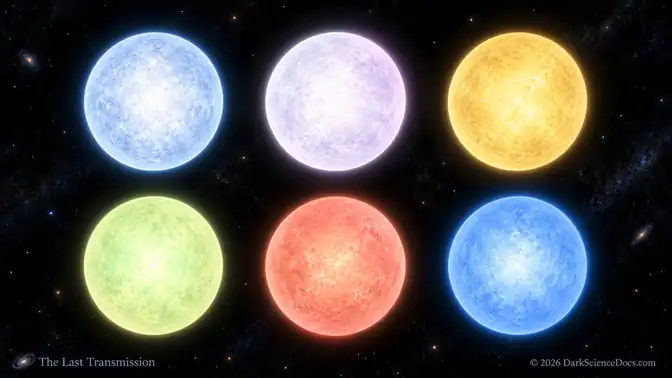
WD J2356−2054 has an effective temperature of approximately 4,000 kelvin, making it a relatively cool white dwarf. Under the familiar relationship between temperature and visible color, a stellar surface at this temperature would normally look orange. The cause is again found in its dense atmosphere, where extraordinarily strong sodium absorption suppresses much of the middle portion of the visible spectrum. The remaining visible light is weighted heavily toward shorter wavelengths, particularly around 450–500 nanometers. The result resembles the light of a much hotter star, even though its actual surface temperature is relatively low. The researchers found that this star lies so far from the usual relationship between temperature and color that it cannot meaningfully be assigned an ordinary blackbody color temperature.
Read the illustrated companion article for the full narrative and its source trail. The selected passages above follow that article’s investigation.
Continue reading on SubstackTHE EVIDENCE / THE OPEN QUESTION
What we know.
White-dwarf spectra reveal absorption shaped by temperature, atmospheric density and chemical composition. Researchers combine those spectra with models of human color response to predict how a resolved stellar disk would appear.
What remains open.
The inferred chartreuse color does not mean the star emits only green wavelengths. Atmospheric abundances and pressure-broadened absorption matter, and an illustrated disk cannot establish the precise color a person would perceive in a real viewing situation.
Why it matters.
This is a useful bridge between spectroscopy and planetary debris around stellar remnants. Understanding which wavelengths are absorbed explains why perceived color can carry information that a simple temperature-color rule misses.
GO DEEPER / EVIDENCE FILE
How Can a White Dwarf Appear Green?
Dense stellar atmospheres can remove broad regions of a spectrum and alter perceived color. The green-white-dwarf result comes from spectra and color modeling, rather than a close-up photograph.
COMPARE THE QUESTIONS
Follow what the light reveals.
Follow the relevant evidence and teaching models. Each model explains a mechanism and retains its own stated assumptions and limits.
FOLLOW THE EVIDENCE
Research behind the field note.
EXPLORE IN 3D / ATLAS S-01
Explore the related science model
This is a useful bridge between spectroscopy and planetary debris around stellar remnants. Understanding which wavelengths are absorbed explains why perceived color can carry information that a simple temperature-color rule misses.
Explore Stellar Fates in 3DVISUAL EVIDENCE
Inside the investigation.

FOLLOW THE THREAD
Related signals.
The First Known Green Star Is Already Dead
Scientists have identified a stellar remnant that should appear green to human eyes. Its strange color reveals something remarkable about what happens to stars—and the worlds they leave behind.
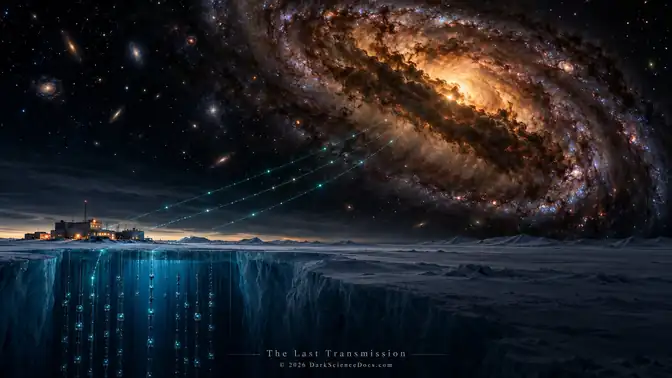
The Black Hole Hid Its Light. The Neutrinos Escaped.
Scientists buried a telescope beneath Antarctica to catch particles from the universe’s most violent places. What they discovered is shocking.
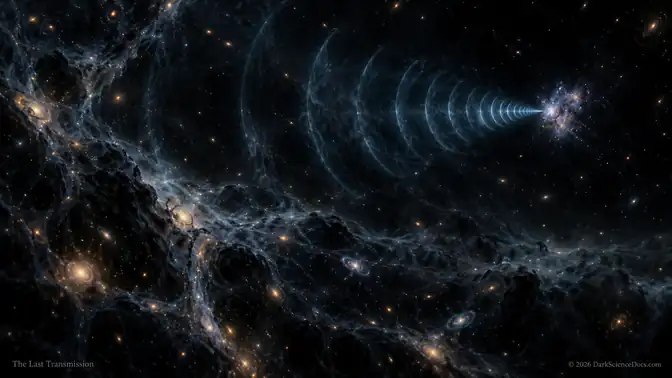
A Signal Crossed 10 Billion Years of Darkness. We Still Don't Know What Sent It.
The James Webb Space Telescope has traced an extraordinarily powerful radio flash to a galaxy so small that Earth's largest telescopes couldn't see it.