
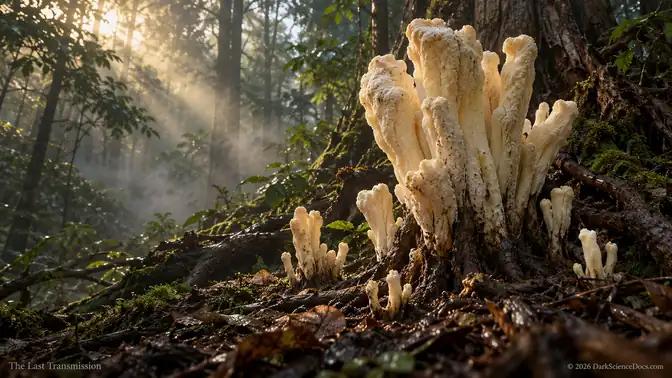
EVIDENCE FILE 31 / RESEARCH
What Establishes Dianjunus rex as a Distinct Fungal Lineage?
What Establishes Dianjunus rex as a Distinct Fungal Lineage?
All Evidence FilesTHE SHORT ANSWER
The study describes collected fungal specimens, their reproductive structures and genetic relationships. The large fruiting structures are present-day observations; the proposed age of the wider lineage comes from evolutionary analysis.
THE EVIDENCE MAP / RESEARCH
What Establishes Dianjunus rex as a Distinct Fungal Lineage?
A large fungus collected in Yunnan connects anatomy, molecular classification and an inferred ecological transition. Its evolutionary age and relationship with trees ask different kinds of questions.
- 01Measurement
Specimens come before an evolutionary story
The collected material provides the starting point: locality records, visible structures, microscopic anatomy and genetic sequences. Large size attracts attention but does not by itself establish a distinct taxonomic lineage. Researchers must compare characters with other fungi and document which features separate the specimens. A dramatic reconstruction of a fungus beside a tree cannot replace preserved material, sequence records or the comparisons needed to support a classification.
- 02Interpretation
A tree of relationships is an inference
Molecular phylogeny compares genetic information under models of how sequences change. The inferred grouping can support a relationship that is difficult to see from appearance alone. Its reliability depends on the chosen markers, sequence quality, comparison taxa and analytical assumptions. A branch in that tree is therefore a model-supported relationship among sampled organisms, rather than a direct observation of the ancestors themselves or every unsampled relative.
- 03Competing explanation
Dating a lineage is different from dating a specimen
An estimated origin near the end of the dinosaur age refers to the history inferred for a lineage. It does not make a collected fruiting structure millions of years old. Divergence-time estimates depend on calibration and evolutionary models, with uncertainty around the reported age. Temporal proximity to the end-Cretaceous extinction motivates a historical question, but it does not demonstrate that the catastrophe caused the lineage to arise or determined its later ecology.
- 04Open test
The next useful comparisons
Additional collections can test whether the described features remain consistent across sites and conditions. Broader sequence sampling can alter inferred relationships or refine their support. Direct ecological work can establish how the fungus interacts with hosts and substrates. These tests address different claims, so agreement in one does not automatically settle the others. The species description can be useful and well documented while its deeper ecological history remains an open investigation.
OBSERVATION / INFERENCE / LIMIT
Read the signal.
Collected specimens
The study describes collected fungal specimens, their reproductive structures and genetic relationships. The large fruiting structures are present-day observations; the proposed age of the wider lineage comes from evolutionary analysis.
A model-dependent explanation
A large fungus collected in Yunnan connects anatomy, molecular classification and an inferred ecological transition. Its evolutionary age and relationship with trees ask different kinds of questions.
A stronger claim needs another test
A lineage dated near the end-Cretaceous extinction does not establish that the extinction caused its origin. Genomic clues also do not directly demonstrate every stage of a transition between living plant tissues and decomposition of dead wood.
INSIDE THE EVIDENCE
The chain of reasoning.
Each step has a different level of certainty. Follow the measured result into the explanation, then see where the trail ends.
Specimens come before an evolutionary story
The collected material provides the starting point: locality records, visible structures, microscopic anatomy and genetic sequences. Large size attracts attention but does not by itself establish a distinct taxonomic lineage. Researchers must compare characters with other fungi and document which features separate the specimens. A dramatic reconstruction of a fungus beside a tree cannot replace preserved material, sequence records or the comparisons needed to support a classification.
A tree of relationships is an inference
Molecular phylogeny compares genetic information under models of how sequences change. The inferred grouping can support a relationship that is difficult to see from appearance alone. Its reliability depends on the chosen markers, sequence quality, comparison taxa and analytical assumptions. A branch in that tree is therefore a model-supported relationship among sampled organisms, rather than a direct observation of the ancestors themselves or every unsampled relative.
Dating a lineage is different from dating a specimen
An estimated origin near the end of the dinosaur age refers to the history inferred for a lineage. It does not make a collected fruiting structure millions of years old. Divergence-time estimates depend on calibration and evolutionary models, with uncertainty around the reported age. Temporal proximity to the end-Cretaceous extinction motivates a historical question, but it does not demonstrate that the catastrophe caused the lineage to arise or determined its later ecology.
A genome suggests functions that ecology must test
Genes associated with particular biological activities can motivate an ecological hypothesis, especially when specimens occur near declining trees or dead material. The presence of a genetic capacity does not show when, where or how strongly the organism uses it. Testing a proposed transition between living tissues and decomposition would require observations of host relationships, activity and life stages. Those studies can distinguish a functional possibility from a demonstrated sequence in nature.
The next useful comparisons
Additional collections can test whether the described features remain consistent across sites and conditions. Broader sequence sampling can alter inferred relationships or refine their support. Direct ecological work can establish how the fungus interacts with hosts and substrates. These tests address different claims, so agreement in one does not automatically settle the others. The species description can be useful and well documented while its deeper ecological history remains an open investigation.
THE EASY MISREADING
A lineage dated near the end-Cretaceous extinction does not establish that the extinction caused its origin. Genomic clues also do not directly demonstrate every stage of a transition between living plant tissues and decomposition of dead wood.
PRIMARY RESEARCH & MISSION RECORDS
Check the source.
These are the studies and mission records behind this explainer. The illustrated article and related research pages continue the investigation.
FOLLOW THE THREAD
Stay with the question.
A large fungus collected in Yunnan connects anatomy, molecular classification and an inferred ecological transition. Its evolutionary age and relationship with trees ask different kinds of questions.
Explore the related science modelMORE EVIDENCE FILES
Keep looking.

EVIDENCE FILE 01 / EUROPA
How Do We Know Europa Has an Ocean?
Galileo's magnetic measurements point to a conducting layer beneath Europa's ice. A salty ocean is the leading explanation. Its chemistry and seafloor activity remain open questions.
Read the evidence
EVIDENCE FILE 02 / TITAN & PLUTO
What Is the 5.11-Micrometer Mark on Titan and Pluto?
The 5.11-micrometer absorption is measured on both worlds, but the Pluto feature is broader. A shared wavelength is a clue to investigate, not a chemical identification.
Read the evidence