
04 / RESEARCH / OBSERVATION & INTERPRETATION
Dianjunus rex: A Giant Fungus and an Inferred History
A large fungus collected in Yunnan connects anatomy, molecular classification and an inferred ecological transition. Its evolutionary age and relationship with trees ask different kinds of questions.
The study describes collected fungal specimens, their reproductive structures and genetic relationships. The large fruiting structures are present-day observations; the proposed age of the wider lineage comes from evolutionary analysis. A lineage dated near the end-Cretaceous extinction does not establish that the extinction caused its origin. Genomic clues also do not directly demonstrate every stage of a transition between living plant tissues and decomposition of dead wood.
The organism that was collected
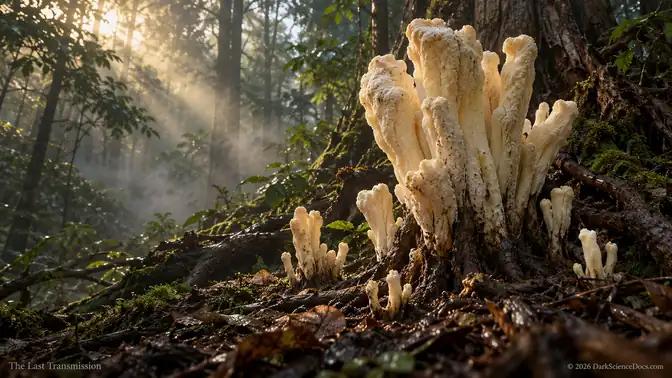
The discovery emerged from surveys conducted during 2024 and 2025 in Yunnan Province, a region of southwestern China where tropical rainforests, subtropical woodlands, and mountain ecosystems create an extraordinary concentration of biodiversity. Researchers collected unusual fungal specimens from several locations, including forests near Kunming and the tropical region of Xishuangbanna. One of the original collections, made in August 2024, was associated with the roots of a Chinese cork oak, Quercus variabilis. The organisms were substantial enough to make an immediate impression. Their exposed bodies varied from slender columns to broad, irregular structures, while darker stalk-like portions extended into the soil.
Where classification meets ancestry
When scientists discover an unusual organism, appearance can be misleading. Different species sometimes develop similar shapes despite having very different evolutionary histories. They examined its anatomy under microscopes, cultivated its spores, studied reproductive features, and compared sequences from four genetic regions commonly used to establish fungal relationships. They also analyzed genome-scale data to investigate its deeper evolutionary position. The fungus belonged to the order Xylariales, a diverse group that includes organisms involved in wood decomposition, plant associations, and other ecological relationships. Yet it did not fit comfortably inside any existing family. Its closest recognized family was Graphostromataceae, but the genetic separation and distinctive morphology were substantial enough that researchers proposed an entirely family.
An ecological interpretation to test
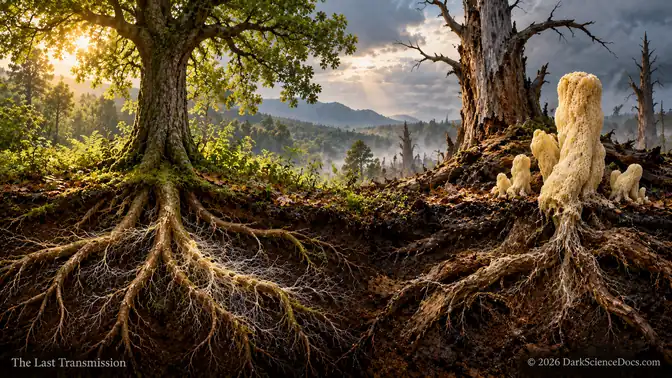
The great evolutionary age of this fungus is fascinating. Its possible relationship with living and dying trees may be even more revealing. During the field investigations, researchers found its enormous reproductive structures associated with the roots and woody remains of dying or dead host plants. Some members of the Xylariales are endophytes, fungi that can live inside plant tissues without producing obvious symptoms of disease. Others are saprotrophs, organisms that obtain nutrients from dead organic material. Fungi that break down dead plant material often possess substantial collections of genes encoding carbohydrate-active enzymes, proteins that help them process structural components of plant tissues.
Read the illustrated companion article for the full narrative and its source trail. The selected passages above follow that article’s investigation.
Continue reading on SubstackTHE EVIDENCE / THE OPEN QUESTION
What we know.
The study describes collected fungal specimens, their reproductive structures and genetic relationships. The large fruiting structures are present-day observations; the proposed age of the wider lineage comes from evolutionary analysis.
What remains open.
A lineage dated near the end-Cretaceous extinction does not establish that the extinction caused its origin. Genomic clues also do not directly demonstrate every stage of a transition between living plant tissues and decomposition of dead wood.
Why it matters.
Careful comparisons can turn an unfamiliar organism into a test of fungal diversity and forest ecology. Direct observations of host interactions would sharpen the distinction between a plausible ecological interpretation and an established life history.
GO DEEPER / EVIDENCE FILE
What Establishes Dianjunus rex as a Distinct Fungal Lineage?
A large fungus collected in Yunnan connects anatomy, molecular classification and an inferred ecological transition. Its evolutionary age and relationship with trees ask different kinds of questions.
COMPARE THE QUESTIONS
Follow what the light reveals.
Follow the relevant evidence and teaching models. Each model explains a mechanism and retains its own stated assumptions and limits.
FOLLOW THE EVIDENCE
Research behind the field note.
EXPLORE IN 3D / ATLAS L-01
Explore the related science model
Careful comparisons can turn an unfamiliar organism into a test of fungal diversity and forest ecology. Direct observations of host interactions would sharpen the distinction between a plausible ecological interpretation and an established life history.
Explore Rainforest: The Hidden Engine in 3DVISUAL EVIDENCE
Inside the investigation.

FOLLOW THE THREAD
Related signals.
The Giant Fungus That May Have Found Its Place After the Dinosaurs Died
Deep in the forests of China, scientists discovered a nearly five-pound fungus belonging to an evolutionary family that may have emerged 65 million years ago.

They Grew a Human Cortex Inside a Mouse. Then They Tested Its Memory.
Scientists created mice whose cortical tissue was almost entirely derived from human cells. The tissue grew, formed connections, generated electrical activity, and revealed something extraordinary.
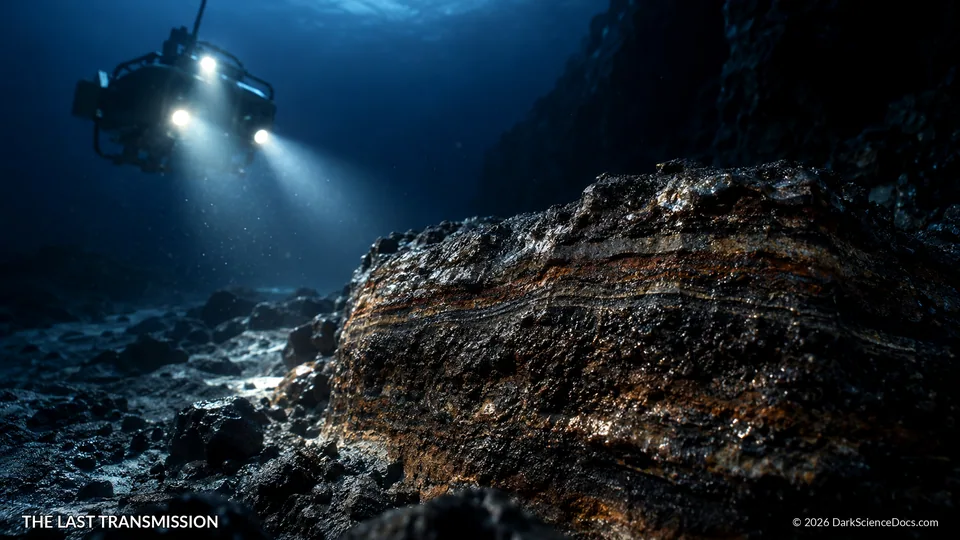
They Found Plutonium at the Bottom of the Pacific. The Explosion That Made It May Be Over 95 Million Years Old.
Deep beneath the ocean, scientists discovered radioactive debris from beyond Earth. The most disturbing clue was an element they could not find.