01 / THE EXTERIOR
A shadow is not a surface.
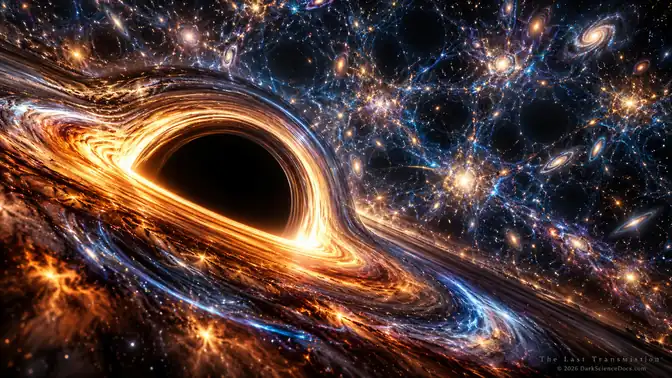
The event horizon is a boundary beyond which light cannot return to distant observers. A black hole’s apparent shadow is shaped by the paths of light around it, and it can be larger than the horizon itself. The glowing material belongs to the surrounding gas. Moving your viewpoint changes which light reaches you, including light bent around from the far side of that material.
The exterior illustration uses nonrotating Schwarzschild geometry to bend its rays. The disk’s brightness, color, density, and motion are chosen for exploration. They are not a fitted emission model, a measured spin, or an optical photograph of Sagittarius A*. The Event Horizon Telescope’s radio reconstructions and polarization observations are a separate record to examine.
See the EHT observation and its interpretation ↗02 / THE SIGNAL
The offset changes the outcome.
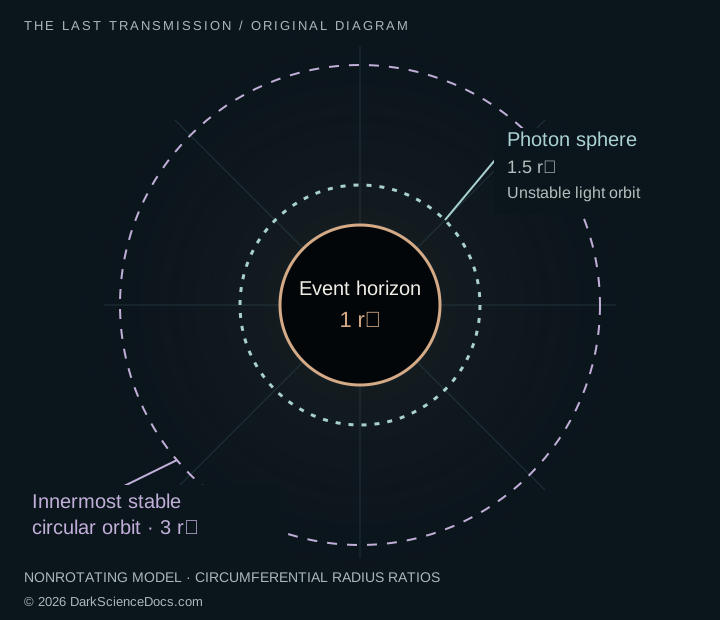
A ray arriving from far away can escape after a deflection, spend a long path near the unstable photon orbit, or cross the horizon. This experiment numerically follows a light geodesic in the equatorial plane of a nonrotating black hole. All distances in this view use the horizon radius as their unit. The dashed circle marks the photon orbit at 1.5 horizon radii; it is a guide, not a physical ring of matter.
For incoming light in this model, the capture threshold is an offset of about 2.598 horizon radii measured far away. That offset differs from closest approach: the path bends before reaching the center. Near the threshold, a small adjustment can produce a large change in the route. The pulse is a teaching marker, and its screen travel time does not represent a clock held by a distant observer.
Follow the Schwarzschild light-path equations ↗03 / THE RETURNING STAR
An ellipse begins the story.
Astronomers followed S2 for decades, measuring positions and spectra through the dust that obscures the Galactic Center. Its roughly sixteen-year orbit and close passage helped establish the mass concentrated around Sagittarius A*. Later measurements revealed the turning of its orbit predicted by general relativity, adding a more demanding test than the broad shape of the ellipse alone.
The interactive star follows Kepler’s equation on a fixed ellipse with rounded values inspired by S2. It reproduces the changing speed around that ellipse, but it does not calculate the measured relativistic precession or fit the star’s sky orientation. This view changes scale from horizon radii to hundreds and thousands of astronomical units. The enlarged black-hole marker would be tiny at the same physical scale. S301, described in the linked research files, is a different star with a different proposed opportunity to investigate spin.
Read the S2 observations ↗04 / THE RELEASE
A little speed. A different fate.
The probe starts sideways at ten horizon radii. With resistance off, 1.00× gives a circular orbit; slower releases can return or plunge, while about 1.342× permits escape. Energy and angular momentum determine the outcome in this gravity-only model.
Compact gravity-only paths play over 40 seconds, showing ten circuits. Flight also ends at the horizon or the 24-radius viewing boundary. A bound path can leave that boundary without escaping. Completing ten circuits records the observation; it does not prove long-term stability in a real environment.
Resistance-driven paths have no circuit cutoff. Exaggerated braking removes energy and angular momentum until capture or departure from the plotted region. Its simplified medium has no angular motion; the rotating wisps are decorative. Show gas changes appearance only; changing resistance resets the flight. This teaching model assumes a nonrotating black hole and omits thrust, tides, and realistic plasma interactions. Playback is compressed and does not predict spacecraft lifetimes.
Explore the effective potential for particle orbits ↗05 / THE DESCENT
Keep falling.
The picture becomes stranger.
The viewpoint follows radial free fall in a nonrotating black hole of 4.3 million solar masses. From the displayed start at twenty horizon radii, the falling clock takes about forty-two minutes to reach the horizon. From there, this particular trajectory reaches the classical singularity limit in about twenty-eight falling seconds. Playback stretches that interior interval across a minute, slowing the final approach even further.
The curved light paths come from Schwarzschild geometry and the falling observer’s local frame. Lensing can make several images of the same source and stretch bright structures into arcs. Close to the classical singularity, tidal distortion radically changes the picture. Incoming light remains possible inside the horizon; the entire future of the universe does not flash past.
A banded gas giant, an ocean world and glowing gas form an invented, enlarged debris field. The fictional planet surfaces borrow Earth and Jupiter imagery for visual detail; these are not our solar system’s planets falling into Sagittarius A*. Their motion, atmosphere loss, breakup, colors and the final bright band’s enlarged width are illustrations, not calculated encounters, fitted spectra or a fluid simulation. Dense gas parcels peel from the giant; the rocky world also sheds imagined fragments. The cores dissolve progressively and do not re-form later in the journey. Switch off Show infalling matter to examine the bent background light by itself. Sagittarius A* may rotate, which this nonrotating model does not include.
The final approach resolves radii down to a millionth of the horizon radius, then reaches the classical trajectory’s endpoint. The viewpoint deliberately continues beyond any camera’s survival. At the singularity, the classical equations fail; the final black screen marks the end of the model. It is not a photographed interior, a visible central object or a prediction of what lies beyond.