

02 / RESEARCH / OBSERVATION & INTERPRETATION
Civilization Survival and the Limits of the Silent Sky
Civilizational extinction is one possible explanation for an unanswered sky. Search coverage, technological detectability and the unknown frequency of life prevent silence from selecting that explanation on its own.
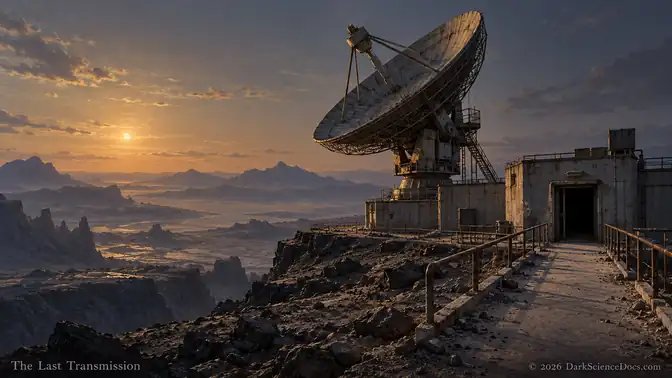
No extraterrestrial technological civilization has been confirmed. Individual searches sample particular directions, frequencies, sensitivities and times, so their nondetections apply to the signals those searches could have detected. We do not know whether major evolutionary obstacles lie behind technological life or whether survival barriers lie ahead. Fictional abandoned cities are thought experiments, and an absence of detected signals is not a census of extinct societies.
What a nondetection can say
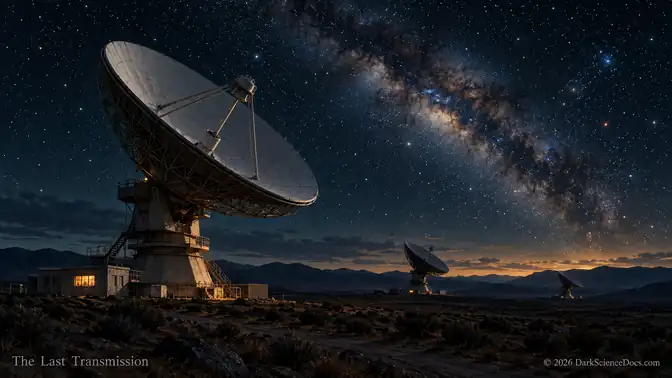
NASA reports that it has found no credible evidence of extraterrestrial life. There is no confirmed alien civilization on the other end of our searches. That is a statement about what we have established, rather than a census of everything that exists. A telescope can examine a direction at particular wavelengths for a particular length of time. A transmitter might be too faint, aimed elsewhere, active at another moment, or built around a method we are not testing. Even a populated galaxy would not necessarily resemble a room full of people calling our name. In a 2018 study, Jason Wright, Shubham Kanodia, and Emily Lubar modeled the enormous range of possible radio searches.
An obstacle behind technological life
Robin Hanson’s Great Filter argument asks what prevents the progression from lifeless matter to civilizations that expand and persist on cosmic scales. Somewhere along that proposed journey, one barrier or a combination of barriers might sharply reduce the number that make it through. Perhaps the decisive difficulty is becoming alive. Perhaps it lies in later biological transitions, or in developing technology. If the largest obstacles belong to our distant past, our existence could mean that Earth has already passed through something extraordinarily unusual. An inhabited planet would not automatically contain a civilization. Earth supported life for billions of years before humans developed radio technology.
Several explanations remain open
A frightening explanation can feel persuasive because it organizes uncertainty into a story. We should be especially careful when the story is this compelling. In Dissolving the Fermi Paradox, Anders Sandberg, Eric Drexler, and Toby Ord explored how deeply uncertain estimates of life’s origins and development change expectations about other civilizations. Their analysis showed that plausible uncertainty can leave substantial room for cosmic solitude without requiring a universal pattern of technological self-destruction. We cannot use a quiet sky to calculate that humanity is doomed. We cannot establish that every civilization encounters the same danger, that anyone has already failed, or that there is one decisive test awaiting us.
Read the illustrated companion article for the full narrative and its source trail. The selected passages above follow that article’s investigation.
Continue reading on SubstackTHE EVIDENCE / THE OPEN QUESTION
What we know.
No extraterrestrial technological civilization has been confirmed. Individual searches sample particular directions, frequencies, sensitivities and times, so their nondetections apply to the signals those searches could have detected.
What remains open.
We do not know whether major evolutionary obstacles lie behind technological life or whether survival barriers lie ahead. Fictional abandoned cities are thought experiments, and an absence of detected signals is not a census of extinct societies.
Why it matters.
The Great Filter can organize conditional questions without supplying a measured extinction rate. Better searches and explicit assumptions matter because different histories can produce the same present-day lack of a confirmed signal.
COMPARE THE QUESTIONS
Follow what the light reveals.
Follow the relevant evidence and teaching models. Each model explains a mechanism and retains its own stated assumptions and limits.
FOLLOW THE EVIDENCE
Research behind the field note.
EXPLORE IN 3D / MAP 13
Explore the related science model
The Great Filter can organize conditional questions without supplying a measured extinction rate. Better searches and explicit assumptions matter because different histories can produce the same present-day lack of a confirmed signal.
Open Universe mapVISUAL EVIDENCE
Inside the investigation.
FOLLOW THE THREAD
Related signals.
What If the Silence Means They Didn’t Survive?
The Great Filter raises an unsettling possibility: a civilization might learn to command enormous power before it learns how to live with it.
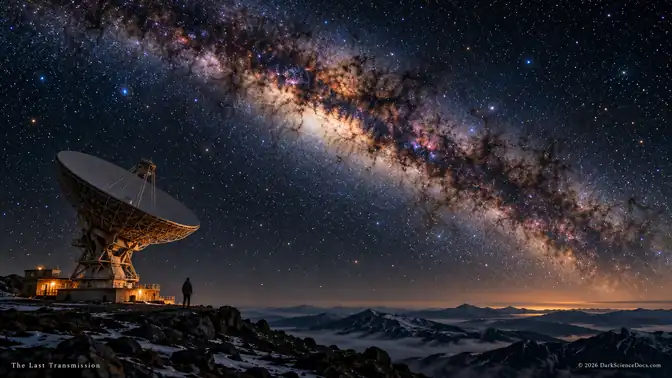
What If Every Civilization Goes Silent Just Before It Reaches the Stars?
The universe has had billions of years to produce intelligent life. Yet we have found no confirmed evidence of anyone else.
Read the illustrated article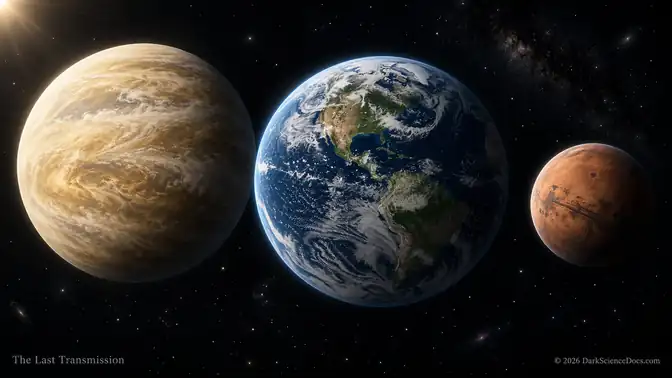
We Found Water on Other Worlds. We Still Haven’t Found Another Earth.
Venus can destroy a lander in hours, while Mars preserves the remains of ancient lakes. Our neighbors reveal why finding the ingredients for life is only the beginning.