
97 / COSMIC MYSTERIES / FIELD NOTE
A Radio Flash Seen Once
Follow the distinction between observed repetition and a genuinely one-time event, using CHIME population statistics and a distant FRB host as separate clues.
One detection leaves an unfinished history
A fast radio burst can appear in a telescope’s data for only milliseconds. Afterward, astronomers may spend years searching for another pulse, refining its position or identifying a host galaxy. A source detected once has supplied one event in the observing record. The record alone does not establish whether that source is physically capable of repeating.
That distinction gives the apparent division between repeaters and other FRBs its importance. Limited observing time, sensitivity, changing activity and the direction of emission can affect what is detected. A useful population analysis must consider those selection effects before interpreting a difference as evidence for distinct engines.
Repetition supplies an additional constraint
Some FRB sources have produced multiple detected bursts. Their continuing activity allows researchers to compare energies, durations, polarization and changes over time. Repetition constrains explanations that require the same engine to be completely destroyed in a single event, although it leaves substantial room for different physical processes within a surviving system.
Magnetars are among the leading possible engines. A radio burst associated with a Galactic magnetar demonstrates that at least one such object can produce FRB-like emission. Establishing that capability does not assign every extragalactic burst to the same mechanism. Population comparisons ask how far one physical family can explain the observed diversity.
A statistical difference can suggest multiple pathways
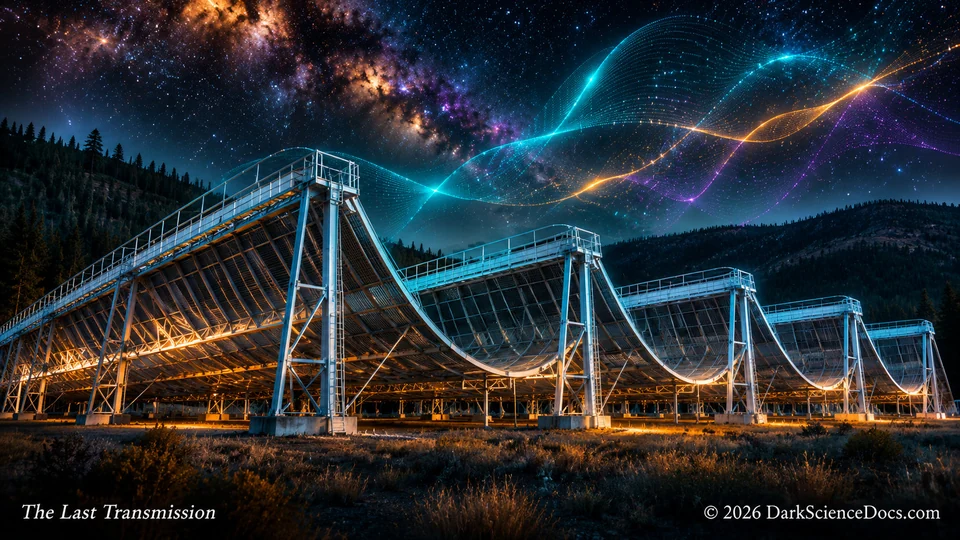
A September 2026 preprint by Dong and colleagues compares 3,057 apparently nonrepeating sources with 78 repeaters selected from CHIME Catalog 2. The analysis uses both the first detected and highest-fluence bursts of the repeating sources, reducing the risk of treating their many recorded pulses as interchangeable independent sources.
The authors find differences in inferred energy distributions and cosmic event-rate evolution. They interpret the results as evidence that at least some sources may be intrinsically nonrepeating. The conclusion remains a population argument from a preprint, with redshifts largely estimated from dispersion and with the analysis’s assumptions still relevant to its interpretation.
A distant host answers a different question
FRB 20240304B provides another route into the problem. Webb imaging identified its host galaxy, and spectroscopy measured a redshift of 2.148. The signal therefore reaches us from a period when the universe was about three billion years old, giving researchers a case to compare with FRBs in more recent cosmic environments.
The host measurement is distinct from the CHIME population analysis. It securely changes the distance and context assigned to this burst; it does not prove that its engine was destroyed. Its approximately 10.6-billion-year light journey is also a travel-time description rather than the host’s present-day separation from Earth.
Let silence remain an observation
A source can be watched without another detectable burst arriving. That silence is valuable when its observing duration and sensitivity are recorded. Turning it into a statement that the source can never repeat would require much more than a finite interval of non-detection. The best descriptions preserve exactly what was searched for and what the search found.
Use an FRB investigation to keep detection, localization and interpretation connected. A brief pulse can carry constraints on ionized material, a possible environment and a distant epoch. Some engines may endure, and some events may be catastrophic. The scientific task is to establish which measurements can distinguish those possibilities.
Sources and further reading
- Dong et al. (September 2026 preprint): Are Repeaters Prevalent Among the Known Fast Radio Burst Sources?
- CHIME/FRB Collaboration: Catalog 2
- NASA: Webb spectroscopy of the FRB 20240304B host
- Caleb et al. (2026): a fast radio burst at redshift 2
- Bochenek et al. (2020): a radio burst associated with a Galactic magnetar