
06 / RESEARCH / OBSERVATION & INTERPRETATION
FRB 20240304B: A Radio Burst and Its Distant Host
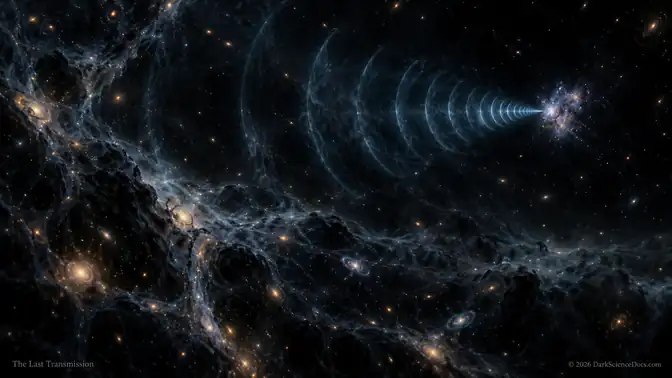
A brief radio flash led researchers to a faint host galaxy and a redshift of 2.148. The distance and host properties constrain possible sources without identifying the engine uniquely.
MeerKAT detected the burst and localized it on the sky. Follow-up work identified a faint galaxy, while spectral measurements supplied the redshift used to place the event in a cosmological history. A young magnetar is a proposed engine, not a resolved object seen producing this particular burst. Host association, stellar-population estimates and the conversion from redshift to lookback time each depend on measurements and assumptions.
Locating a signal without a visible host
The burst was cataloged as FRB 20240304B, a designation reflecting the date of its discovery. It was detected by the MeerTRAP project using the MeerKAT radio telescope array in South Africa, where dozens of radio dishes work together to study the universe. As radio waves travel through ionized matter, lower radio frequencies are delayed more than higher frequencies. Astronomers can measure this effect, known as dispersion, to estimate how many free electrons the signal encountered during its journey. FRB 20240304B showed an exceptionally large dispersion measure, suggesting that its radio waves had traveled through an enormous amount of intervening material.
The galaxy behind the radio flash
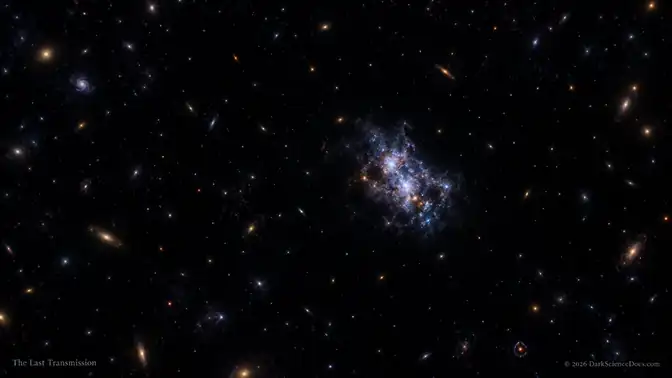
The team had anticipated finding a relatively substantial galaxy populated by many generations of stars. Instead, they discovered a dwarf galaxy whose stellar mass was roughly a thousand times smaller than the kind of host they had expected. Its stars collectively contained only about 10 million times the mass of our Sun, although the galaxy itself could contain additional mass in gas and dark matter. It was actively producing stars, with evidence indicating that a substantial fraction of its stellar population had formed relatively recently. Depending on the model used to reconstruct its history, much of that stellar mass could have assembled over only tens of millions of years.
A plausible engine is not an identification
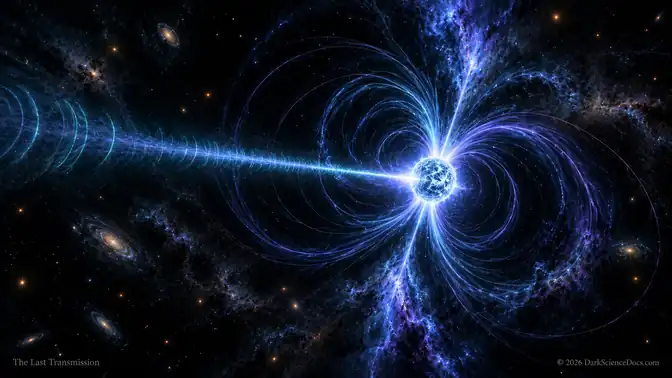
When a massive star exhausts its nuclear fuel, its core may collapse, leaving behind an extraordinarily dense remnant called a neutron star. Some neutron stars possess magnetic fields of almost unimaginable strength. These objects are known as magnetars. Their magnetic fields can undergo violent rearrangements, releasing enormous amounts of energy and generating bursts of high-energy radiation. In April 2020, astronomers observed an intense radio burst associated with the Milky Way magnetar SGR 1935+2154. That discovery provided compelling evidence that magnetars can produce at least some fast radio bursts. A galaxy undergoing vigorous star formation produces large numbers of massive, short-lived stars.
Read the illustrated companion article for the full narrative and its source trail. The selected passages above follow that article’s investigation.
Continue reading on SubstackTHE EVIDENCE / THE OPEN QUESTION
What we know.
MeerKAT detected the burst and localized it on the sky. Follow-up work identified a faint galaxy, while spectral measurements supplied the redshift used to place the event in a cosmological history.
What remains open.
A young magnetar is a proposed engine, not a resolved object seen producing this particular burst. Host association, stellar-population estimates and the conversion from redshift to lookback time each depend on measurements and assumptions.
Why it matters.
Fast radio bursts connect compact objects with distant galaxies and intervening ionized matter. Keeping the measured radio signal, host spectrum and source hypothesis separate shows how a millisecond event can become a much larger investigation.
GO DEEPER / EVIDENCE FILE
What Does FRB 20240304B’s Host Redshift Tell Us?
A brief radio flash led researchers to a faint host galaxy and a redshift of 2.148. The distance and host properties constrain possible sources without identifying the engine uniquely.
COMPARE THE QUESTIONS
Follow what the light reveals.
Follow the relevant evidence and teaching models. Each model explains a mechanism and retains its own stated assumptions and limits.
FOLLOW THE EVIDENCE
Research behind the field note.
EXPLORE IN 3D / MAP 13
Explore the related science model
Fast radio bursts connect compact objects with distant galaxies and intervening ionized matter. Keeping the measured radio signal, host spectrum and source hypothesis separate shows how a millisecond event can become a much larger investigation.
Open Universe mapVISUAL EVIDENCE
Inside the investigation.
FOLLOW THE THREAD
Related signals.
A Signal Crossed 10 Billion Years of Darkness. We Still Don't Know What Sent It.
The James Webb Space Telescope has traced an extraordinarily powerful radio flash to a galaxy so small that Earth's largest telescopes couldn't see it.
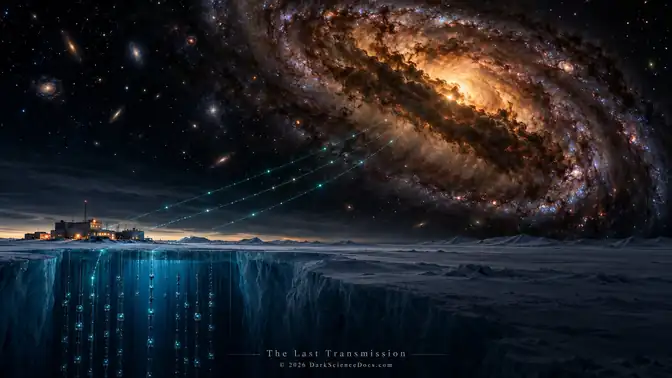
The Black Hole Hid Its Light. The Neutrinos Escaped.
Scientists buried a telescope beneath Antarctica to catch particles from the universe’s most violent places. What they discovered is shocking.
What If Dark Energy Comes From the Edge of the Universe?
At 14, Liam Desre won an international science prize for exploring a remarkable possibility: perhaps the force accelerating the cosmos is connected to the information we can never see.