
VISUAL ARCHIVE / IMAGE STORY
A Boundary Is Not a Volume
Curved spacetime complicates the familiar relationship between an outside size and an interior.
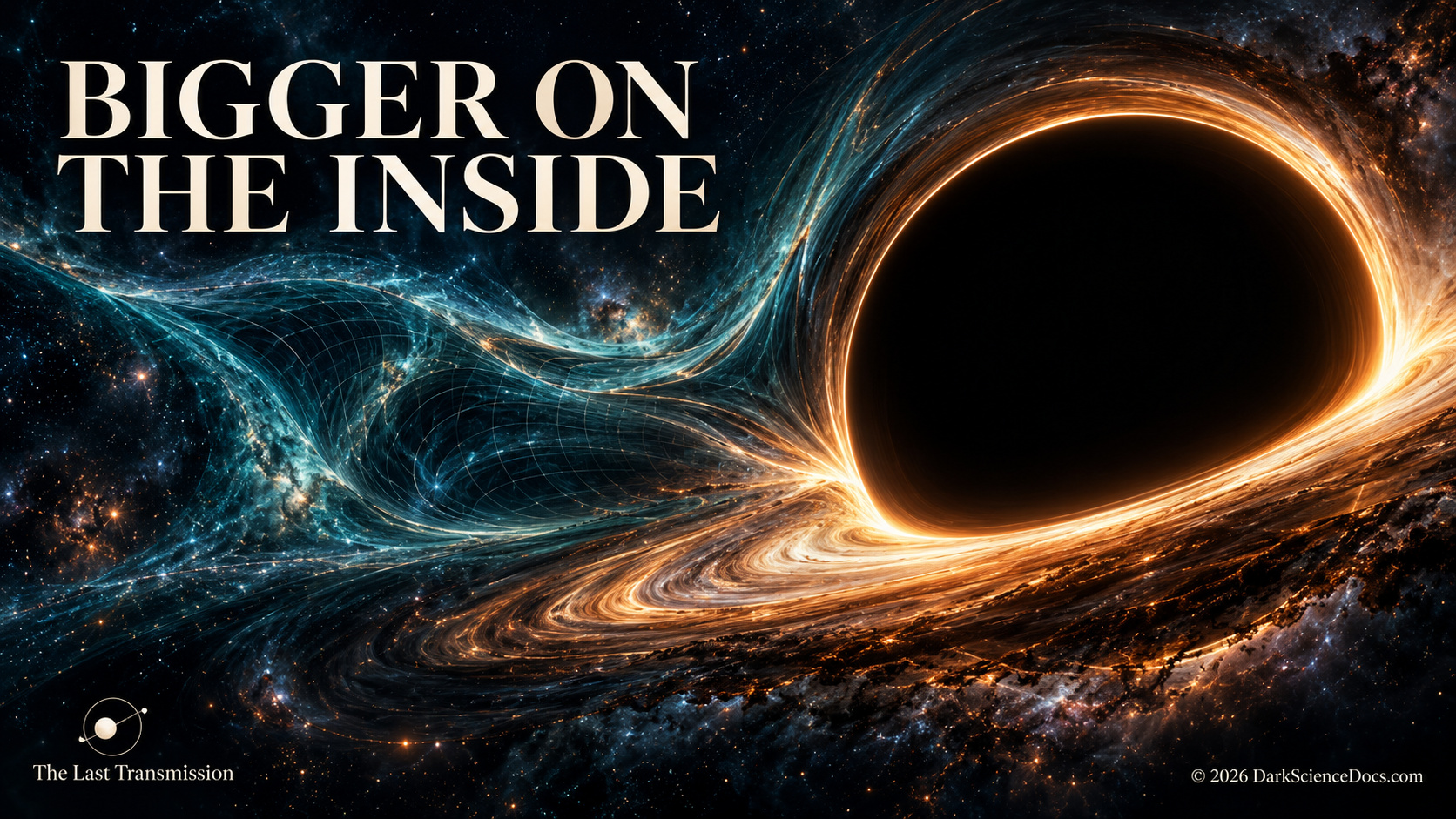
A finite horizon can bound an enormous spatial volume under a carefully defined geometric measure. The blue geometry is an artistic metaphor, rather than a visible interior.
THE OBSERVATION
What we can actually see.
Theoretical work defines a maximal spatial volume for particular black-hole geometries. That quantity can grow while the horizon area stays fixed; it is a property of a chosen spatial slice, not a photographed hidden room or extra travel time for an observer.
THE ILLUSTRATION
What the artwork imagines.
The composition visualizes this idea: Curved spacetime complicates the familiar relationship between an outside size and an interior. A finite horizon can bound an enormous spatial volume under a carefully defined geometric measure. The blue geometry is an artistic metaphor, rather than a visible interior.
FROM THE ILLUSTRATED ARTICLE
The story that inspired it.
The article asks what black-hole size means when horizon area and a chosen interior volume behave differently. It separates spatial geometry, an infalling traveler’s finite proper time, and theoretical evaporation rather than turning a large volume into an escape route. This frame focuses on curved spacetime complicates the familiar relationship between an outside size and an interior.
Read A Black Hole Can Grow Inside While Its Outside Stays the SameCHECK THE RECORD
The image interprets the research below. Follow the original work for the measurements and limits behind the scene.
NASA: Anatomy of a Black Hole Marios Christodoulou and Carlo Rovelli: How big is a black hole? Yen Chin Ong: Never Judge a Black Hole by Its Area Raphael Bousso: The holographic principle Marios Christodoulou and Tommaso De Lorenzo: On the volume inside old black holes Geoffrey Penington: Entanglement Wedge Reconstruction and the Information ParadoxOTHER IMAGE STORIES
Keep looking.
 What Does a Ruler Measure Here?
 The Last Boundary for a Returning Signal
 The Mark Shared by Titan and Pluto
EXPLORE IN 3D / MAP G-01
Compare an exterior view and an infall model
Explore signals, orbits, and an illustrated fall near Sagittarius A*. The exterior model and infall sequence do not measure maximal interior volume or depict unknown quantum-gravity physics.
Open Sagittarius A* map