EVIDENCE FILE 07 / GALACTIC CENTER
Can S301 Measure Our Black Hole's Spin?
A star races close to Sagittarius A*. Which part of its path has actually been measured, and which part might reveal rotation later?
All Evidence FilesTHE SHORT ANSWER
The GRAVITY interferometer measured S301's changing position relative to Sagittarius A* and fitted a tight, highly elongated orbit. The published analysis predicts that a rotating black hole could cause an extra change in that orbit over repeated passages. The star's existence and orbit are observations; a measurement of Sagittarius A*'s spin from S301 is a proposed future result. Nearby unseen masses and ordinary relativistic effects must be accounted for before a spin estimate is credible.
THE EVIDENCE MAP / GALACTIC CENTER
A measured orbit and a future spin signal
S301 is real and its orbit is fitted. Spin-induced precession must emerge from repeated positions after other gravity has been modeled.
- 01Measurement
GRAVITY locates S301
Near-infrared interferometry supplies 19 positions relative to Sagittarius A* that fit a highly eccentric orbit lasting about 8.7 years.
- 02Interpretation
Closest passage amplifies relativity
A rotating black hole should add a small orientation-dependent change to the orbit beyond the much larger precession expected from its mass alone.
- 03Competing explanation
Hidden masses tug on the star
Ordinary gravitational pulls from nearby faint stars or stellar-mass black holes can shift the path and must be separated from any proposed frame-dragging signal.
- 04Open test
Track another close passage
Combine future astrometry and radial velocities, especially around pericenter, and fit mass, extended matter, and spin effects together across several orbital phases.
OBSERVATION / INFERENCE / LIMIT
Read the signal.
19 positions
The published orbit fit combines measured or inferred positions from 2017 to 2025.
About 8.7 years
S301 passes close enough for a predicted spin-sensitive signal.
Spin from S301
The spin sensitivity comes from simulations of future observations.
INSIDE THE EVIDENCE
The chain of reasoning.
Each step has a different level of certainty. Follow the measured result into the explanation, then see where the trail ends.
A star located by interference
Dust hides the Galactic Center in visible light, so the GRAVITY instrument at ESO's Very Large Telescope Interferometer works in the near infrared. Its team reconstructed images and fitted source positions relative to Sagittarius A*. They report 19 astrometric positions for the faint star S301, including less precise earlier detections and follow-up observations. The points support a consistent orbital solution. A plotted ellipse is the model fitted to those data points, not a continuous film of a star circling a black hole.
Why this orbit matters
S301 completes a circuit in roughly 8.7 years and reaches a modeled peak speed near 25,000 kilometers per second. General relativity already predicts several effects on stellar orbits in this region, including precession caused by the central mass even if the black hole did not rotate. Spin adds a smaller frame-dragging contribution with a different dependence on orbital orientation and phase. S301's close passage could make that small contribution accessible sooner than it is for more distant stars.
The forecast is not the measurement
The discovery paper uses current observations and simulated future astrometry and radial velocities to estimate how well a coming data set might constrain spin. Its illustrative mock observations extend to 2035. Those simulated points are not observations already obtained, and their precision depends on instruments, observing time, and the star remaining trackable. Describing S301 as sensitive to spin therefore means it offers a testable opportunity. The paper does not present a measured spin magnitude or direction derived from this star.
Other gravity can move the orbit
A cluster of faint stars or stellar-mass black holes near Sagittarius A* can exert ordinary Newtonian forces. The discovery team explicitly models such perturbations and notes that some distributions could complicate a spin measurement. The expected frame-dragging signal is concentrated around closest approach, whereas perturbations from a granular background can show a different pattern elsewhere on the orbit. More complete time coverage and comparison with other stars can help separate these possibilities before assigning a small residual to black-hole rotation.
What the next passage can test
Continued positions from GRAVITY and later instruments, coupled to spectroscopy measuring the star's motion along our line of sight, can tighten the full three-dimensional orbit. An especially valuable comparison will track changes near closest approach against changes farther out, while fitting both the familiar mass-related precession and plausible surrounding mass. If the pattern persists across repeated passages and the competing gravitational pulls are controlled, S301 may offer a dynamical measure of spin. Until then, the orbit is the result and the spin is the question.
THE EASY MISREADING
The discovery of S301 does not mean Sagittarius A*'s spin has been measured from its orbit. The paper's spin precision estimates use simulated future data.
PRIMARY RESEARCH & MISSION RECORDS
Check the source.
These are the studies and mission records behind this explainer. The illustrated article and Field Note continue the investigation.
EXPLORE IN 3D / MAP 12
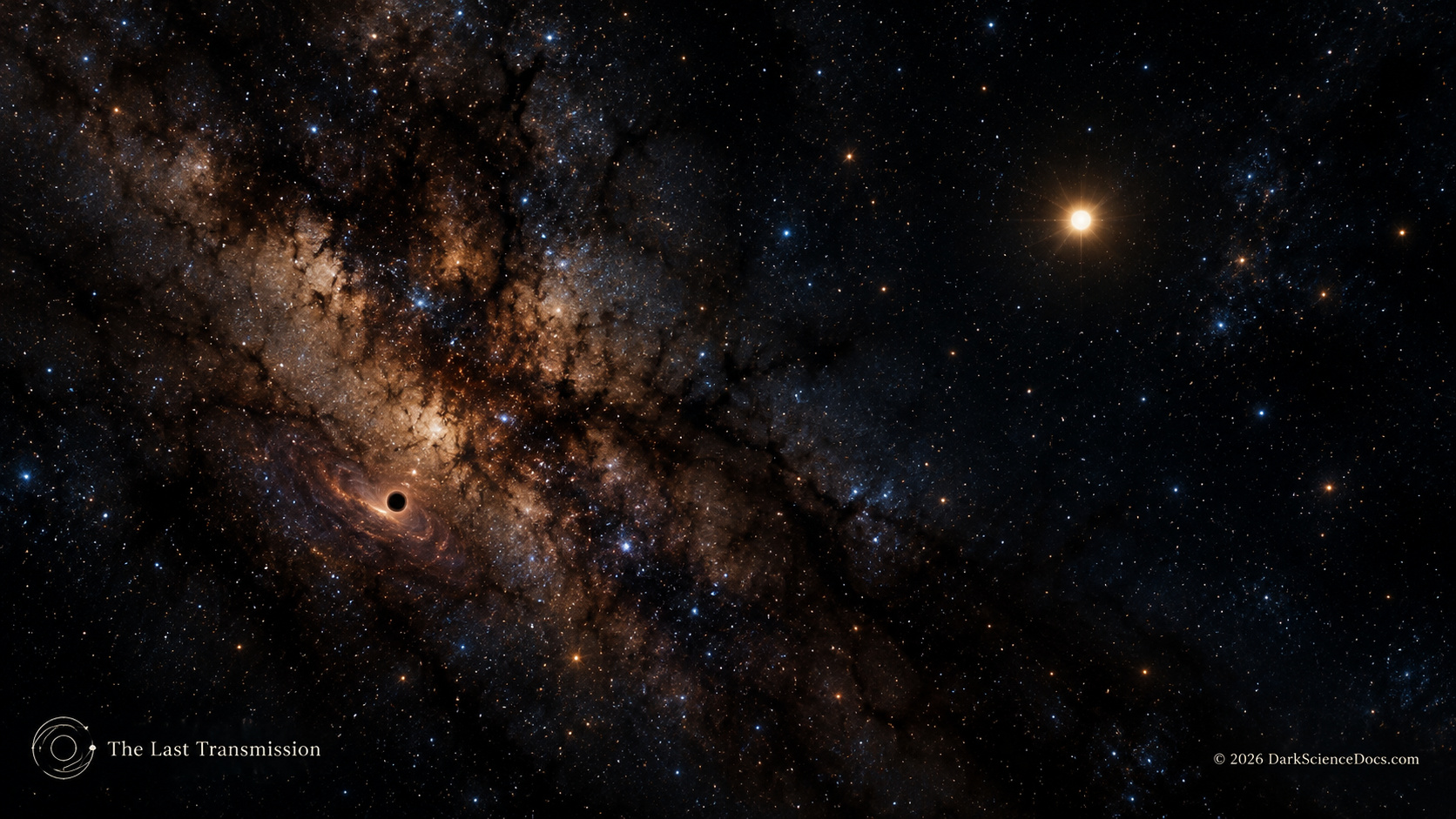
Find the Galactic Center behind the orbit
Place Sagittarius A* inside the Milky Way, then return to the much smaller S301 orbit and the proposed spin measurement.
Open Milky Way mapFOLLOW THE THREAD
Stay with the question.
S301 circles the Milky Way's central black hole on an unusually tight, elongated path. Repeated measurements may expose the subtler effect of the black hole's rotation.
Watch the related documentaryMORE EVIDENCE FILES
Keep looking.

EVIDENCE FILE 01 / EUROPA
How Do We Know Europa Has an Ocean?
Galileo's magnetic measurements point to a conducting layer beneath Europa's ice. A salty ocean is the leading explanation. Its chemistry and seafloor activity remain open questions.
Read the evidence
EVIDENCE FILE 02 / TITAN & PLUTO
What Is the 5.11-Micrometer Mark on Titan and Pluto?
The 5.11-micrometer absorption is measured on both worlds, but the Pluto feature is broader. A shared wavelength is a clue to investigate, not a chemical identification.
Read the evidence