
VISUAL ARCHIVE / IMAGE STORY
Two Kinds of Matter, Different Responses
The collision hypothesis relies on gas interacting differently from largely collisionless dark matter.
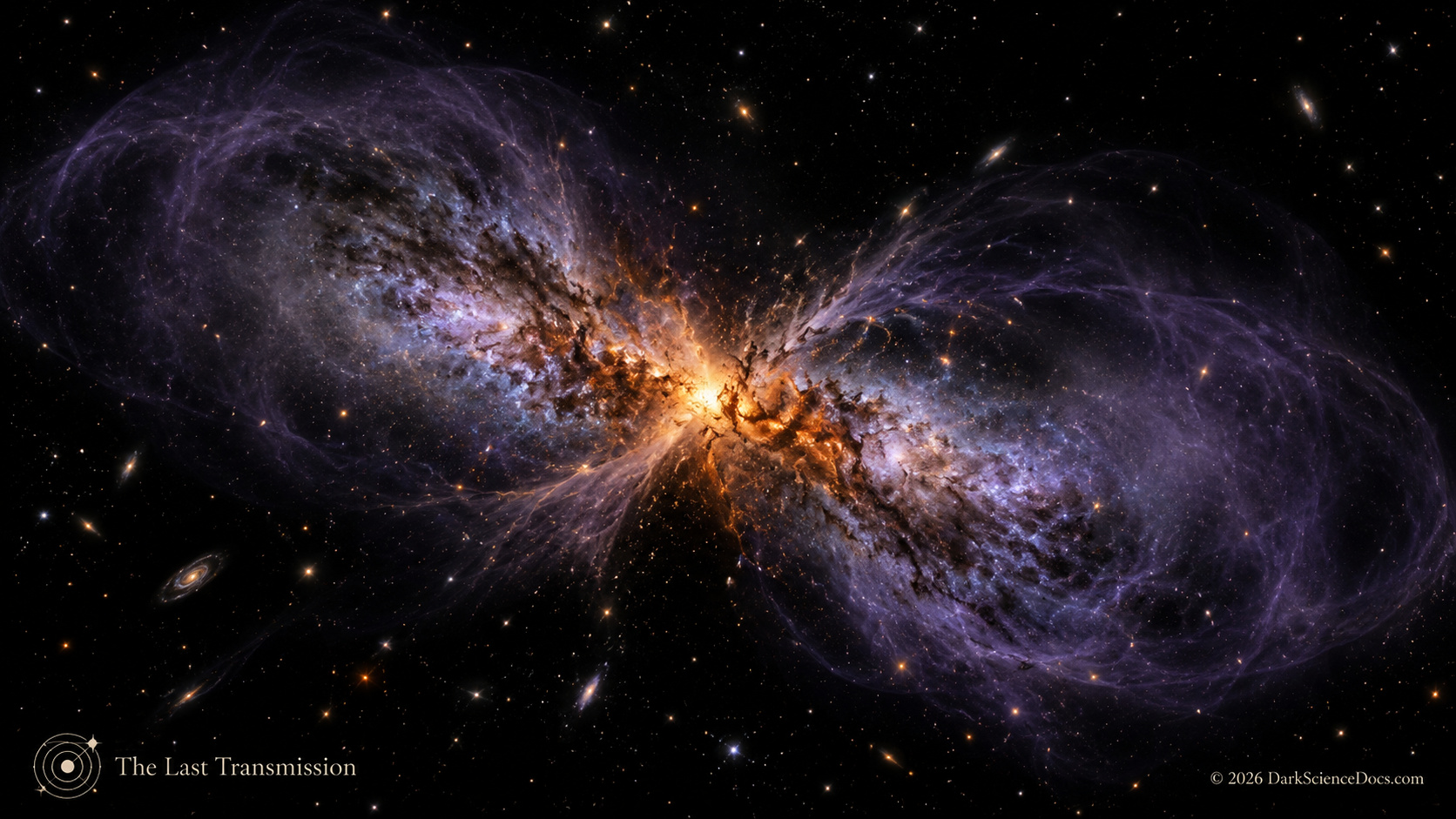
In the bullet-dwarf hypothesis, colliding gas slows and compresses while largely collisionless dark matter continues through. AI-generated concept illustration; violet represents hypothetical dark halos.
THE OBSERVATION
What we can actually see.
Gas can shock and slow during a galaxy encounter, while dark matter is modeled as largely collisionless. This distinction motivates the proposed separation; the image does not demonstrate that the particular NGC 1052 trail formed through that mechanism.
THE ILLUSTRATION
What the artwork imagines.
The composition visualizes this idea: The collision hypothesis relies on gas interacting differently from largely collisionless dark matter. In the bullet-dwarf hypothesis, colliding gas slows and compresses while largely collisionless dark matter continues through. AI-generated concept illustration; violet represents hypothetical dark halos.
FROM THE ILLUSTRATED ARTICLE
The story that inspired it.
The article follows faint galaxies in the NGC 1052 field whose measured motions require little additional dark matter in the studied regions. It compares a collision-separation hypothesis with competing formation histories instead of treating the origin as settled. This frame focuses on the collision hypothesis relies on gas interacting differently from largely collisionless dark matter.
Read The Galaxies That Lost Their Dark MatterCHECK THE RECORD
The image interprets the research below. Follow the original work for the measurements and limits behind the scene.
Keim and colleagues: A Third Galaxy Missing Dark Matter along a Trail of Galaxies in the NGC 1052 Field (2026) Van Dokkum and colleagues: A trail of dark-matter-free galaxies from a bullet-dwarf collision, Nature (2022) Lee and colleagues: Multiple Beads on a String, The Astrophysical Journal (2024) NASA Science: Dark Matter NASA Hubble: Mystery of Galaxy’s Missing Dark Matter Deepens (2021) Chandra: The Bullet Cluster Keim and colleagues: Kinematic Confirmation of a Remarkable Linear Trail of Galaxies in the NGC 1052 Field (2025) Tang and colleagues: Hubble and Webb distances to the NGC 1052 trail (2026) Hammer and Yang: Tidal origin of dark-matter free dwarf galaxies in the NGC 1052 group (2026)OTHER IMAGE STORIES
Keep looking.
 When Gas and Invisible Mass Part Ways
 A Galaxy You Can Almost See Through
 The Mark Shared by Titan and Pluto
EXPLORE IN 3D / MAP 13
Look beyond one galaxy’s visible stars
Move through an illustrated cosmic neighborhood and compare galaxy scales. The explorer does not measure dark-matter halos or simulate the proposed collision that produced the NGC 1052 trail.
Open Universe map