
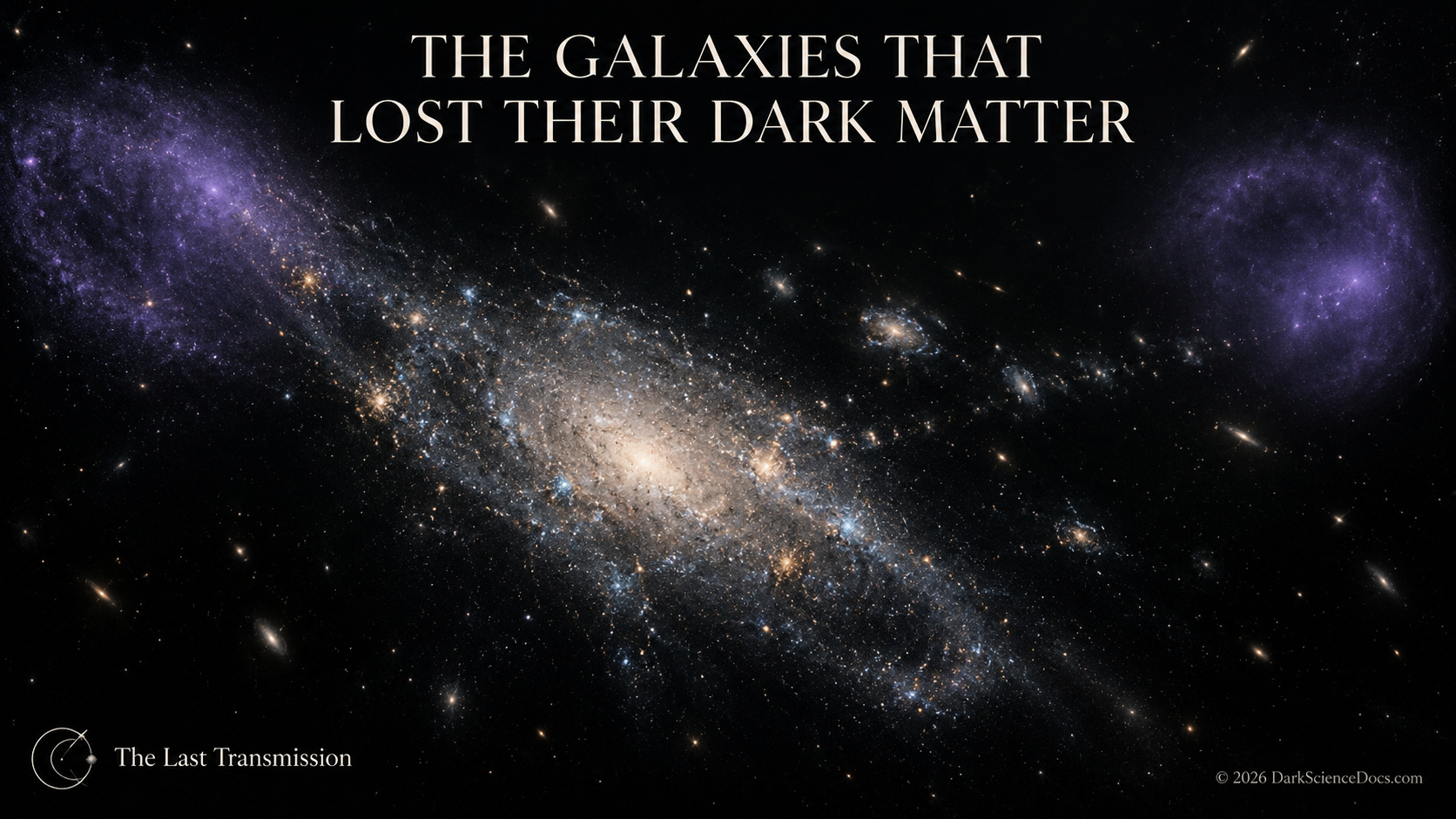
EVIDENCE FILE 17 / DARK-MATTER-DEFICIENT GALAXIES
How Can a Galaxy Appear to Have Almost No Dark Matter?
Astronomers cannot photograph a dark halo. What does a faint galaxy’s starlight let them measure instead?
All Evidence FilesTHE SHORT ANSWER
Researchers compare the spread of stellar velocities with the gravity expected from the visible stellar mass. For DF9, the reported dispersion is consistent with the stars alone in the measured region. That supports dark-matter deficiency there; it does not prove the absence of every dark particle or uniquely establish the galaxy’s origin.
THE EVIDENCE MAP / DARK-MATTER-DEFICIENT GALAXIES
From faint starlight to a missing-mass question
A dynamical mass estimate and a reconstructed formation event need different kinds of evidence.
- 01Measurement
Extract stellar velocities from faint spectra
Keck measurements constrain DF9’s velocity dispersion, while distance and stellar-light models inform the mass estimate. Each quantity has uncertainty and a stated region of applicability.
- 02Interpretation
The observed stars can explain the measured motions
The measured spread is compatible with the stellar-mass prediction in the studied region, supporting a low dark-matter contribution there rather than proving an everywhere-empty halo.
- 03Competing explanation
Different histories and assumptions can change the account
A bullet-dwarf collision and a tidal origin offer competing formation stories. Distance, stellar mass, and dynamics also need scrutiny before a low-mass inference becomes a unique history.
- 04Open test
Combine uniform distances with more kinematics
Test positions, velocities, stellar populations, and interaction features together. A successful model should explain the related system rather than only its most striking projected alignment.
OBSERVATION / INFERENCE / LIMIT
Read the signal.
About 6.5 km/s
The reported DF9 stellar velocity dispersion has substantial uncertainty and is inferred from faint absorption-line spectra.
Stars can account for it
The measured spread is compatible with the stellar-mass prediction and lower than the study’s comparison model with a large halo.
The sampled region
A mass inference applies to the region and dynamical assumptions being tested; it does not inventory all matter at every radius.
INSIDE THE EVIDENCE
The chain of reasoning.
Each step has a different level of certainty. Follow the measured result into the explanation, then see where the trail ends.
A faint image is not a mass measurement
An ultra-diffuse galaxy can be so sparsely lit that background objects remain visible through its stars. That appearance describes surface brightness rather than the amount of invisible matter around it. To investigate gravity, researchers need motion as well as light. Spectra provide information about stellar velocities, while distance and stellar-population assumptions help estimate the visible mass. The question becomes whether those stars can explain the measured motions or whether additional gravitational mass is needed in the region being studied.
NASA / Hubble: distance measurements and the DF2 mass questionMeasure a spread rather than one galaxy’s travel speed
DF9’s velocity dispersion describes the spread of stellar velocities within the system, not simply the speed at which the whole galaxy approaches or recedes from Earth. The Keck observations reported a value around 6.5 kilometers per second with substantial uncertainty. Comparing that spread with the prediction from the estimated stars makes the absence claim quantitative. It is the relationship between two uncertain estimates that matters, rather than the dramatic title or a painted halo fading out around a galaxy.
Keim et al. (2026): the stellar velocity dispersion of DF9Keep the mass conclusion tied to the region tested
For DF9, the reported stellar motions do not require a large additional dark component in the sampled region under the study’s analysis. That result is unusual relative to the comparison halo model, but it is narrower than an inventory of all matter everywhere around the object. Distance, stellar mass, and dynamical assumptions affect the inference. The claim can be challenged by better measurements or a different physical model; low inferred dark matter should not be translated into a certainty that no dark particle exists.
Keim et al. (2026): the stellar velocity dispersion of DF9A line of galaxies tests a common-origin story
The bullet-dwarf proposal explains a trail of faint galaxies through a past collision that separated gas from largely collisionless dark matter. The gas could then make stellar systems with unusually little surrounding dark matter. A projected alignment offers a clue, while measured velocities provide a stronger test of whether the objects belong to a related structure. The 2025 kinematic work examined that relationship. Agreement with a trail prediction strengthens the common-history question without making one particular collision scenario the only explanation.
A different origin has to answer to the same data
A tidal-origin model offers another way to build small galaxies from material drawn out during a larger interaction. That competing history matters because several formation routes can produce a suggestive image. The useful test is whether a model jointly reproduces positions, distances, velocities, stellar populations, and the larger system’s interaction features. More uniform observations could narrow the comparison. The evidence for low dark matter and the evidence for a specific birth event remain separate questions, even when one proposed event explains both.
THE EASY MISREADING
Dark-matter-deficient is a mass inference under stated assumptions, not proof that every dark particle is absent. It also does not invalidate dark matter elsewhere or settle whether the trail formed in a bullet-dwarf encounter rather than a tidal interaction.
PRIMARY RESEARCH & MISSION RECORDS
Check the source.
These are the studies and mission records behind this explainer. The illustrated article and related research pages continue the investigation.
EXPLORE IN 3D / MAP 13
Put the faint galaxies into cosmic perspective
Move outward through an illustrated cosmic neighborhood before returning to the NGC 1052 measurements. The view teaches astronomical scale; it does not measure the trail’s dark matter or reconstruct its collision.
Open Universe mapFOLLOW THE THREAD
Stay with the question.
Read the illustrated article for the trail and its competing histories, then use the Universe map for scale. The Field Note on a tentative gamma-ray line asks a separate question about particle evidence in the Milky Way.
MORE EVIDENCE FILES
Keep looking.
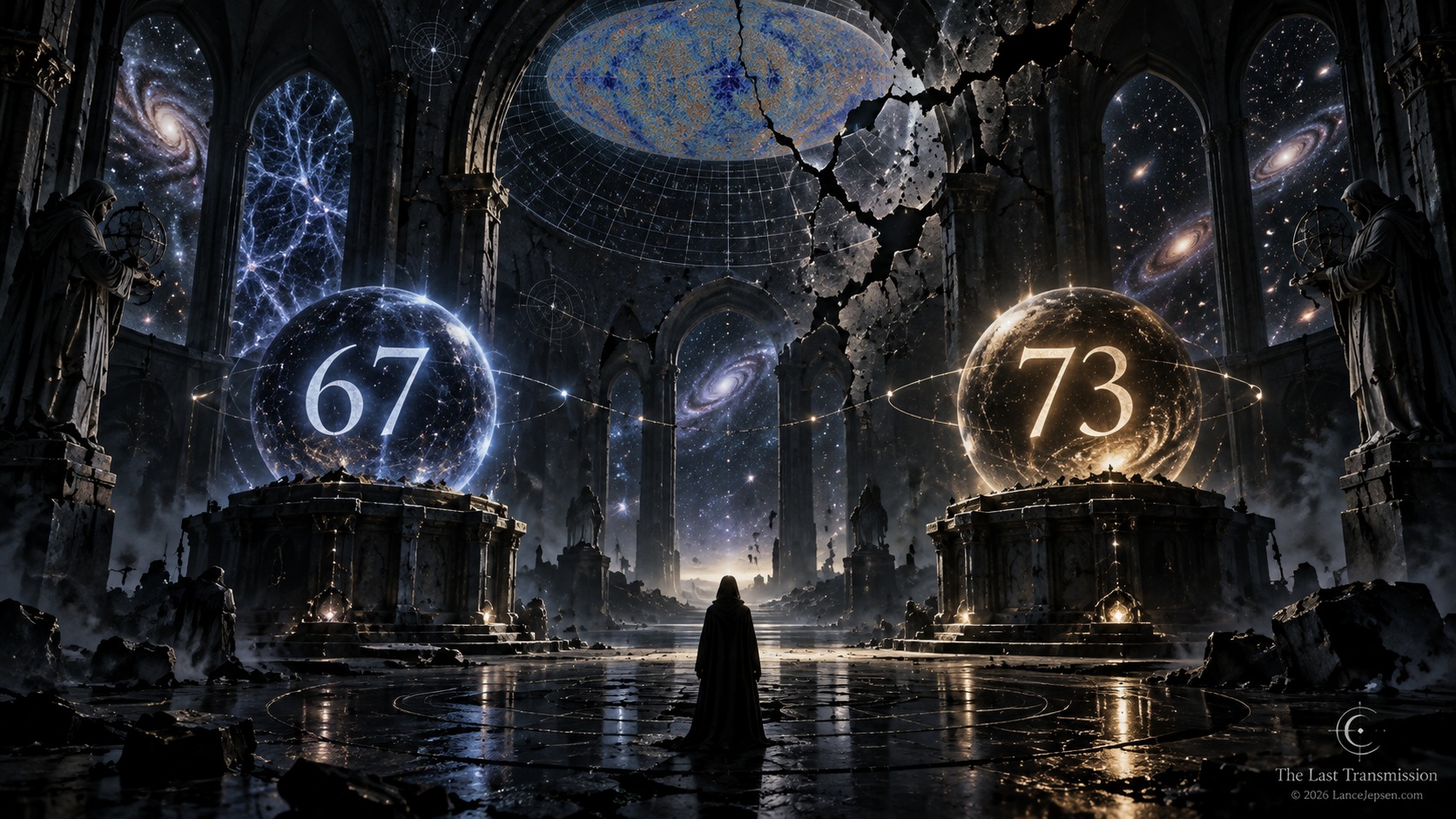
EVIDENCE FILE 05 / COSMOLOGY
Why Do Two Measurements of Cosmic Expansion Disagree?
Planck's early-universe data imply an expansion rate near 67.4 under the standard cosmological model; the SH0ES distance ladder finds about 73.0. The discrepancy is real in those analyses, but its cause is unresolved.
Inside the Data →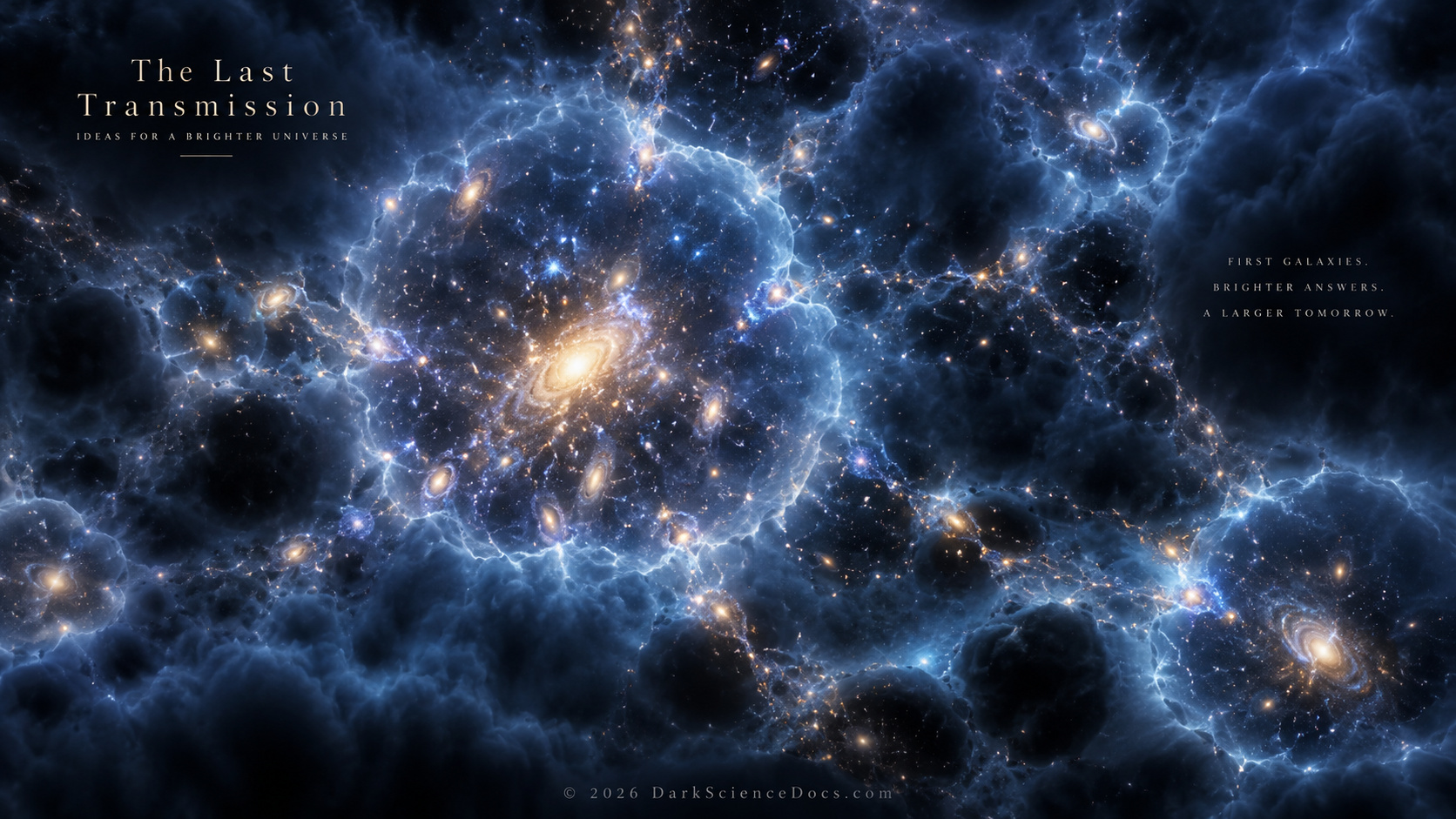
EVIDENCE FILE 06 / COSMIC DAWN
What Does Missing Light Tell Us About Cosmic Dawn?
Lyman-alpha visibility depends on neutral hydrogen, the galaxy's own emission, dust, and the viewing direction. THESAN models the journey; spectra provide the check.
Read the evidence