
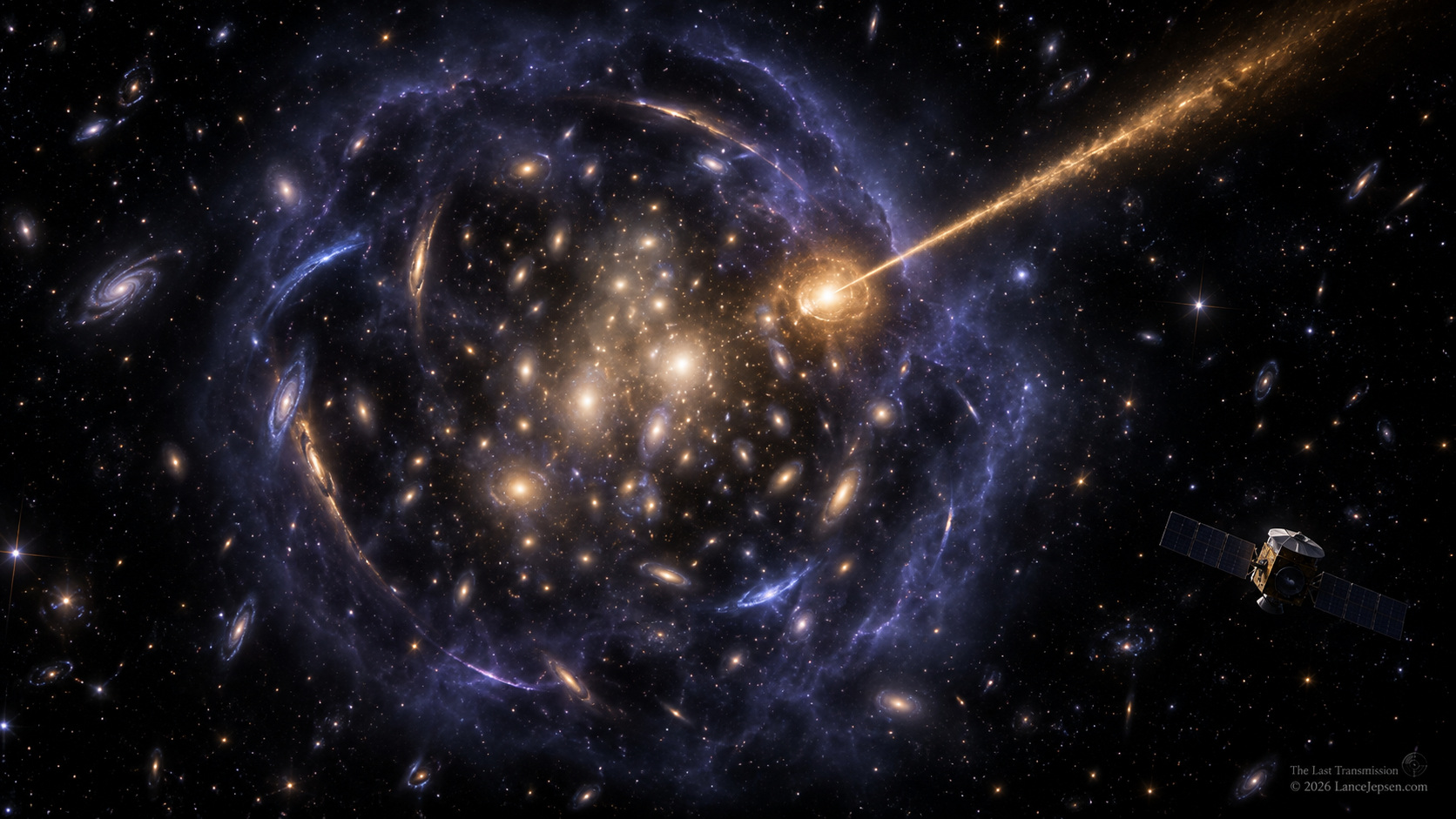
48 / A narrow line in the dark
The 43 GeV Line and the Missing Galactic Echo
A narrow gamma-ray feature in three galaxy clusters has some of the qualities dark matter hunters have sought for decades. Its absence from another expected region is equally important.
Across 15.5 years of Fermi telescope observations, a feature near 43 billion electron volts emerged when researchers combined data from the Virgo, Fornax, and Ophiuchus galaxy clusters. A sharp spectral line could be a valuable clue if particles of dark matter annihilate and release photons at a characteristic energy. Yet the universe is under no obligation to make a candidate signal easy to interpret. The same simple explanation ought to face tests in other dark-matter-rich regions, including the inner Milky Way, where a corresponding line has not become clear.
The full investigation continues with the evidence, illustrations, and sources at The Last Transmission on Substack.
Continue reading on SubstackTHE EVIDENCE / THE OPEN QUESTION
What we know.
The cluster analysis reported a trial-corrected significance of about 4.3 sigma for the three selected systems; a stack of all thirteen clusters gave a weaker result near 3.7 sigma. The authors tested event selections, backgrounds, and control data to look for instrumental or statistical traps. The feature is interesting because ordinary high-energy sources usually make broader spectra, while some hypothetical particle processes could make a line.
What remains open.
This is a candidate, not a dark matter discovery. The line lacks independent confirmation, and its absence from the inner Milky Way challenges a straightforward annihilation picture. Cluster substructure, more complicated particle behavior, an unusual astrophysical process, or a remaining analysis problem could change the interpretation. A separate broad gamma-ray excess reported toward the Galaxy is not the same signal and should not be combined with the line as if they corroborated one another.
Why it matters.
The power of a scientific fingerprint lies in where else it should appear. A future independent instrument can look for the same narrow energy in the same clusters and compare its spatial pattern with physical predictions. Until then, the contradiction between a promising cluster line and a missing galactic counterpart is part of the discovery process itself.
FOLLOW THE EVIDENCE
Research behind the field note.
EXPLORE IN 3D / MAP 12
Look beyond the Milky Way’s light
Explore the visible disk and outer halo while keeping the tentative gamma-ray line separate from the galaxy illustration.
Open Milky Way mapCOMING MILESTONE / SCIENCE COUNTDOWN
Euclid opens the next map of the dark universe
The DR1-Foundation release brings survey material into public view. The interesting part is what independent researchers can test with it. November 12, 2026, tentative DR1-Foundation release.
WATCH THE RELATED DOCUMENTARY
The story in motion.
FOLLOW THE THREAD
Related signals.
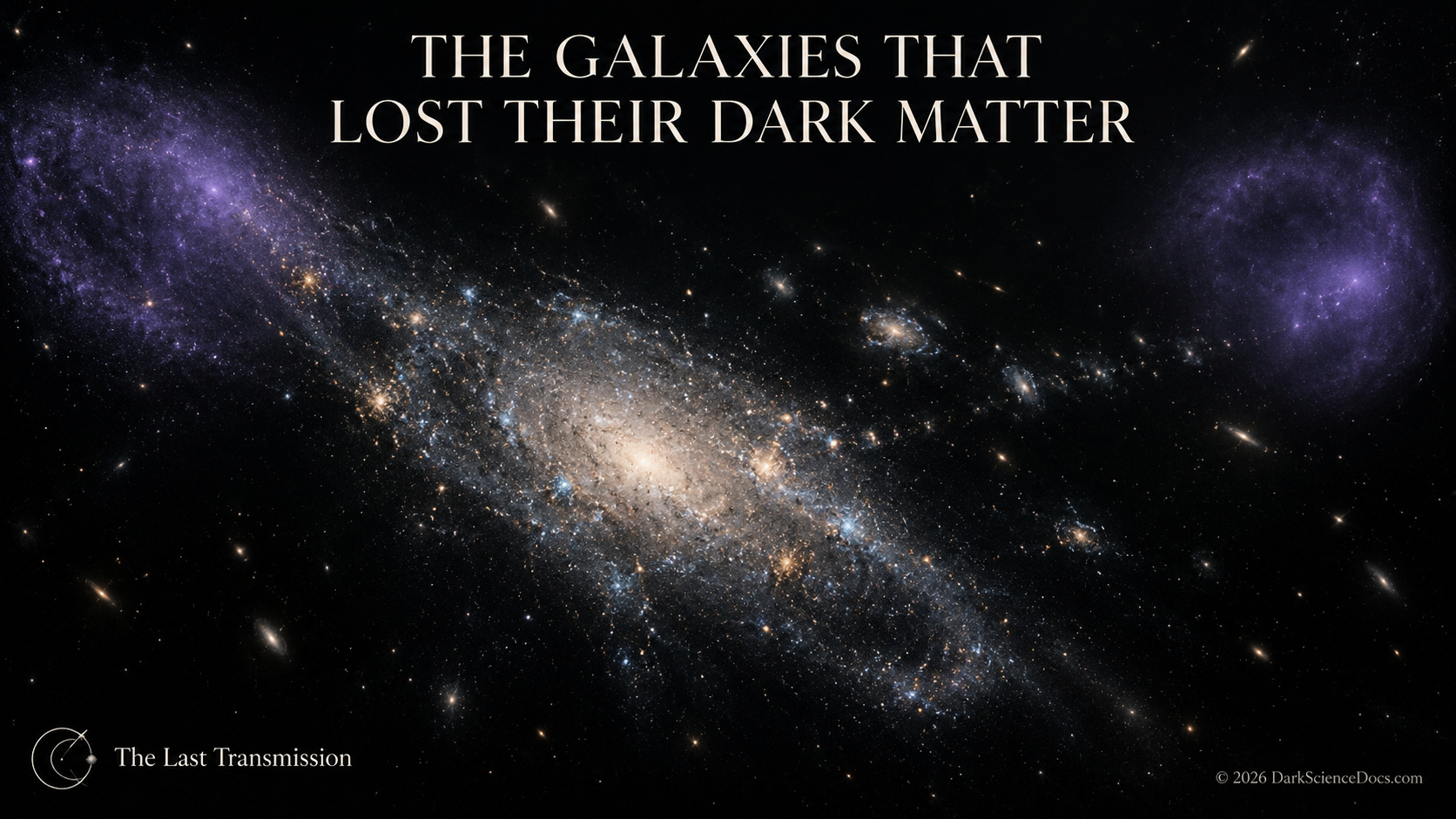
The Galaxies That Lost Their Dark Matter
A third galaxy has joined a strange cosmic trail, strengthening the possibility that an ancient collision separated ordinary matter from the invisible mass that usually surrounds it.
A Star Blinked Twice. Whatever Caused It May Be Much Closer to Earth.
Two nearly identical optical disturbances, 4.4 seconds apart, appeared in HD 89389’s light. Follow the unexplained record, a foreground diffraction hypothesis, and the synchronized telescopes proposed to test it.
What If the Universe Is Accelerating Because Stars Die?
For nearly three decades, scientists have struggled to identify the mysterious force accelerating the expansion of the universe. Now a radical theory suggests the answer.