
VISUAL ARCHIVE / IMAGE STORY
Two Places to Keep Time
Electron and nuclear transitions offer different frequency references.
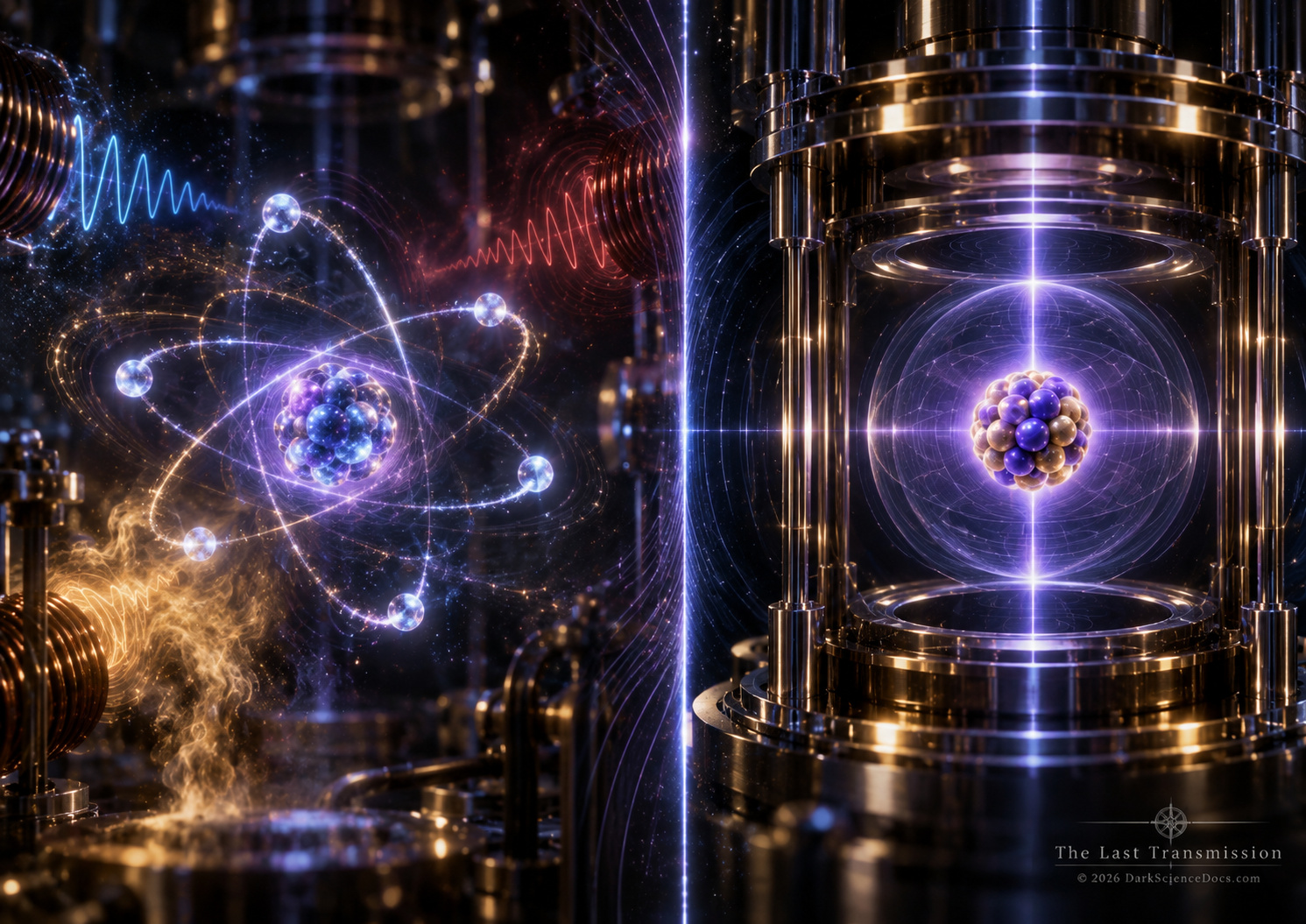
Conventional atomic clocks use transitions associated with electrons, shown at left, while a nuclear clock reaches far deeper into the atom. The nucleus is roughly five orders of magnitude smaller than the atom and considerably less exposed to many environmental disturbances. Illustration: The Last Transmission.
THE OBSERVATION
What we can actually see.
Optical atomic clocks commonly reference electronic transitions. Thorium-229 offers a laser-accessible nuclear transition, which may respond differently to some environmental effects and searches for physics beyond established models.
THE ILLUSTRATION
What the artwork imagines.
The nested rings and giant nucleus exaggerate scale to make an inaccessible transition visible. A smaller nucleus is not by itself proof of a more accurate clock.
FROM THE ILLUSTRATED ARTICLE
The story that inspired it.
The article traces the path from thorium-229 spectroscopy to a laser kept on a nuclear transition by feedback. Electron and nuclear transitions offer different frequency references.
Read The First Nuclear Clock Has Started TickingCHECK THE RECORD
The image interprets the research below. Follow the original work for the measurements and limits behind the scene.
Thorium-229 clock feedback experimentOTHER IMAGE STORIES
 A Clock Deeper Than the Electron
 A Crystal Filled With Clock Nuclei
 The Mark Shared by Titan and Pluto