
VISUAL ARCHIVE / IMAGE STORY
A Crystal Filled With Clock Nuclei
A thorium-doped solid gives the laser many nuclei to interrogate at once.
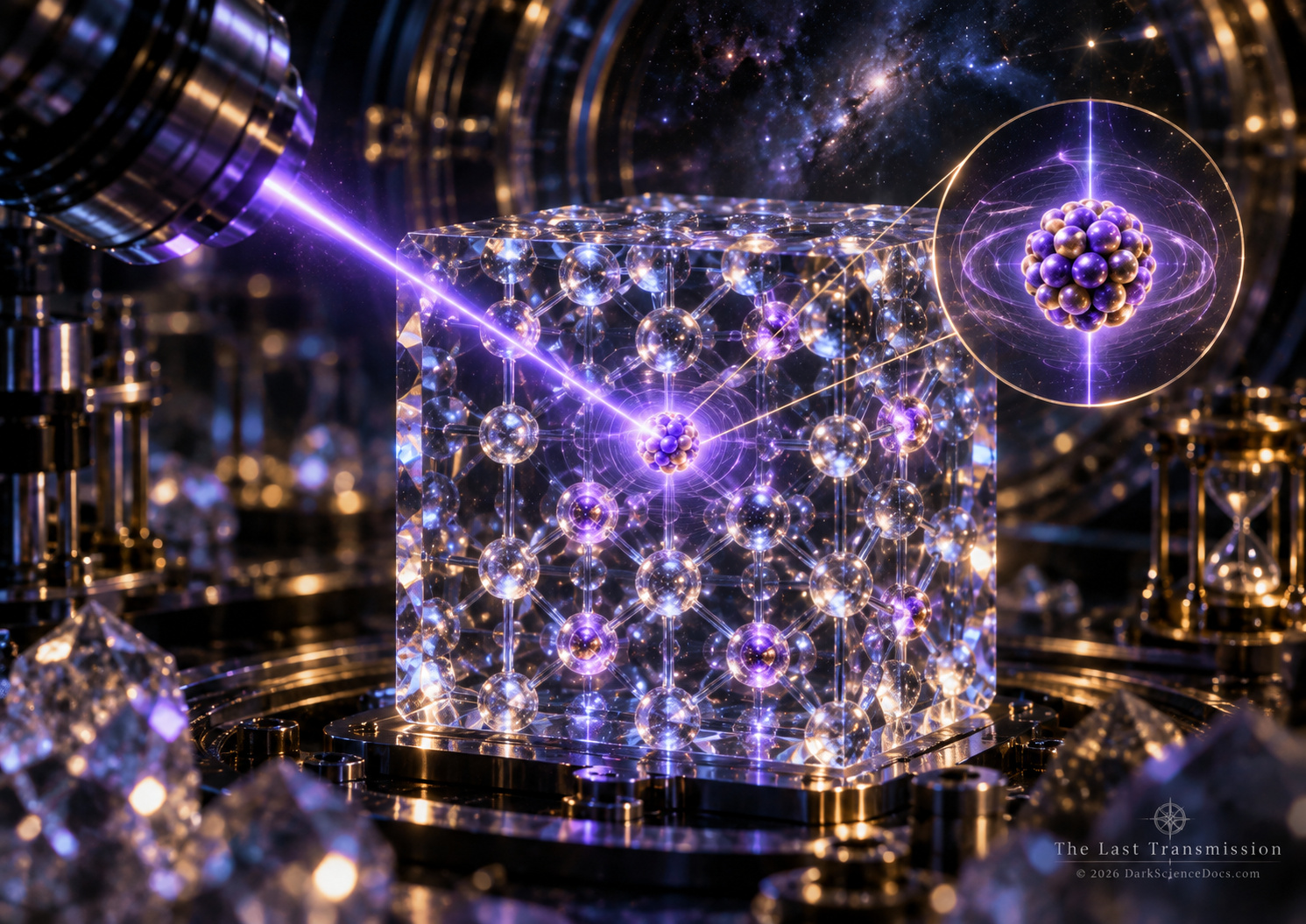
One approach embeds enormous numbers of thorium-229 nuclei inside a transparent calcium fluoride crystal. Vacuum-ultraviolet laser light interrogates the nuclear transition near 148 nanometers, turning an exotic nuclear property into a potential frequency standard. Illustration: The Last Transmission.
THE OBSERVATION
What we can actually see.
The reported apparatus embeds thorium-229 in calcium fluoride and measures absorption near 148 nanometers. Many nuclei provide signal, while the crystal environment also introduces shifts that need careful control.
THE ILLUSTRATION
What the artwork imagines.
The transparent block and bright beam are a simplified equipment portrait. The nuclei do not glow like beads, and the image does not show the true spatial distribution of dopants.
FROM THE ILLUSTRATED ARTICLE
The story that inspired it.
The article traces the path from thorium-229 spectroscopy to a laser kept on a nuclear transition by feedback. A thorium-doped solid gives the laser many nuclei to interrogate at once.
Read The First Nuclear Clock Has Started TickingCHECK THE RECORD
The image interprets the research below. Follow the original work for the measurements and limits behind the scene.
Thorium-229 clock feedback experimentOTHER IMAGE STORIES
 A Clock Deeper Than the Electron
 Two Places to Keep Time
 The Mark Shared by Titan and Pluto