
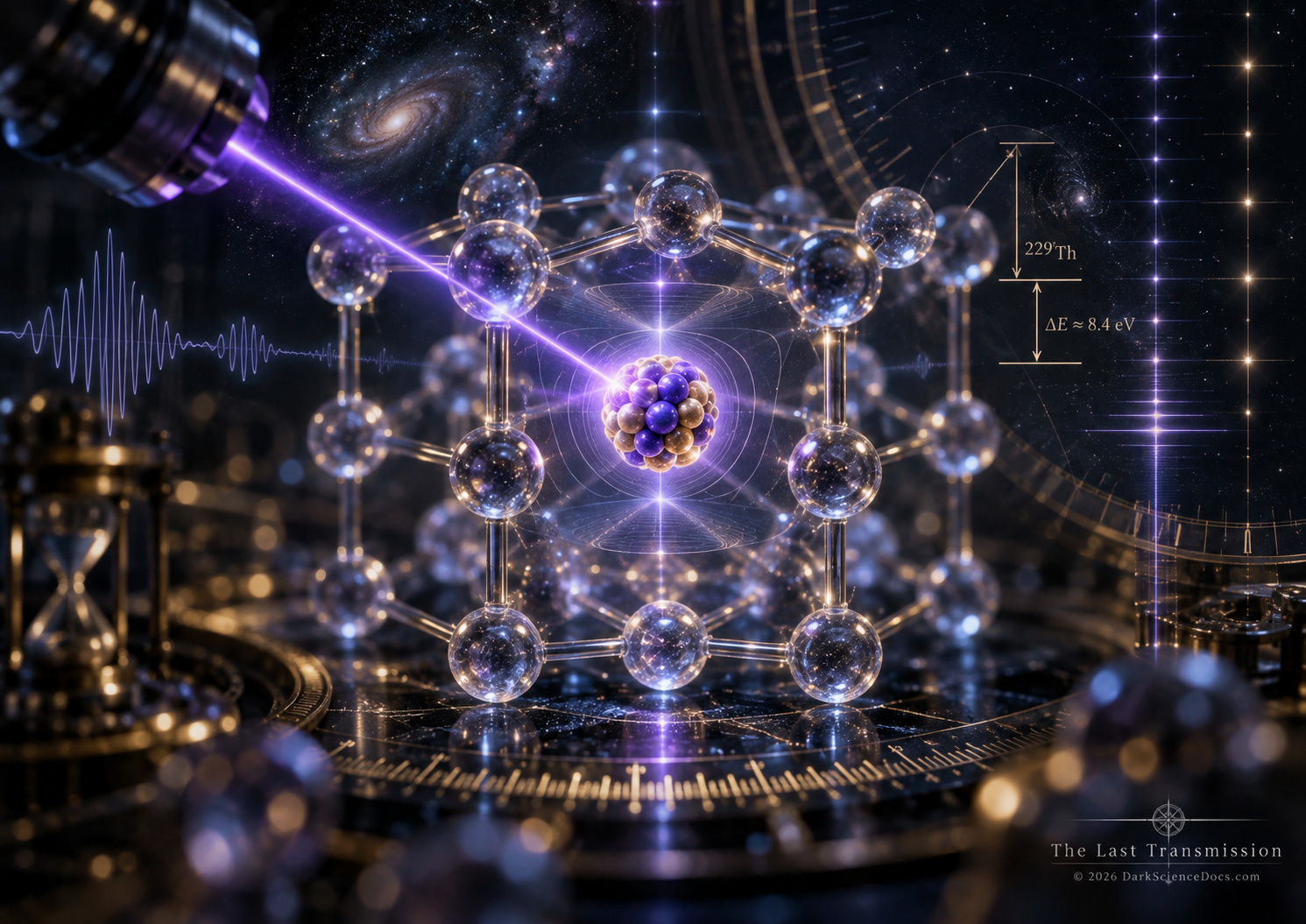
28 / A deeper tick
The Clock Inside the Nucleus
A laser locked to a transition in thorium-229 makes a nuclear clock operate with feedback. Its first performance is a research result, with more precise future versions still to be built.
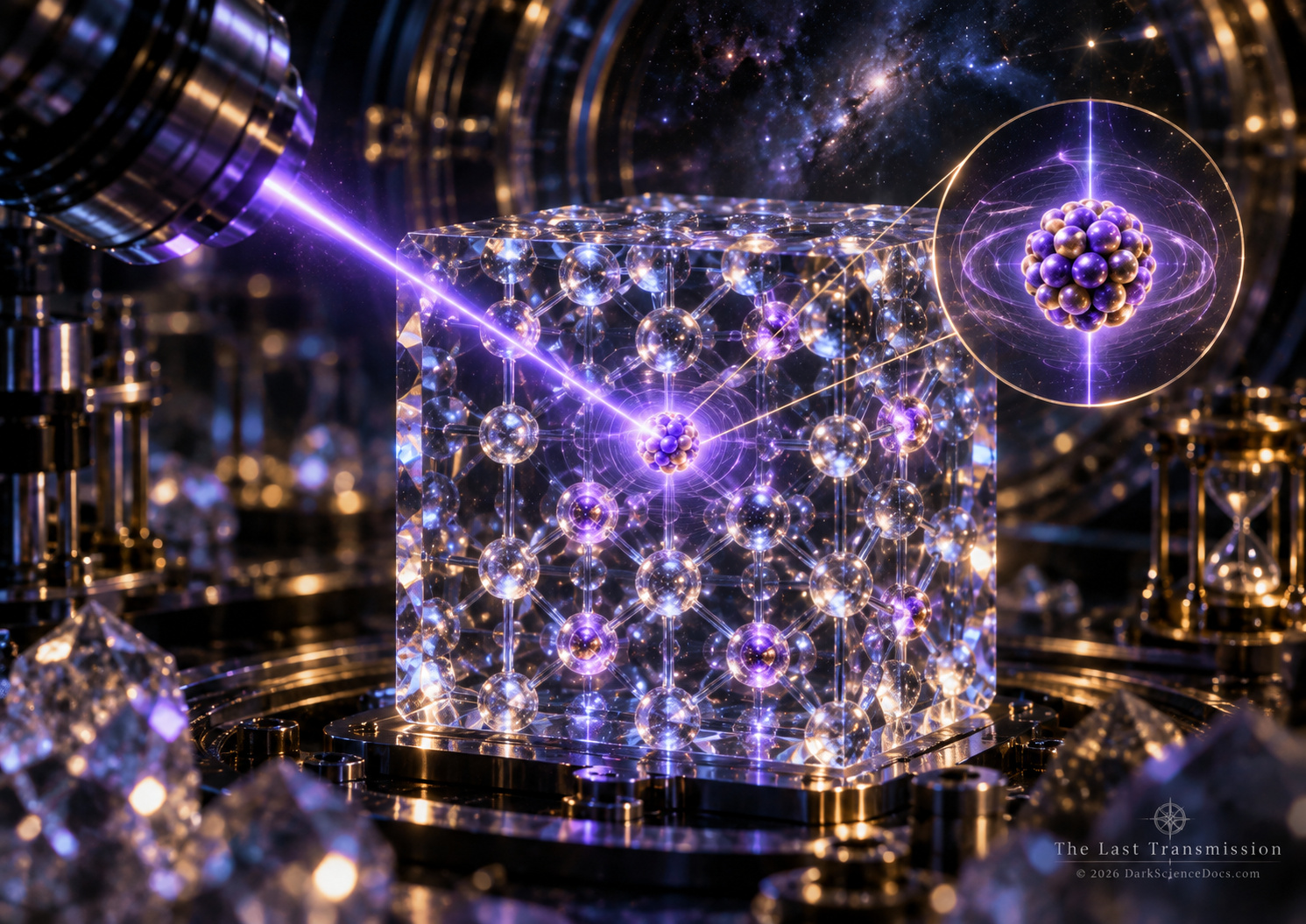
An ordinary optical atomic clock follows transitions associated with electrons. Thorium-229 offers an unusually accessible transition inside the nucleus itself. Researchers embedded nuclei in a calcium fluoride crystal, watched how they absorbed laser light near 148 nanometers, and used that response to correct the laser as it drifted. The feedback loop is the crucial engineering step: it turns a promising resonance into a clock that can run and be compared with another clock rather than remaining a one-off spectroscopic observation.
The full investigation continues with the evidence, illustrations, and sources at The Last Transmission on Substack.
Continue reading on SubstackTHE EVIDENCE / THE OPEN QUESTION
What we know.
The reported apparatus stabilized a laser to the thorium-229 nuclear transition and compared it continuously with a ytterbium ion clock. The team also used the system to test for changes in the transition that some ultralight-dark-matter models would predict.
What remains open.
This implementation does not already outperform the best established optical clocks. Its reported instability and the precision that future versions might achieve are different claims. A null search for a particular fluctuation constrains models within the tested range; it does not rule out dark matter.
Why it matters.
A better clock makes tiny discrepancies legible. By placing the reference transition inside a nucleus, researchers open a complementary way to compare fundamental physics across time and across experiments.
GO DEEPER / EVIDENCE FILE
What Makes a Nuclear Clock Actually Tick?
A laser locked to thorium-229's 148-nanometer transition is compared with an ion clock. The feedback loop runs; a future record-setting clock remains an engineering challenge.
FOLLOW THE EVIDENCE
Research behind the field note.
EXPLORE IN 3D / ATLAS I-01
Enter the clock’s nuclear scale
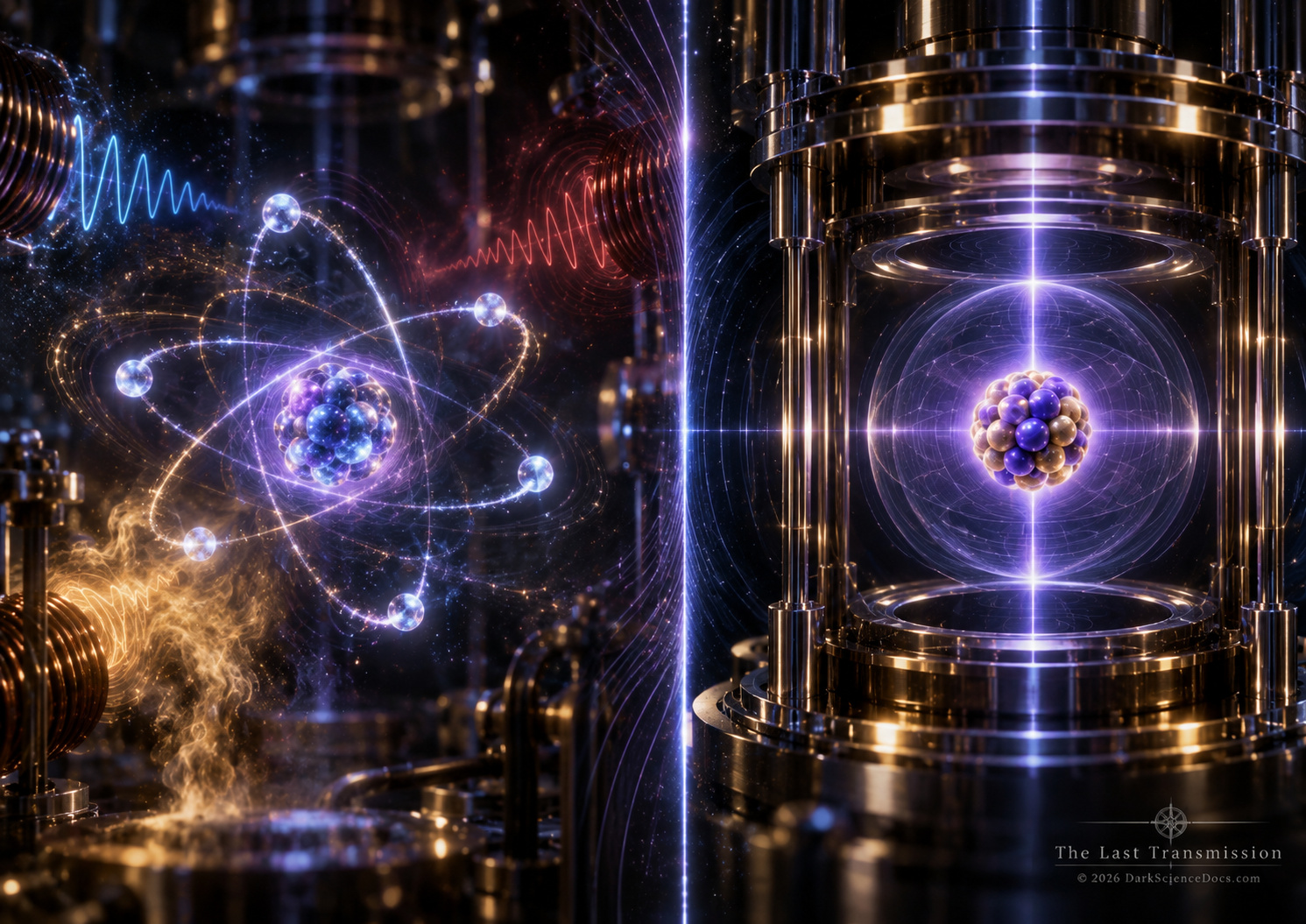
Move from a hydrogen electron cloud to the schematic thorium-229 nucleus, then follow the laser feedback that made the real clock operate.
Explore Atom in 3DWATCH THE RELATED DOCUMENTARY
The story in motion.
VISUAL EVIDENCE
Inside the investigation.
FOLLOW THE THREAD
Related signals.
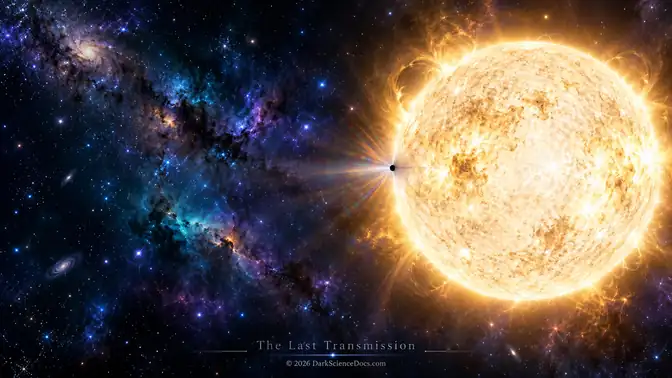
A Star Blinked Twice. Whatever Caused It May Be Much Closer to Earth.
Two nearly identical optical disturbances, 4.4 seconds apart, appeared in HD 89389’s light. Follow the unexplained record, a foreground diffraction hypothesis, and the synchronized telescopes proposed to test it.
What If the Universe Is Accelerating Because Stars Die?
For nearly three decades, scientists have struggled to identify the mysterious force accelerating the expansion of the universe. Now a radical theory suggests the answer.
A Star Died 6.5 Billion Years Ago. Its Explosion Is About to Arrive Again.
NASA is watching for a supernova we have already seen. When that light finally reaches Earth, it could help answer one of the most troubling questions in modern cosmology.