
VISUAL ARCHIVE / IMAGE STORY
A Clock Deeper Than the Electron
Thorium-229's nuclear transition is real; the glowing apparatus is an interpretation of a precision experiment.
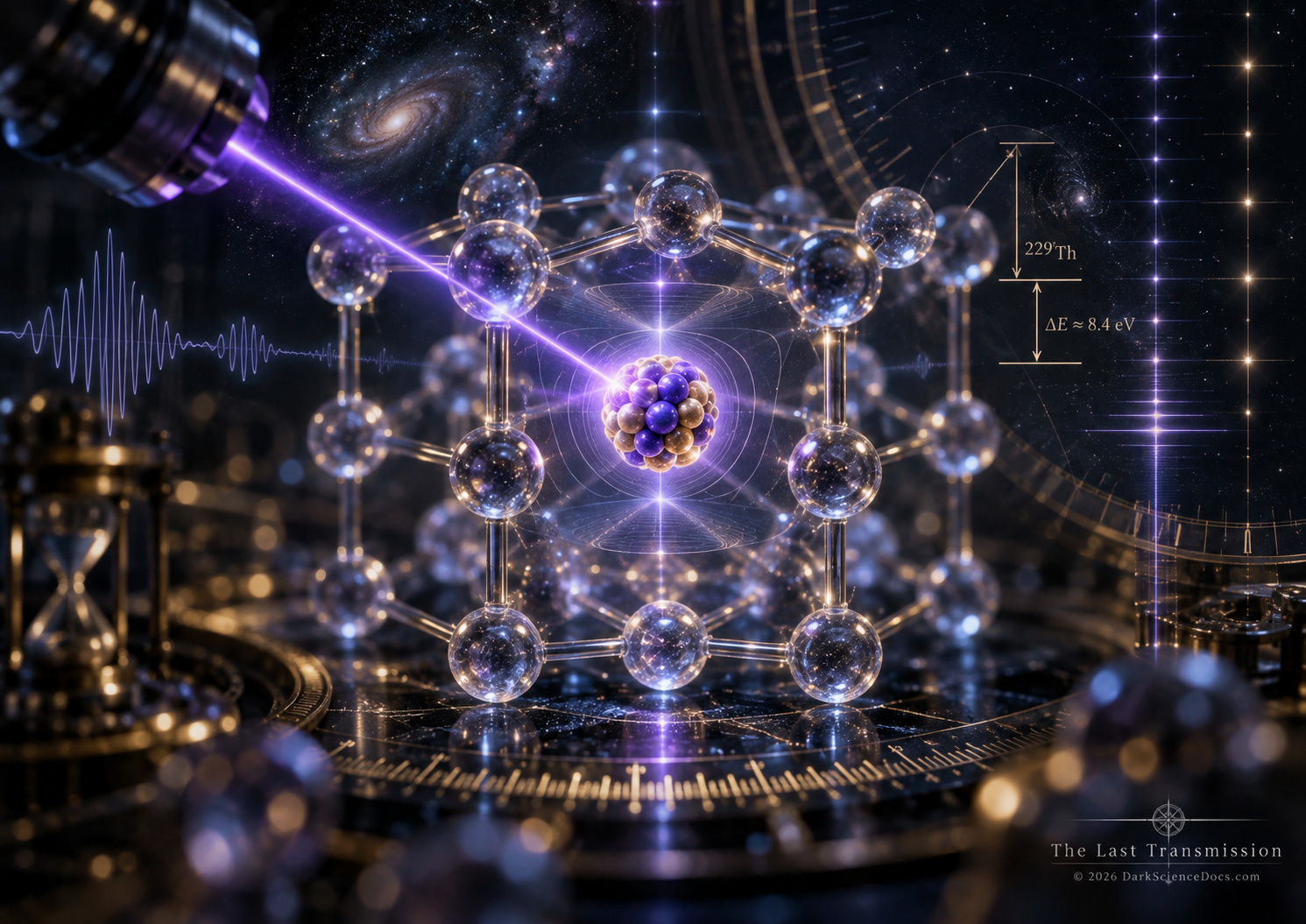
For nearly fifty years, physicists chased the possibility of building a clock around a transition inside the atomic nucleus. In 2026, that possibility crossed the line from an experiment in spectroscopy to an operating nuclear clock. Illustration: The Last Transmission.
THE OBSERVATION
What we can actually see.
Researchers stabilized a laser to a thorium-229 nuclear transition using feedback from absorption spectroscopy, with the nuclei embedded in a calcium fluoride crystal. A separate ion clock supplied a reference for comparison.
THE ILLUSTRATION
What the artwork imagines.
The nucleus is not a luminous gear and the feedback cannot be seen as a beam winding through space. Color, scale, and mechanical details make the measurement legible to the eye without depicting the actual instrument's appearance.
FROM THE ILLUSTRATED ARTICLE
The story that inspired it.
The article explains why locking a laser to a nuclear resonance matters and why an operating prototype should be distinguished from a future clock that might surpass today's best systems.
Read The First Nuclear Clock Has Started TickingCHECK THE RECORD
The image interprets the research below. Follow the original work for the measurements and limits behind the scene.
Thorium-229 clock experimentOTHER IMAGE STORIES
 Two Places to Keep Time
 A Crystal Filled With Clock Nuclei
 The Mark Shared by Titan and Pluto