
VISUAL ARCHIVE / IMAGE STORY
Time Compared Across the World
Networks of clocks can compare frequency shifts and gravitational conditions.
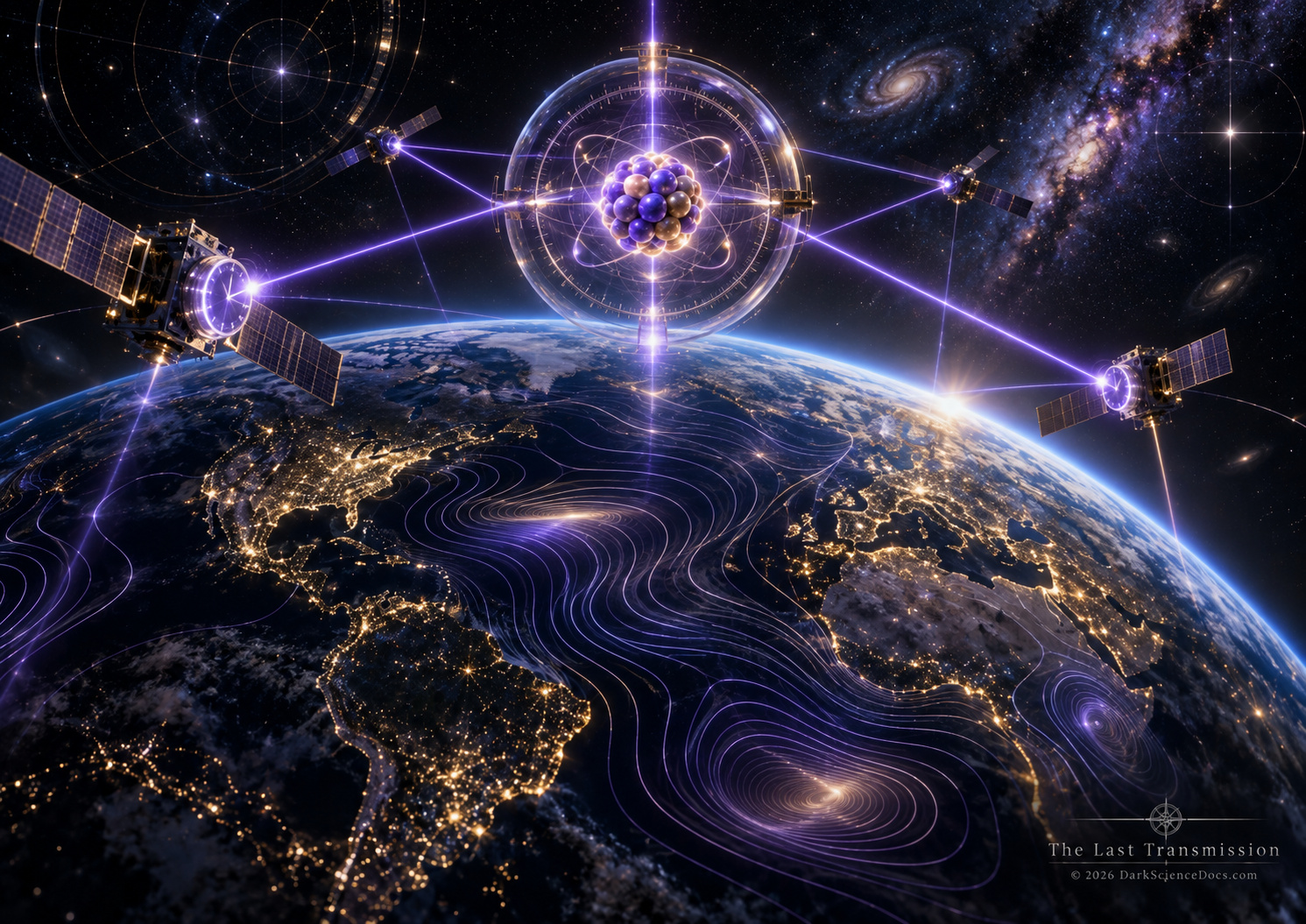
Future precision clocks could become part of global networks for comparing gravitational potential, testing relativity and searching for changes in fundamental physics. The deeper our clocks reach into matter, the more the measurement of time becomes a measurement of the universe itself. Illustration: The Last Transmission.
THE OBSERVATION
What we can actually see.
Precision frequency comparisons are useful for metrology and tests of fundamental physics. Nuclear references could become another kind of clock in such networks if their stability and systematic errors improve.
THE ILLUSTRATION
What the artwork imagines.
The linked luminous clocks are a future-facing proposal, not a deployed thorium network. The lines do not depict measured signals traveling between operating nuclear devices.
FROM THE ILLUSTRATED ARTICLE
The story that inspired it.
The article traces the path from thorium-229 spectroscopy to a laser kept on a nuclear transition by feedback. Networks of clocks can compare frequency shifts and gravitational conditions.
Read The First Nuclear Clock Has Started TickingCHECK THE RECORD
The image interprets the research below. Follow the original work for the measurements and limits behind the scene.
NIST: nuclear clocks overviewOTHER IMAGE STORIES
 A Clock Deeper Than the Electron
 Two Places to Keep Time
 The Mark Shared by Titan and Pluto