VISUAL ARCHIVE / IMAGE STORY
Two Active Nuclei in One Green Pea System
Chandra and Keck support a dual active nucleus; the black-hole scene is not a photograph.
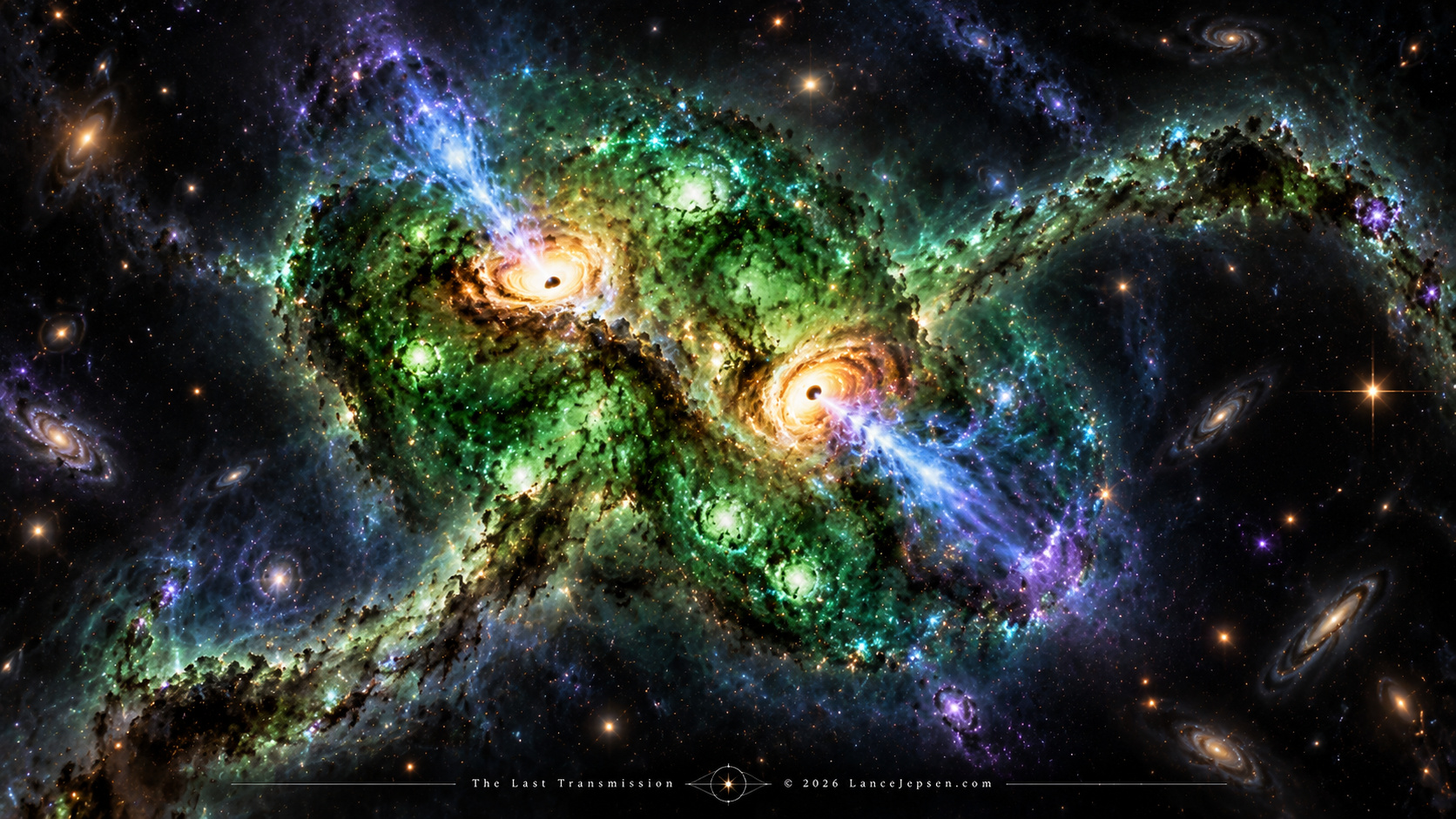
In 2026, astronomers reported the first confirmed dual active galactic nucleus in a Green Pea system. Chandra resolved two luminous hard X-ray sources about 27,000 light-years apart, providing a nearby laboratory for studying how black holes and galaxies may have grown together in the early universe. AI-generated illustration. The Last Transmission | © 2026 DarkScienceDocs.com
THE OBSERVATION
What we can actually see.
A 2026 study of SDSS J162209.41+352107.5 reported two luminous hard X-ray sources separated by 8.4 kiloparsecs in projection. Keck spectra placed the optical nuclei at the same redshift and supported active accretion in both. Those measurements locate an unusual dual system, not visible black-hole disks as pictured.
THE ILLUSTRATION
What the artwork imagines.
The luminous centers and connecting gas turn X-ray and spectral evidence into a scene. The size of the disks, the brightness, and the intervening structures are illustrative rather than resolved details from Chandra.
FROM THE ILLUSTRATED ARTICLE
The story that inspired it.
The article moves from Green Peas as star-forming laboratories to a rarer clue about how black holes might grow amid compact galaxies.
Read The Galaxies With Ridiculous Names That May Have Turned On the UniverseCHECK THE RECORD
The image interprets the research below. Follow the original work for the measurements and limits behind the scene.
Kouroumpatzakis et al., dual active nucleus in a Green Pea systemOTHER IMAGE STORIES
 When Galaxies Cleared the Cosmic Fog
 The Green Smudge Volunteers Noticed
 The Mark Shared by Titan and Pluto