
VISUAL ARCHIVE / IMAGE STORY
A Telescope Looks Back Toward First Light
Distant light gives astronomers access to earlier cosmic epochs, one spectrum at a time.
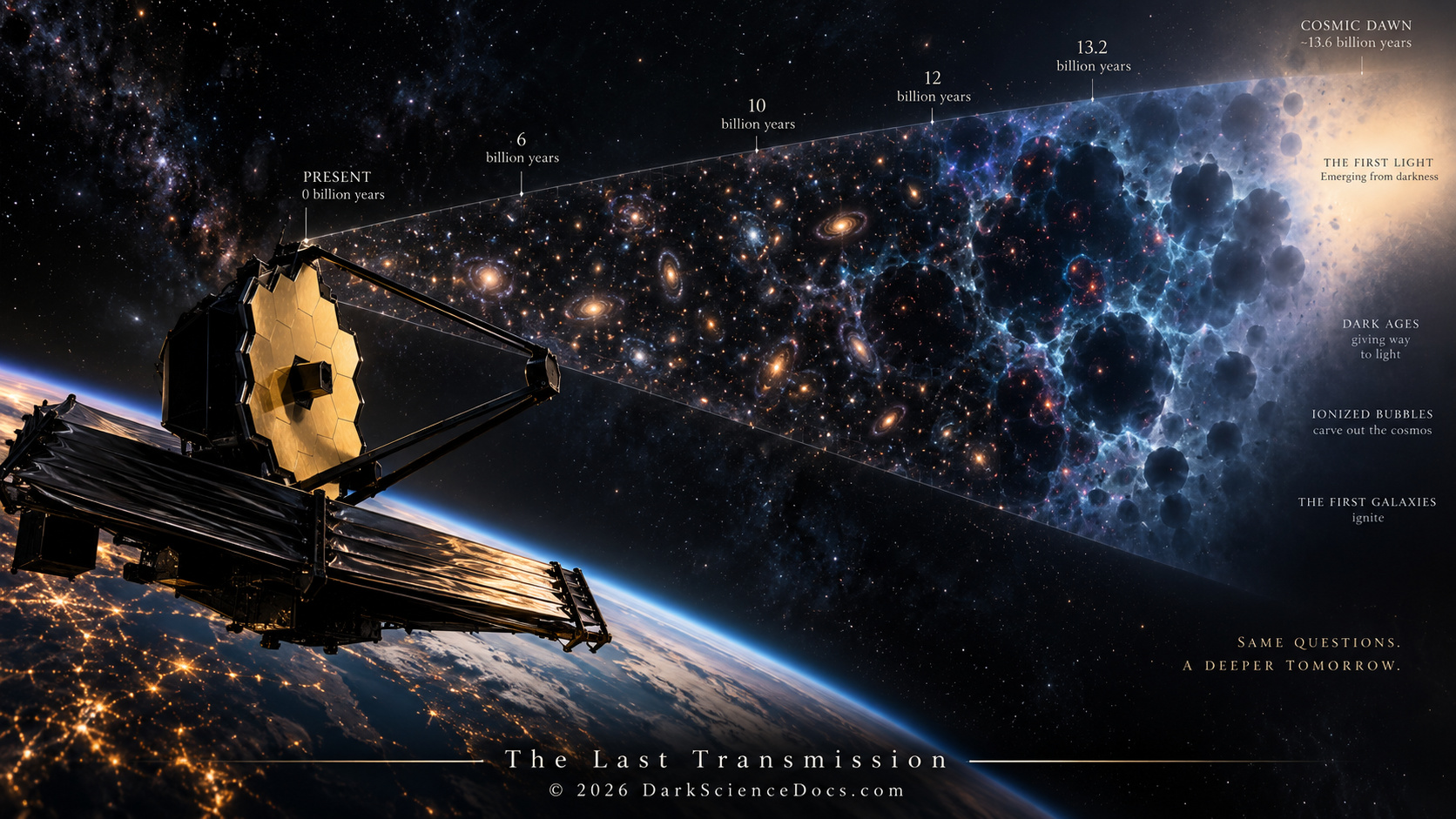
Artist’s interpretation of a modern space telescope looking backward across billions of years toward the patchy first light of cosmic dawn. AI-generated artistic interpretation, not a scientific visualization.
THE OBSERVATION
What we can actually see.
Because light takes time to cross space, telescopes observe distant galaxies as they were long ago. Webb can measure faint high-redshift sources, while the state of surrounding hydrogen must still be inferred from spectra and other probes.
THE ILLUSTRATION
What the artwork imagines.
The telescope does not literally peer down a corridor to a visible cosmic sunrise. The backward vista and illuminated horizon compress distance, time, and analysis into one visual metaphor.
FROM THE ILLUSTRATED ARTICLE
The story that inspired it.
The article follows the patchy return of transmissible light as early galaxies changed the gas between them. Distant light gives astronomers access to earlier cosmic epochs, one spectrum at a time.
Read The Universe Was Dark Until Light Learned How to EscapeCHECK THE RECORD
The image interprets the research below. Follow the original work for the measurements and limits behind the scene.
NASA Webb missionOTHER IMAGE STORIES
 The First Openings in the Dark
 The Web Before the Dawn
 The Mark Shared by Titan and Pluto