
VISUAL ARCHIVE / IMAGE STORY
Listening for a Changing Tick
A running nuclear clock can constrain certain periodic frequency variations.
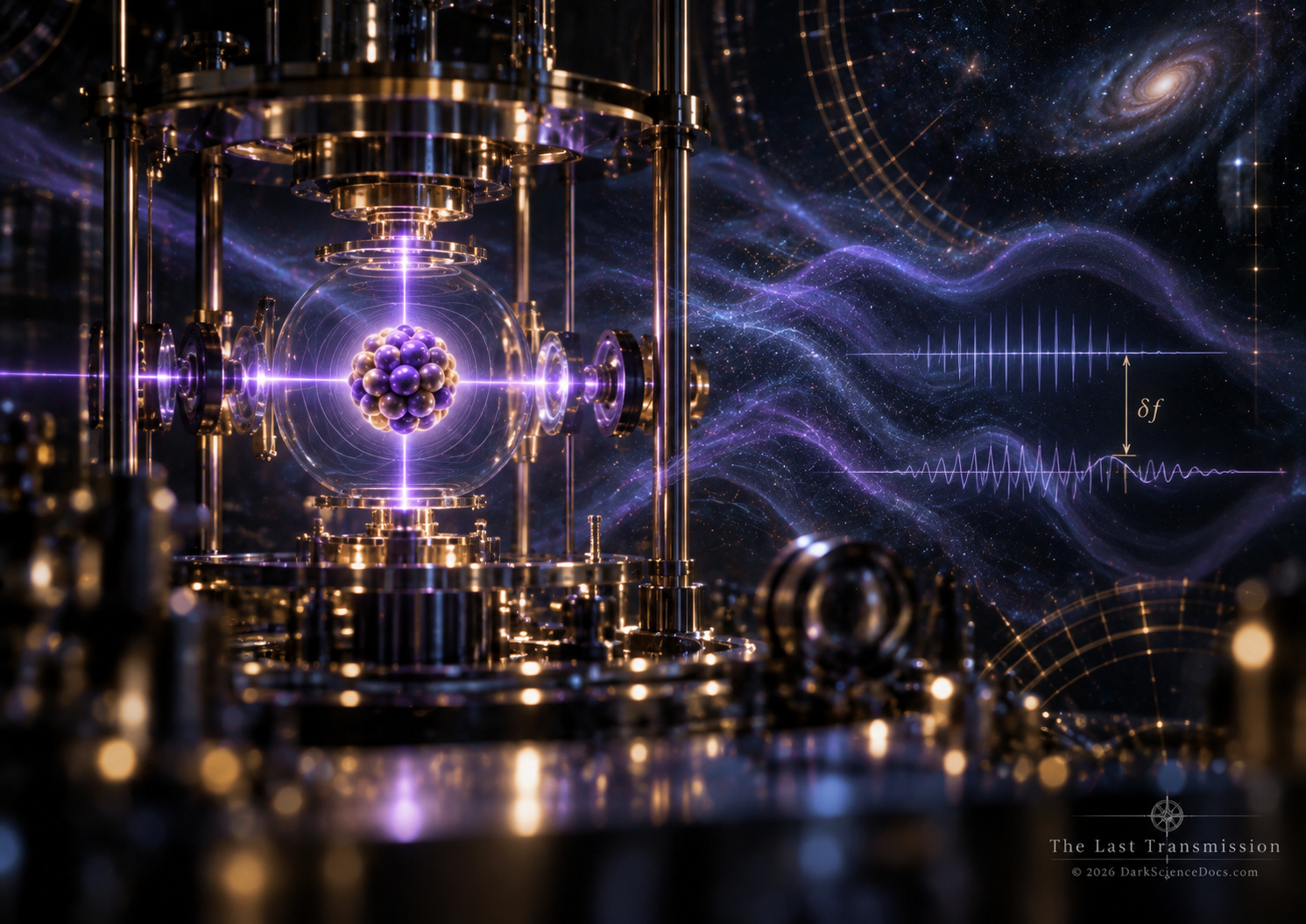
A nuclear clock may eventually become more than a timekeeper. Because the thorium-229 transition can be unusually sensitive to changes in fundamental physics, researchers have already used an early clock to search for tiny variations that could be associated with ultralight dark matter. No dark matter was detected, but additional constraints were established. Illustration: The Last Transmission.
THE OBSERVATION
What we can actually see.
The experiment searched for periodic fluctuations and slow drifts over timescales from roughly 20 seconds to one day, constraining specified ultralight-dark-matter models without detecting such a field.
THE ILLUSTRATION
What the artwork imagines.
The dark wave crossing the clock is speculative imagery. A null result within one sensitivity window is not evidence that all dark matter or all physics beyond established models has been ruled out.
FROM THE ILLUSTRATED ARTICLE
The story that inspired it.
The article traces the path from thorium-229 spectroscopy to a laser kept on a nuclear transition by feedback. A running nuclear clock can constrain certain periodic frequency variations.
Read The First Nuclear Clock Has Started TickingCHECK THE RECORD
The image interprets the research below. Follow the original work for the measurements and limits behind the scene.
Thorium-229 clock feedback experimentOTHER IMAGE STORIES
 A Clock Deeper Than the Electron
 Two Places to Keep Time
 The Mark Shared by Titan and Pluto